Level with the chariots
Two bronze chariots crown the Vittoriano. Each is a quadriga, a four-horse chariot driven by a winged Victory, and the terrace takes its name from them. Up here you stand almost at eye level with the horses’ heads, high above the white marble mass that Romans have long mocked as “the typewriter” or “the wedding cake”.
That marble is pale Botticino stone from Lombardy, and it is why the monument glares against the ochre city around it. The terrace sits on the very top of the complex. The odd payoff is that the Vittoriano is the one building in central Rome you can’t see from here, because you’re standing on it.
Reading the city, direction by direction
Take it slowly and turn a full circle. The view is open on every side, and the main landmarks are easy to pick out:
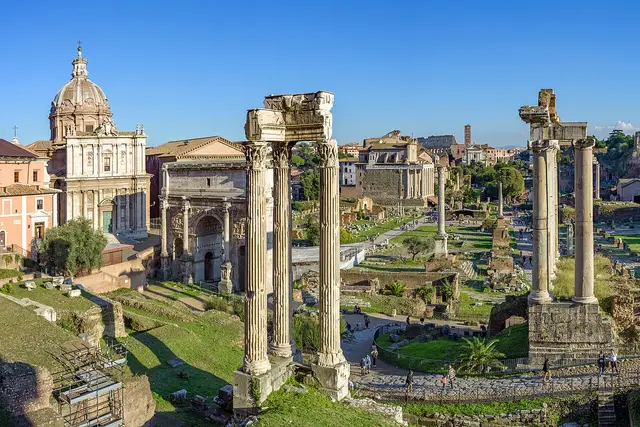
- South-east: the Roman Forum below you, with the Colosseum at the far end of Via dei Fori Imperiali.
- South: the Capitoline Hill and the brick flank of Santa Maria in Aracoeli, close enough to study its roofline.
- North: Via del Corso running ruler-straight towards Piazza del Popolo.
- West: a sea of domes and terracotta roofs, with St Peter’s dome on the horizon.
- Below: Piazza Venezia, its traffic circling and Palazzo Venezia on the corner.
Bring sunglasses on a clear day. The white marble throws the light back up at you.
Finding the glass lift
The lift is not at the front of the monument. It rises from the back of the Vittoriano, on the Capitoline side, so you climb up through the monument’s terraces to reach it. The Piazza di San Marco side entrance, beside Palazzo Venezia, is the address listed for the terrace.
The lift is glass on all sides, so the city opens up as you rise. It has its own ticket, separate from the free outer terraces. Prices and combined options are posted at the ticket point and on the official Vittoriano and Palazzo Venezia site.
Getting to Piazza Venezia is simple. Many city bus routes stop right in the square. Colosseo station on Metro Line B is about a 15-minute walk down Via dei Fori Imperiali, with the Forum on your left as you go.
Climbing the Altare without a whistle
The Vittoriano is a working national shrine, and the staff treat it that way. The Tomb of the Unknown Soldier sits on the front steps under the statue of Roma. Two soldiers stand guard there, and an eternal flame burns.
What this means in practice:
- Don’t sit on the steps or the marble ledges. Guards will whistle at you, and they do it often.
- Keep your voice down and your hat in hand as you pass the tomb.
- No eating on the monument. Save the panino for the piazza.
- Expect a bag check at the entrance, so travel light.
Once you’re on the terrace the mood loosens. People lean on the railings and pass phones around for photos. Still, the space is narrow in places, so take your shot and step aside rather than holding the corner.
When to go up
Light matters more than the clock here. Morning sun falls across the Forum and the Colosseum, which works well for photos looking south-east. Late-afternoon light warms the domes to the west.
The current hours are 9:30am to 6:45pm. In winter the sun sets well before that, so a late visit can catch the city turning gold. Hours change with the season, though, so check this month’s times on the official site before you plan a sunset trip.
The terrace is still fairly under the radar compared with the Colosseum or the Vatican domes. Visitors pass beneath it all day without knowing a lift goes higher. Arriving soon after opening usually means fewer people at the railing. Midday tour groups working through Piazza Venezia tend to fill the lower terraces first.
Back on the ground
The terrace makes a good orientation stop. Everything you’ve just picked out is within walking distance, and you now know the layout. Good places to go next:
- Museo Centrale del Risorgimento, inside the same complex, covering Italy’s unification.
- Michelangelo’s Piazza del Campidoglio and the Capitoline Museums, up the ramp-like cordonata behind the monument.
- Santa Maria in Aracoeli, up its long, steep flight of 124 steps.
- The Roman Forum and Palatine, entered from Via dei Fori Imperiali or near the Colosseum.
- Trajan’s Column and Markets, a few minutes east of the square.
To see a lot in one morning, do the terrace first, then the Campidoglio, then go down into the Forum. You’ll walk mostly downhill, and the ruins will already make sense from above.
Frequently asked questions
How do I get to Terrazza delle Quadrighe?
It's on top of the Vittoriano in Piazza Venezia. Many city bus lines stop in the square, and Colosseo station (Metro Line B) is about a 15-minute walk along Via dei Fori Imperiali. The glass lift is at the back of the monument, on the Capitoline side.
What are the opening hours?
At the moment it opens 9:30am–6:45pm every day of the week. Observation terrace hours change through the year and on some holidays, so check the official Vittoriano site for this month's times.
How long should I spend there?
30–45 minutes is enough for the terrace itself. Allow about two hours if you also walk the monument's outer terraces and visit the Museo Centrale del Risorgimento inside.
What can I see from the top?
You get a full 360° view. It takes in the Roman Forum and the Colosseum, the Capitoline Hill, Via del Corso running north, and St Peter's dome to the west.
Are there rules on the monument?
Yes. The Vittoriano holds the Tomb of the Unknown Soldier, so guards stop people sitting on the steps or eating on the monument. Expect a bag check at the entrance.
Plan your trip to Rome
Italy eSIM & staying connected →
Some links above are affiliate links — if you book through them, Wander Atlas earns a small commission at no extra cost to you. It's how we keep every guide free.