Why go
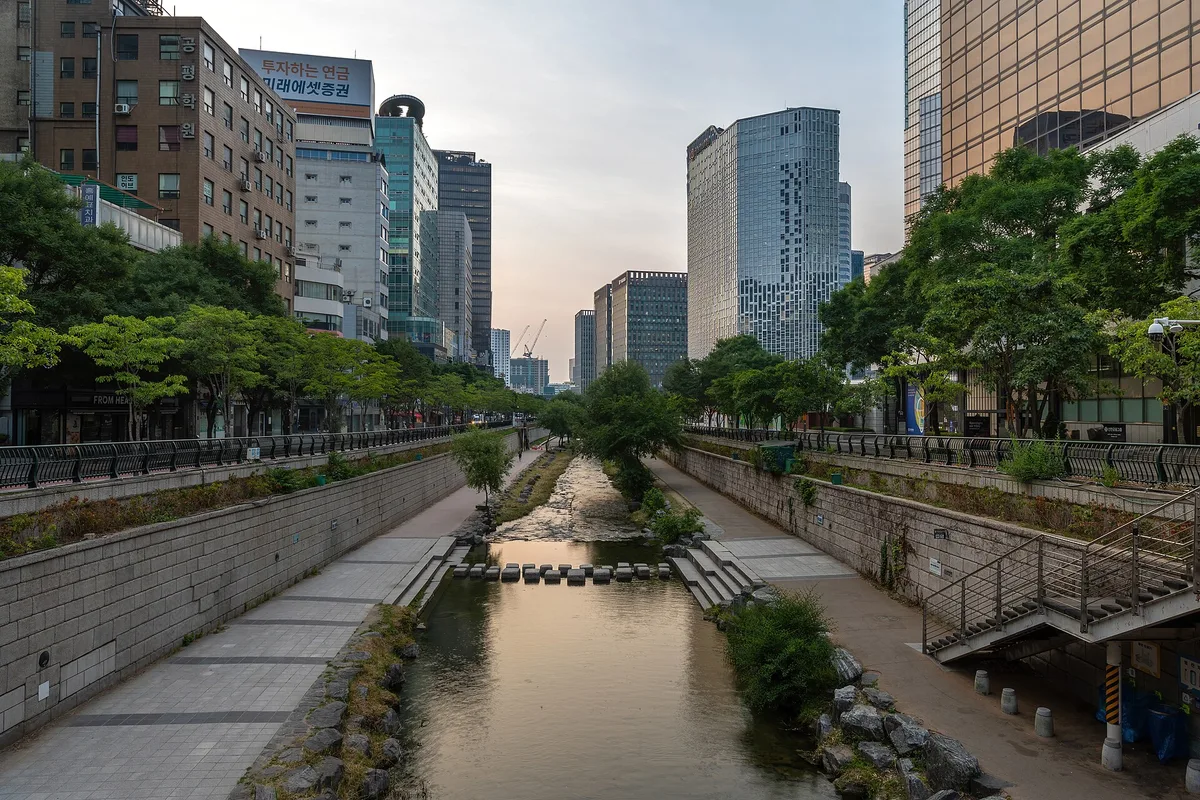
You come down a short flight of steps off a six-lane road and the city noise drops by half. That’s the trick of Cheonggyecheon: it sits several meters below street level, so the honking taxis and glass towers of downtown Jongno recede into a kind of backdrop while you walk beside shallow, moving water. It’s not a wilderness, you’re never more than a few meters from a footbridge or an office worker on a lunchtime phone call, but the contrast with the traffic overhead is real, and it’s the reason this stream, once buried under an elevated highway, has become one of the most-visited public spaces in the city.
What you’re actually looking at
Cheonggyecheon isn’t a natural feature you’re rediscovering. It’s a 2005 civic engineering project. For decades the stream ran under an expressway; the water underneath was largely pumped in rather than a live waterway, and the entire 11-km corridor from Gwanghwamun to Dab-dong was demolished and rebuilt as a linear park. Knowing that changes how you read what you see: the stone embankments, the rows of low bridges each with their own name and design, the LED-lit “Candlelight Fountain” pattern near the start, and the mosaic tile mural quoting a Joseon-era royal procession are all part of one deliberate, continuous design, not accumulated history.
Along the first kilometer near Gwanghwamun you’ll pass sculptures, including Claes Oldenburg’s spiral-shaped “Spring,” before the path narrows and turns quieter, more residential, as it heads toward Dongdaemun.
Getting there
The most useful entry point is Cheonggye Plaza, at the stream’s western end, reachable from Gwanghwamun Station (Line 5, Exit 5) or City Hall Station (Line 1 or 2, Exit 4/5), both a five-minute walk. If you’d rather join partway, Jonggak Station (Line 1, Exit 5) and Dongdaemun History & Culture Park Station (Lines 2, 4, 5) both drop you within a couple of minutes’ walk of the stream path.
There’s no ticket gate and no entrance fee, you simply descend a stairway or ramp from street level whenever you see one.

How much time to spend, and where to walk
Most visitors don’t walk the whole 11 km; a satisfying visit is the first 1–2 km from Cheonggye Plaza to around Gwangtong Bridge or Supyo Bridge, which takes 30–45 minutes at an easy pace and covers the most photographed stretch, the plaza’s cascading waterfall wall, the stepping-stone crossings, and the willow-lined banks. If you have more time, continuing to Dongdaemun Design Plaza gives you a natural endpoint with shopping and street food nearby.
When to go
This is Seoul’s most visited public space, so timing matters more than at a quieter park. Weekend afternoons draw the heaviest foot traffic, especially from Cheonggye Plaza through the first kilometer, so if you want the stream to yourself, aim for a weekday morning before 10am or after dinnertime on a weeknight, when the surrounding lighting installations come on and the office crowd has thinned.
Spring (cherry blossoms and forsythia along the banks, April) and early autumn (September–October, cooler air, fewer mosquitoes) are the most comfortable seasons; midsummer brings humidity and the stream can smell faintly of standing water after heavy rain.
How to visit like a local
Treat it as a walking corridor, not a sightseeing stop, Seoul office workers use it to cut between meetings, and joggers use the lower path at dawn and after 9pm, so keep to the side and don’t block the stepping stones for photos if a line forms behind you. There’s nothing to buy a ticket for and nothing to pay, so skip any tour or app charging an entrance fee.
Cash and cards are irrelevant here. You’ll only spend money at the cafés and street stalls up on street level, where card payment is standard. Given how popular this stretch is, the smartest move is timing, not searching for a secret entrance: come right after sunrise or well after dark for photos without a crowd of umbrellas and tour groups in frame.
The most common mistake tourists make is treating Cheonggyecheon as a half-day excursion; it rewards a brisk 30–60 minute walk paired with something else nearby (Gwangjang Market for street food, Insadong for shopping, or Dongdaemun Design Plaza at the eastern end) rather than being a destination on its own.
Frequently asked questions
How do I get to Cheonggyecheon?
Walk to Cheonggye Plaza, the stream's starting point, from Gwanghwamun Station (Line 5, Exit 5) or City Hall Station (Lines 1/2), both about a 5-minute walk. Jonggak and Dongdaemun stations offer entry points further along.
Is there an entrance fee?
No — Cheonggyecheon is a free, open public walkway with no gates or tickets.
How long should I spend there?
Most visitors walk 1–2 km from Cheonggye Plaza to Gwangtong or Supyo Bridge, about 30–45 minutes. Walking the full 11 km to Dongdaemun takes 3+ hours.
When is the quietest time to visit?
Weekday mornings before 10am or evenings after dinner are calmest. Weekend afternoons, especially near Cheonggye Plaza, get the heaviest crowds.
What's nearby worth combining with a visit?
Gwangjang Market for street food, Insadong for traditional shopping, and Dongdaemun Design Plaza at the stream's eastern end all sit within walking distance of the path.
Plan your trip to Seoul
South Korea eSIM & staying connected →
Some links above are affiliate links — if you book through them, Wander Atlas earns a small commission at no extra cost to you. It's how we keep every guide free.
Related guides
This spot is Day 1 of our Seoul 5-day itinerary