La Rambla: Barcelona Travel Guide (4.3★)
✓ Facts verified via Google Places · Aug 28, 2026
At a glance
How this guide is made
Produced with AI assistance and reviewed against live data sources. Facts such as hours, ratings, and location come from Google Places; images are licensed or public domain. Details can change — please verify before visiting. Editorial policy
Why go
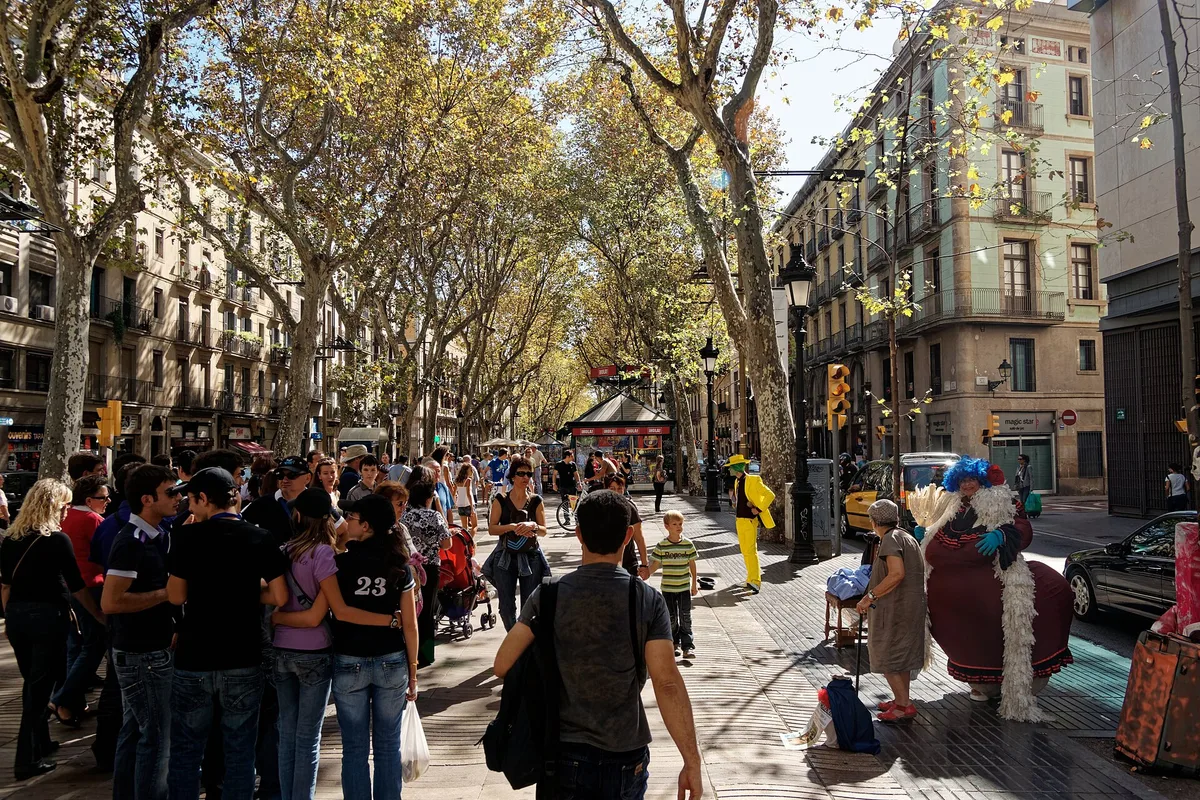
La Rambla isn’t a single street so much as five short ones stitched together (Rambla de Canaletes, dels Estudis, de Sant Josep, dels Caputxins, and de Santa Mònica) each named for what used to stand there before the boulevard was paved over an old seasonal riverbed (a “ramla” in Arabic) in the 18th century. What you notice first is the canopy: a double row of plane trees arching over a wide central pedestrian median, with narrow traffic lanes running on either side.
Wrought-iron lampposts, wavy black-and-white mosaic tiles underfoot near the Liceu opera house (a Joan Miró design, easy to miss if you’re not looking down), and a parade of wedding-cake facades from the 19th century line the route. It’s touristy, crowded, and occasionally chaotic, and still worth the walk once for the sheer theater of it.
Getting there
The boulevard runs from Plaça de Catalunya, served by Catalunya station (Metro lines L1 and L3, plus the Aerobús airport shuttle), down to the Columbus Monument at Port Vell. You can enter or exit at several points along the way: Liceu station (L3) drops you roughly at the midpoint, near the opera house, and Drassanes station (L3) sits at the southern end near the harbor.
If you’re coming from the Gothic Quarter, any of the small side streets off the eastern side, Carrer de Ferran is the main one, will feed you onto La Rambla within a couple of minutes’ walk.
What to see along the way
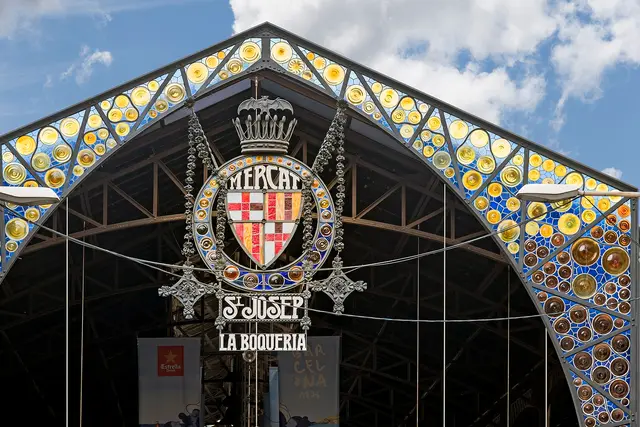
Start at Plaça de Catalunya and head south. Early on you’ll pass Font de Canaletes, a modest cast-iron drinking fountain that’s become a ritual stop for FC Barcelona fans celebrating titles, legend says drinking from it guarantees a return to the city. Further down, the Boqueria Market’s wrought-iron entrance sign marks a worthwhile detour (it’s one block off the main walkway, not directly on it).
Continue past the Liceu opera house, one of Europe’s great 19th-century theaters, rebuilt after a fire in the 1990s, and the Royal Academy of Fine Arts before reaching Plaça Reial, an arcaded 19th-century square tucked just off the boulevard with palm trees and Gaudí’s early lamppost designs. The walk ends at the Columbus Monument, a cast-iron column pointing, somewhat inaccurately, out to sea, with the marina and the Maremagnum shopping complex just beyond.
When to go
Because this is one of the most heavily trafficked pedestrian corridors in Spain, timing matters more here than at almost any other Barcelona sight. Mornings before 9am are noticeably calmer, shutters are still down on the souvenir stalls, the human statues haven’t set up, and you can actually see the mosaic pavement and building facades without dodging tour groups.
Avoid early-to-mid afternoon on weekends, when cruise ship crowds, day-trippers, and street performers converge and the center median turns into a slow-moving crush. Evenings bring a different energy: the plane tree canopy lit from below, restaurant terraces filling up, and a livelier but still very busy atmosphere.
How to visit like a local
Locals treat La Rambla as a route to walk through, not a place to linger (nearly everyone crossing it is headed somewhere else, to the Boqueria, the Gothic Quarter, or the harbor. Do the same: walk with purpose on the outer edges of the central path rather than drifting in the middle where the crowd bottlenecks. Skip eating or drinking at the cafés directly on the boulevard) prices run high and quality is inconsistent, geared entirely toward footfall rather than repeat customers.
Instead, duck one block in either direction into El Raval or the Gothic Quarter for food. Keep bags zipped and worn in front; pickpocketing is a well-documented, longstanding issue on this specific street given the density of distracted tourists, and it’s the single biggest complaint locals raise about the area. Payment on the boulevard itself is almost entirely card or contactless at legitimate shops, but street performers and human statues who ask for tips generally expect small coins in cash.
If you want a photo with one of the costumed performers, a coin in the box is the polite, expected exchange, not a request for a free pose.
Nearby detours worth the extra ten minutes
Once you reach either end, extend the visit: Plaça de Catalunya connects to Passeig de Gràcia and the Eixample’s Modernista buildings, while Port Vell at the southern end leads to the Barceloneta beach promenade. Both make a more relaxed second act after the density of La Rambla itself.
Frequently asked questions
How long does it take to walk La Rambla?
The full stretch from Plaça de Catalunya to the Columbus Monument takes about 20-30 minutes at a steady pace, but budget 45 minutes to an hour if you want to pause at the Boqueria entrance, Plaça Reial, and the Liceu area.
What's the closest metro station?
Catalunya (L1/L3) at the north end, Liceu (L3) at the midpoint, and Drassanes (L3) at the south end near the harbor — all sit directly on or a few steps from the boulevard.
When is La Rambla least crowded?
Before 9am is consistently calmer, before souvenir stalls open and tour groups arrive. Weekend afternoons are the busiest and worth avoiding if you want to actually see the street rather than the crowd.
Is La Rambla safe, especially for pickpockets?
It's generally safe for walking day or night, but it's one of Barcelona's most reported spots for pickpocketing due to sheer visitor density. Keep bags zipped and in front, and be extra alert near street performers, who can draw a crowd around you.
Should I eat at the restaurants on La Rambla itself?
Most locals skip them — prices tend to be higher and quality lower than a block or two away in El Raval or the Gothic Quarter, where you'll find better-value tapas bars and restaurants.
Plan your trip to Barcelona
Some links above are affiliate links — if you book through them, Wander Atlas earns a small commission at no extra cost to you. It's how we keep every guide free.
Related guides
This spot is Day 1 of our Barcelona 3-day itinerary
More Barcelona guides: Museu d Art Contemporani de Barcelona 400 mLa Colmena 700 mCasa Batlló 800 mThe Grill 1.2 kmChristopher Columbus monument 1.3 kmCiutadella Park 1.4 km