King Mangrai Monument: Chiang Rai Travel Guide (4.7★)
When to visit Thailand: month-by-month weather, crowds and holidays →
✓ Facts verified via Google Places · Aug 31, 2026
At a glance
Live foot-traffic data via BestTime.app
How this guide is made
Produced with AI assistance and reviewed against live data sources. Facts such as hours, ratings, and location come from Google Places; images are licensed or public domain. Details can change — please verify before visiting. Editorial policy
Why go
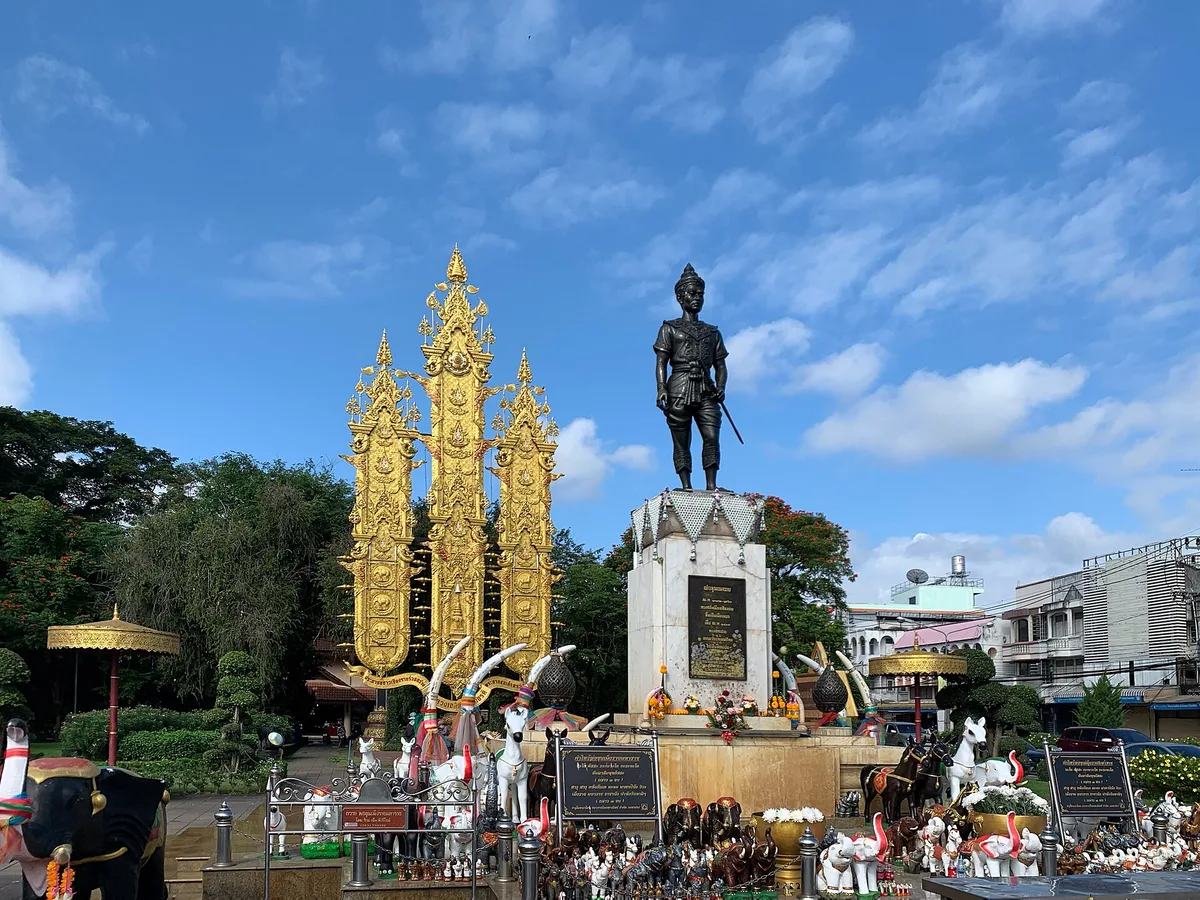
You won’t find crowds of camera-toting tourists here. You’ll find locals. Motorbikes pull up, riders duck out for thirty seconds, press their palms together in front of the statue, and pull back into traffic. That rhythm, repeated all day, tells you more about King Mangrai’s place in this city than any plaque could. He founded Chiang Rai in 1262 as the capital of the Mangrai dynasty before going on to found Chiang Mai three decades later, and the bronze figure raised in his honor still functions less as a tourist attraction than as a working shrine at the heart of civic life.
With a rating built on well over 3,500 reviews, it’s clearly one of the most consistently well-regarded stops in the city, even though most visitors spend only minutes there.
What you’ll see
The king stands on a raised pedestal, sword in hand, robes cast in bronze, gazing out over the intersection that locals sometimes call Ha Yaek, the “five-way junction.” At the base, white horses and elephants flank the statue, a reference to the mounts of Lanna royalty and to the founding legends of the city. Fresh garlands, incense sticks, and small offering trays usually sit at the foot of the plinth, replenished daily rather than left to fade, a sign of how active the devotion here still is.
There’s no ticket booth, no gate, no gift shop, just an open, paved plaza where the statue rises above the traffic island, visible from several directions as you approach.
Getting there
The monument sits inside the old city grid, at a five-way junction on Thanon Ha Yaek in Tambon Wiang, Chiang Rai’s central district, close enough to the Chiang Rai Clock Tower and the Sunday Walking Street area that you can fold it into a walk through downtown rather than a special trip. Chiang Rai has no metro or train system, so most visitors arrive on foot, by rented scooter, or by songthaew (shared red truck) from elsewhere in the old town.
If you’re staying near the night bazaar or the bus terminal, it’s a short, flat walk or a five-minute ride. Because it sits on a busy junction, cross with care. This is a functioning traffic circle, not a pedestrianized square.
When to go
Data on foot traffic here shows a clear pattern: the calmest window, on both weekdays and weekends, is 7am to 8am, before the junction fills with commuters and the statue draws its steady stream of worshippers. On weekends, traffic and visitor numbers stay elevated from 10am all the way through 10pm, so if you’re hoping for a quiet moment to look, photograph, or simply sit with the statue, plan around that stretch rather than into it.
Early morning also happens to be when the light is softest for photos, with the bronze catching a warm glow before the tropical sun climbs and flattens the color.
How to visit like a local
Treat it the way Chiang Rai residents do: a brief pause, not a destination in itself. Dress modestly, shoulders and knees covered is respectful, since this is an active shrine, not a museum piece. If you want to make an offering, small garlands or incense are sold by vendors near similar shrines around town; there’s no admission fee and no expectation of payment, so a quiet, respectful moment is enough.
Many locals pause on two wheels rather than parking and walking up, so don’t be surprised if you’re the only one lingering for more than a minute. The most common mistake visitors make is treating it purely as a photo op and blocking the small offering area while people are trying to pray, step to the side, get your shot, and let the flow of quick, genuine visits continue around you.
Pair the stop with a walk to the nearby Clock Tower, especially if you can time your visit to catch its evening light show, or continue on to the Chiang Rai night market a few minutes away for a natural next stop after your visit here.
Frequently asked questions
How much time should I spend at the King Mangrai Monument?
Most visitors spend 10-20 minutes here — it's a compact statue and plaza, best combined with a longer walk through downtown Chiang Rai rather than visited on its own.
What is the quietest time to visit?
Both weekdays and weekends are quietest between 7am and 8am. On weekends, crowds and traffic stay heavy from 10am until as late as 10pm, so avoid that window if you want a calmer visit.
Is there an entrance fee?
No, the monument is a public shrine at an open traffic junction with no ticket booth or admission charge.
How do I get there without a car?
It's centrally located in Chiang Rai's old city near the Clock Tower, reachable on foot from most downtown hotels, or by scooter or songthaew (shared red truck) if you're staying further out.
What else is nearby?
The Chiang Rai Clock Tower and the night bazaar/walking street area are both within easy walking distance, making it simple to combine with an evening stroll.
Plan your trip to Chiang Rai
Some links above are affiliate links — if you book through them, Wander Atlas earns a small commission at no extra cost to you. It's how we keep every guide free.
Related guides
 attraction
 Rong Suea Ten Temple: Chiang Rai Travel Guide
 attraction
 Baan Dam Museum: Chiang Rai Travel Guide (4.1★)
 attraction
 Wat Rong Khun: Chiang Rai Travel Guide
 attraction