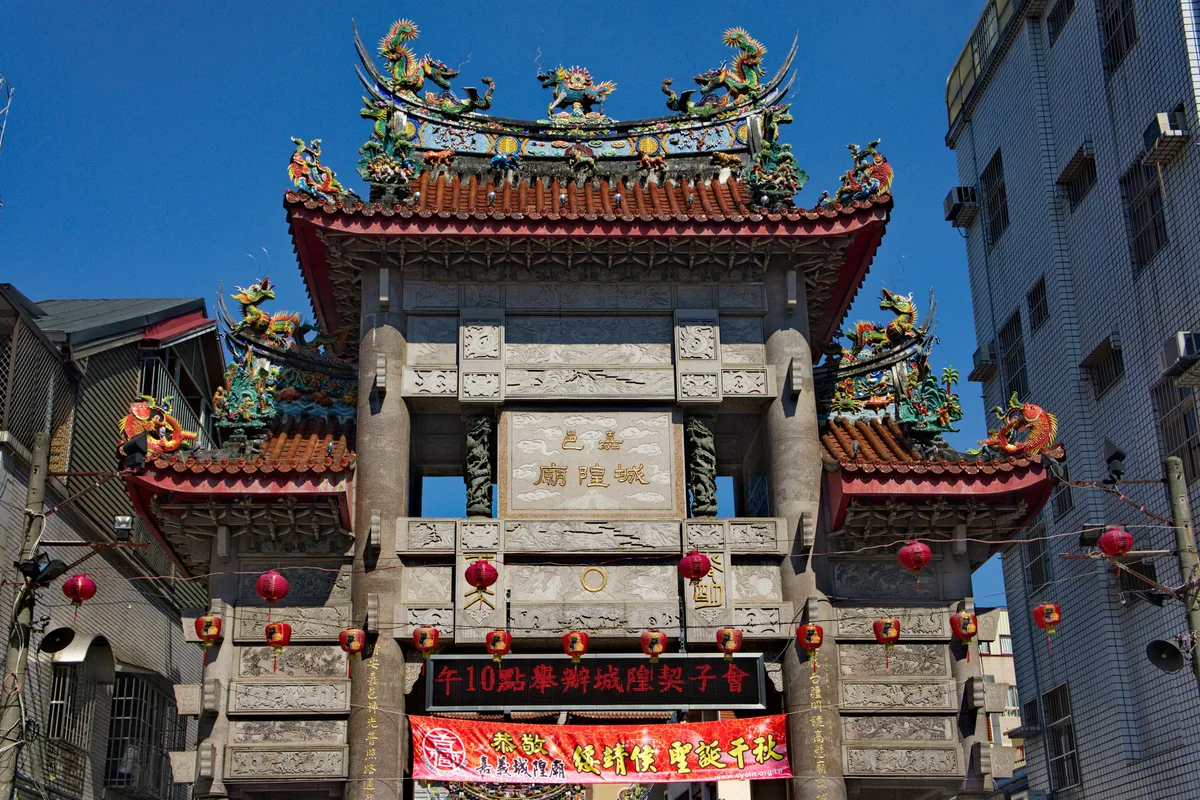
Cheng Huang Temple sits mid-block on Wufeng North Road, its blackened incense-smoked beams and layered rooflines making it easy to spot even among Chiayi’s dense shophouse streets. This is a City God temple, one of Taiwan’s most architecturally important, and the soot-darkened wood alone tells you how long incense has been burning here.
Cheng Huang, the City God, is the mythological magistrate of Chiayi, judging the dead and protecting the living within his jurisdiction. That civic role shapes everything about the building: the multiple ancestor halls, the courtroom-like main altar, the flanking judges and generals carved into the surrounding niches.
The carvings worth slowing down for
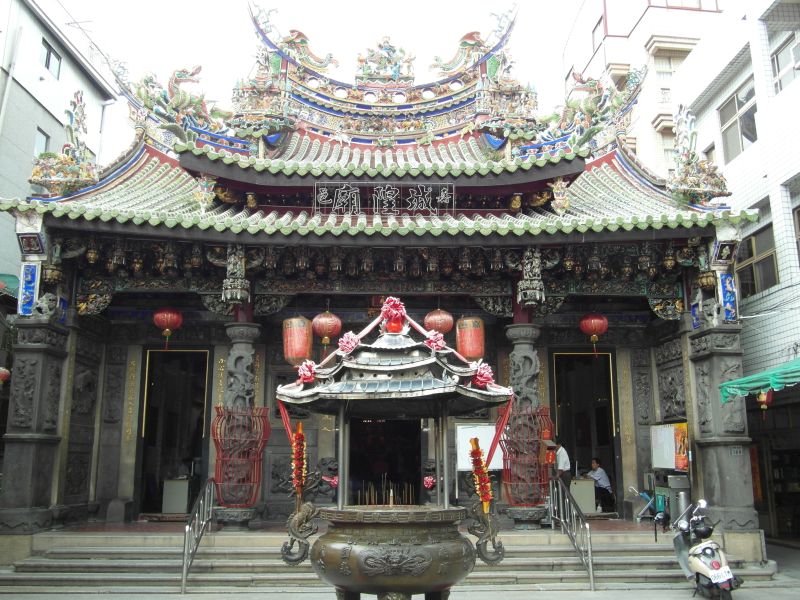
Don’t just glance at the roofline and move on. The jiannian (cut-porcelain) figures along the ridge depict opera scenes and deities in fragmented ceramic, a technique particular to southern Taiwanese temple decoration.
Inside, look up at the caisson ceiling, a spiraling wooden dome built without nails, positioned over the main hall as both structural showpiece and cosmological symbol. The stone and wood carvings around the door gods and beam supports reward a slow walk around the perimeter rather than a straight line to the altar.
Reading the layout
Temples like this are organized, not random, and knowing the order helps you understand what you’re looking at.
- Entrance hall: door god paintings, often repainted but based on traditional patterns
- Main hall: Cheng Huang’s central altar, flanked by the judges of the underworld
- Side halls: subsidiary deities and ancestor tablets
- Rear hall: quieter, less trafficked, good for a final look at the woodwork
A quick walk-through can cover the main halls in a fairly short visit, but if you’re interested in temple architecture specifically, the coffered ceiling and roof decoration justify lingering closer to an hour.
When to go
The temple is open every day of the week from 7am to 9pm, so there’s no day to route around. Weekday mornings between 7am and 9am are the quietest stretch, with far fewer worshippers and tour groups underfoot.
Weekends are a different story: crowds build steadily from around 9am and stay heavy until roughly 5pm, so if you’re aiming for photos of the altar or ceiling without people in frame, an early weekend visit or any weekday morning works best. Evenings after the dinner hour tend to thin out again, letting the smoke-hazed lighting do more of the atmospheric work.
Making an offering without feeling lost
Nobody is going to hand you instructions, so it helps to know the basics before you’re standing at the incense table.
- Incense sticks are typically available near the entrance for those who wish to make an offering
- Light them from the communal burner, not a personal lighter, and let the smoke, not a flame, remain
- Bow once at the main entrance before stepping over the threshold
- Move to the main altar first, then work outward to the side halls
- Keep voices low; this remains an active place of worship, not a sightseeing stage
Photography is generally fine in the courtyards and main hall, but be discreet near people actively praying, and skip flash near the older painted panels.
Getting there and nearby stops
The temple sits in Chiayi City’s East District on Wufeng North Road, an easy walk or short taxi ride from the Chiayi Train Station area. It’s roughly 15-20 minutes on foot from the station, or a quick cab ride if you’re short on time.
Once you’re in the neighborhood, pair the visit with the Chiayi Confucius Temple and the old Hinoki Village timber district, both within a similar radius, to make a half-day loop through the city’s historic core. Wufeng North Road itself has small eateries and tea shops if you want a break between stops.
There’s no admission fee, and the temple’s consistently strong reputation among visitors reflects its status as one of the city’s most complete surviving examples of traditional Taiwanese temple carving. Confirm nothing changes seasonally by checking local signage if you’re visiting around a major festival date, since City God temples often see ceremonial activity tied to lunar calendar dates.
Frequently asked questions
What are the opening hours for Chiayi Cheng Huang Temple?
It's open every day from 7am to 9pm, with no weekly closing day.
When is the quietest time to visit?
Weekday mornings between 7am and 9am are calmest. Weekends stay busy from about 9am to 5pm, so aim outside that window if you want fewer crowds.
Is there an entrance fee?
No, entry is free, though donations for incense are customary if you plan to make an offering.
How long should I plan to spend there?
Most visitors spend 30-45 minutes; allow closer to an hour if you want to study the roof carvings and ceiling in detail.
How do I get to the temple from Chiayi Train Station?
It's about a 15-20 minute walk from the station, or a short taxi ride, and can easily be combined with the Chiayi Confucius Temple and Hinoki Village nearby.
Plan your trip to Chiayi
Taiwan eSIM & staying connected →
Some links above are affiliate links — if you book through them, Wander Atlas earns a small commission at no extra cost to you. It's how we keep every guide free.