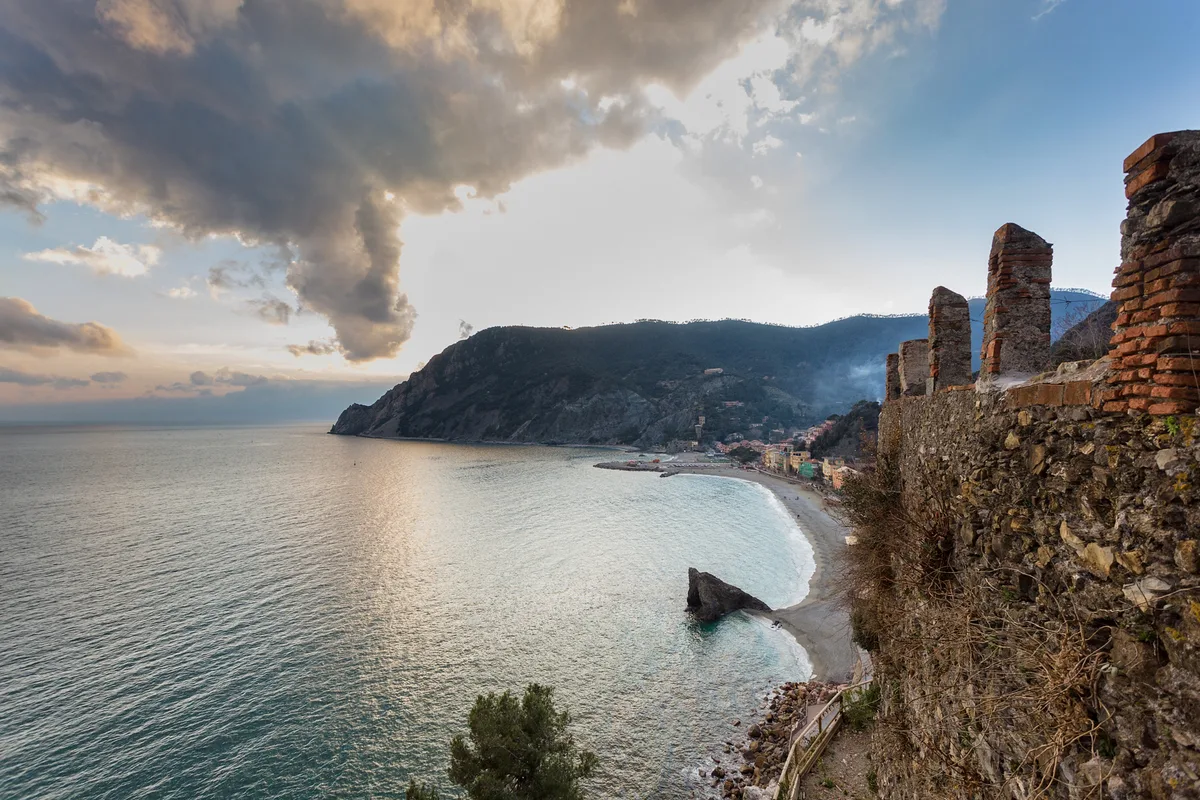
Stand on Fegina beach in Monterosso and look west. A dark green ridge drops straight into the sea, with the concrete Gigante statue carved into the rocks at its foot. That ridge is Punta Mesco. It is the reason Monterosso’s long beach curves the way it does, and it is the best free viewpoint over the whole Cinque Terre coast.
Most visitors photograph it from the sand and never go up. You can.
The headland that closes the bay
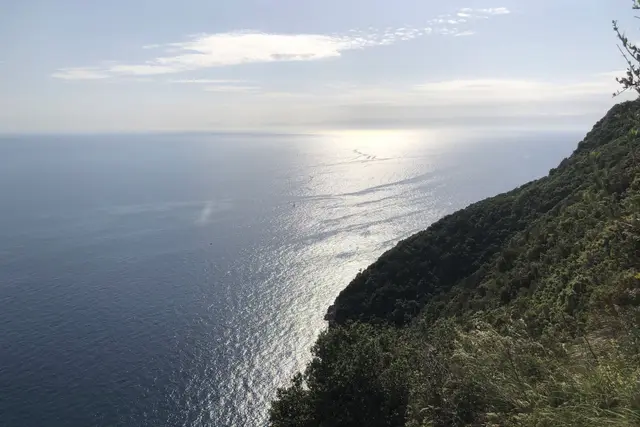
Punta Mesco is the promontory that marks the western edge of the Cinque Terre. It separates Monterosso from Levanto. It is a tall wedge of sandstone covered in holm oak, Mediterranean pine and maquis, falling almost vertically into deep water.
The sea around its base belongs to the Cinque Terre’s protected marine area. That explains the clear water you see below the cliffs.
Near the top sit the ruins of the Eremo di Sant’Antonio del Mesco. This medieval hermitage is now a roofless shell of stone walls on a grassy shoulder of the ridge. A little below are the remains of an old signal station. Neither is staffed or fenced, so you can walk around both.
The climb from Fegina
The route is the coastal trail from Monterosso to Levanto, signed as path 591. Pick it up at the far western end of Fegina, past the Gigante statue. Monterosso’s train station is in Fegina, so you can walk off the platform and be on the trail within minutes.
It is steep from the start. Expect:
- Long flights of uneven stone steps for the first stretch, climbing above the hotels and lemon terraces
- Roughly an hour of steady ascent to the hermitage for most reasonably fit walkers
- Shade from the pines for much of the way, with open sections where the sun hits hard
- Loose stones and roots higher up, so wear proper grip shoes, not beach sandals
The views get better as you climb. Fegina and the old village of Monterosso shrink below you, then the coast opens out to the east.
What you see from the top
On a clear day the view from the hermitage runs down the whole coast. Vernazza, Corniglia, Manarola and Riomaggiore are folded into the cliffs one after another. Beyond them, the Portovenere headland and Palmaria island often show at the far end.
Turn around and the view west takes in Levanto’s bay and the Ligurian Riviera beyond it.
This is the angle that explains the Cinque Terre: five villages wedged into one continuous wall of terraced cliff. You do not get that from the villages themselves.
Getting the ridge to yourself
Punta Mesco gets far fewer people than the paths between the five villages. The steps put off a lot of day-trippers, which is the main reason. Here is how to make the most of it.
- Start early. Climbing in the cool of the morning beats the midday heat on the exposed steps. The eastern coast is also usually lit well then.
- Go up and come back, or carry on. Most people return the same way to Monterosso. You can also continue over the ridge and down to Levanto, about three hours end to end, and take the train back. Trains on the Cinque Terre line run between the two towns often.
- Check the trail status first. Paths in the Cinque Terre National Park close after heavy rain or landslides. The park’s official site and the information office at Monterosso station post current closures and any trail fees.
- Bring everything. There are no bars, taps or bins at the top. Carry water and a snack, and take your rubbish back down.
- Keep to daylight. The headland is technically always accessible, but the trail is unlit and has steep drops. Plan to be off it before dark.
Italian walkers greet each other with a quick “buongiorno” when passing on narrow trails. On the steepest steps, the person coming downhill usually gives way to the person climbing.
When to go
Spring and autumn give you the most comfortable climb. The maquis smells strongest in late spring. Autumn often brings clearer air for long views down the coast.
Summer works if you start at first light. By midday the open sections can be punishing.
Avoid the trail on the day after a big storm: the stone steps hold water and the higher stretches can turn slippery.
Pairing it with Monterosso
Give the headland a half day. Climb in the morning and come back down to Fegina for a swim below the Gigante, the same cliffs now above you.
Then walk through the short tunnel to the old village. There you can see the Church of San Giovanni Battista with its striped façade, and the Capuchin convent on the hill between the two halves of town. If you still have energy, the path from Monterosso to Vernazza starts from the old-village end.
Frequently asked questions
How do I get to Punta Mesco from Monterosso?
Walk to the western end of Fegina beach, past the Gigante statue, and follow the Monterosso–Levanto trail (path 591) uphill. Monterosso train station is in Fegina, so the trailhead is a short walk from the platform.
How long does the hike take?
Plan on roughly an hour of steep climbing to the hermitage ruins, and a bit less to come down. If you carry on over the ridge to Levanto, the full walk takes about three hours.
Is the trail difficult?
It is steep and mostly stone steps, with loose sections higher up. Anyone reasonably fit can do it with shoes that grip well. It is not suited to sandals, and it is hard going in midday summer heat.
When is the best time to hike to Punta Mesco?
Mornings in spring or autumn are the most comfortable and usually give the clearest views of the coast. Avoid the trail after heavy rain, and check the Cinque Terre National Park site for closures before you set off.
Are there facilities at the top?
No. There are no cafés, water taps or toilets on the headland, only the ruins of the Sant'Antonio hermitage and the old signal station. Bring water and food, and carry your rubbish back down.
Plan your trip to Cinque Terre
Italy eSIM & staying connected →
Some links above are affiliate links — if you book through them, Wander Atlas earns a small commission at no extra cost to you. It's how we keep every guide free.
Related guides
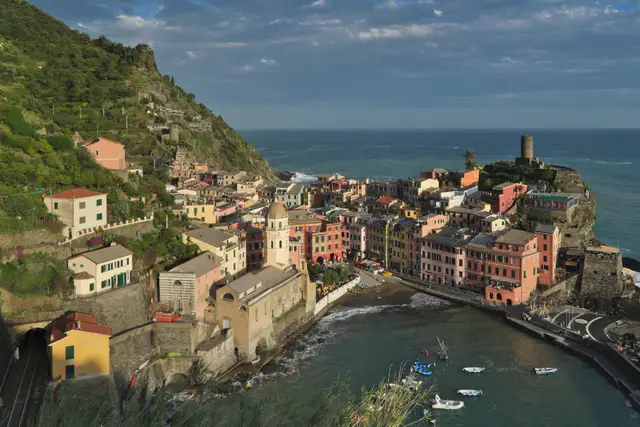 hidden gem
Sentiero Monterosso - Vernazza: Cinque Terre Travel Guide
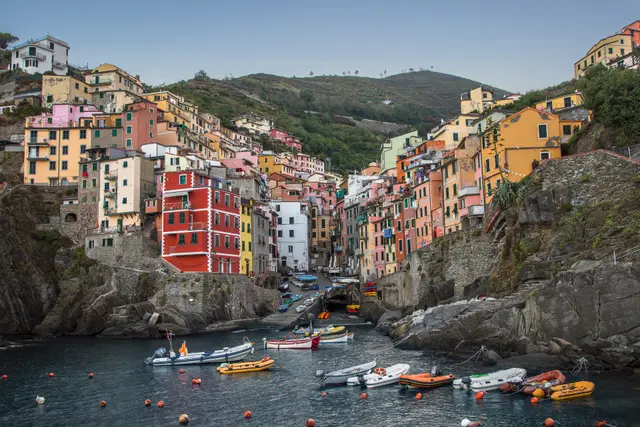 attraction
Parco Nazionale delle Cinque Terre: Travel Guide (4.7★)
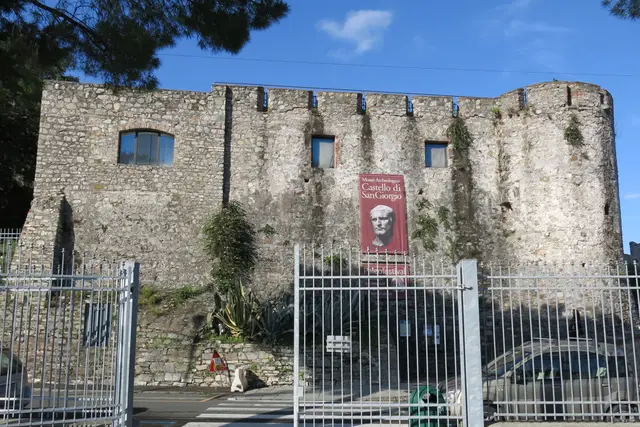 attraction
Castello San Giorgio: Cinque Terre Travel Guide (4.4★)
 attraction