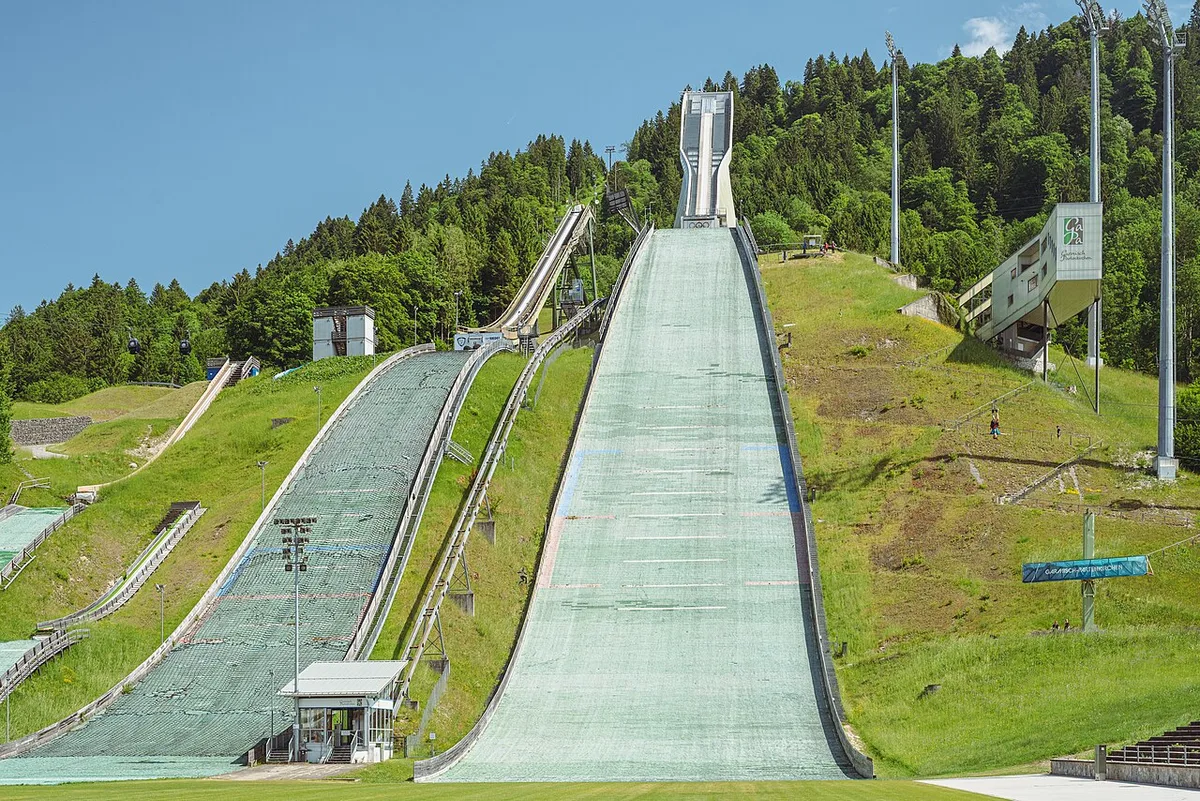
Look up from the stalls on Richard-Strauss-Platz and the Wetterstein range fills the southern sky. That backdrop is the reason this market is worth the trip. Other Bavarian squares have the wooden huts and the mulled wine. Few of them sit under Germany’s highest mountain.
The 2026 edition runs from November 20, 2026 to January 5, 2027. It sits on Richard-Strauss-Platz, the open square at the centre of the Garmisch side of town.
A market under the Zugspitze
Garmisch-Partenkirchen is two villages joined into one. They merged in 1935, ahead of the 1936 Winter Olympics, and locals still talk about Garmisch and Partenkirchen as separate places. The market belongs to Garmisch, the livelier western half, where the pedestrian streets fan out from the square.
The square takes its name from Richard Strauss. The composer built his villa in Garmisch and lived there until his death in 1949. Around the stalls are the low, deep-eaved Alpine buildings you find across the town centre. The Zugspitze massif rises behind them at 2,962 metres.
What fills the stalls
Expect the classic Bavarian Christmas market spread rather than a souvenir mall. The verified facts do not list individual vendors, so here is what markets in this region usually serve:
- Glühwein, hot spiced wine, plus fruit punch and children’s punch (Kinderpunsch)
- Bratwurst in a bread roll, eaten standing at a high table
- Gebrannte Mandeln, almonds roasted in sugar and sold warm in paper cones
- Lebkuchen, the spiced gingerbread that comes as hearts on ribbons or as soft rounds
- Hand-carved wooden figures, candles and straw stars, which are traditional Alpine decorations
Drinks at German markets nearly always arrive in a ceramic mug. Each market usually has its own design and often its own year printed on it.
Running past Christmas, to the eve of Epiphany
The calendar is the unusual part. Many German Christmas markets pack up in the days before or just after December 24. This one runs until January 5, 2027. That is the eve of Heilige Drei Könige (Epiphany), which is a public holiday in Bavaria.
That long tail changes who is there. From late December into early January, the town fills with skiers on their winter break. Some come for the Garmisch-Classic ski area and some for the glacier on the Zugspitze. After a day on the slopes, the square becomes their evening stop. If you are combining a ski holiday with the market, the weeks after Christmas are the obvious window.
Earlier visits, from late November, feel more like a local evening out before the high season begins. In Germany, markets often shorten their hours or close around December 24 and 25. Times for individual days come from the organiser, and the verified facts here do not include them.
Getting to Richard-Strauss-Platz
Most visitors arrive by train. Regional trains run direct from München Hauptbahnhof to Garmisch-Partenkirchen station, and the ride takes roughly an hour and a half through the Loisach valley. From the station, the walk north-west into the Garmisch centre takes about ten minutes on foot. Richard-Strauss-Platz sits among the pedestrianised streets.
By car, the A95 from Munich turns into the B2 and runs straight into town. The centre is compact and partly pedestrianised. Visitors driving in usually leave the car in one of the public car parks and walk the last stretch, rather than circling the narrow streets.
From Innsbruck, the route runs over the Austrian border via Mittenwald. Both rail and road options take about an hour.
Mugs, deposits and standing tables
Bavarian market etiquette is simple once you know the system.
- The mug deposit. Your first drink usually comes with a deposit (Pfand) added for the mug. Hand the mug back to any stall serving the same drinks and you get the deposit returned. Keep it and the mug is yours as a souvenir. Plenty of people do.
- Cash still matters. Many small stall-holders at German markets prefer cash, and some accept nothing else. Card acceptance varies from hut to hut.
- Ordering. A simple “Einen Glühwein, bitte” works everywhere. Ask “mit Schuss” if you want a shot of rum or amaretto added.
- Standing, not sitting. People eat and drink at high round tables. Sharing one with strangers is normal, and nobody expects you to ask.
- Tipping. At a stall counter, rounding up a little is a friendly gesture but not expected the way it is in a restaurant.
The busiest evenings at Alpine markets tend to be Fridays and Saturdays, and the holiday weeks after Christmas, when the ski crowds are in town. Weekday late afternoons usually feel calmer, as the light fades behind the mountains.
Tickets and what it costs
The verified facts do not mention any entry ticket. Bavarian Christmas markets on public squares are generally open-air spaces that you simply walk into, and you pay stall by stall for what you eat, drink or buy. Each hut shows its own prices at the counter. The organiser publishes dates and opening times on its official channels.
Making a day of it
The market works best as the evening end of a full day in town. Nearby options:
- Ludwigstraße in Partenkirchen, the old main street, lined with houses painted in Lüftlmalerei, the Bavarian tradition of frescoed façades. It is a pleasant walk east from the Garmisch centre.
- The Zugspitze, reached by the cog railway from Garmisch or the cable car from Eibsee. On clear days the summit views reach across four countries.
- The Olympic ski stadium, with its ski jump, on the southern edge of town. It hosts the New Year ski jumping event of the Four Hills Tournament, which also falls inside the market’s run.
- Partnachklamm, the gorge beyond the ski stadium. In deep winter it fills with icicles.
Dress in layers. Garmisch sits at around 700 metres, in a valley where cold air settles after dark. Warm boots matter more than anything else you pack: on these evenings, you spend a long time standing still on cold paving.
Frequently asked questions
When is the Garmisch-Partenkirchen Christmas Market in 2026?
It runs from November 20, 2026 to January 5, 2027, the eve of the Epiphany public holiday in Bavaria. That makes its run longer than many German Christmas markets, which close around Christmas.
Where exactly is the market held?
On Richard-Strauss-Platz, the central square of the Garmisch side of town, among the pedestrian streets. It is about a ten-minute walk from Garmisch-Partenkirchen train station.
How do you get there from Munich?
Direct regional trains run from München Hauptbahnhof to Garmisch-Partenkirchen in roughly an hour and a half. By car, the A95 and then the B2 lead into town, and drivers usually leave the car in a public car park and walk to the square.
Do you need a ticket to enter?
The verified facts mention no entry ticket. Bavarian markets on public squares are generally open-air spaces you walk into freely, and you pay at each stall for food, drinks and gifts. Each hut shows its prices at the counter.
What else is nearby to combine with a visit?
Close by are the painted houses of Ludwigstraße in Partenkirchen, the Zugspitze cog railway, the Olympic ski stadium and the Partnachklamm gorge. Many visitors spend the day on the mountain or the slopes and come down to the market in the evening.
Plan your trip to Garmisch-Partenkirchen
Germany eSIM & staying connected →
Some links above are affiliate links — if you book through them, Wander Atlas earns a small commission at no extra cost to you. It's how we keep every guide free.
Related guides
 event
Aespa 'Synk: Complæxity' World Tour – Berlin: Dates, Tickets & Venue (Berlin)
 Ended
ARTMS Berlin 2026: Dates, Tickets & Venue (Berlin)
 event
Berlin WeihnachtsZauber Gendarmenmarkt: Dates, Tickets & Venue (Berlin)
 Ended