Most visitors cross the Causeway, head for a mall and never see this street. That’s a mistake. Jalan Tan Hiok Nee is a single row of two-storey shophouses with a covered five-foot way under the upper floors. It’s short, it’s walkable, and it’s one of the few stretches of Johor Bahru that still looks like the town before the towers went up.
It sits in Bandar Johor Bahru, the old downtown grid close to the Straits of Johor. Plenty of people walk straight past it on their way somewhere else. That’s good news for you.
A street named for a Major China
The street name is a history lesson in itself. Tan Hiok Nee was a Teochew merchant and community leader in nineteenth-century Johor. Maharaja Abu Bakar, the ruler who modernised the state, gave him the title Major China, which made him the official head of the Chinese community.
His power came from the kangchu system. Under it, Chinese headmen were granted river concessions to clear land and plant gambier and pepper, and those crops paid for much of early Johor Bahru. The old town you’re standing in grew out of that trade. So when you read the street sign, you’re reading the name of someone who helped build the place.
Walking the five-foot way
Start at one end and just walk slowly. The shophouses follow the classic Straits pattern:
- a shop or workspace at street level
- living quarters on the floor above
- a shaded arcade, the five-foot way, running along the front
Look up at the upper storeys. That’s where the old details survive: shuttered windows, plaster mouldings and the odd painted date or family name. At ground level the businesses change from year to year, so read the shopfronts as you find them on the day. Don’t go looking for a particular café you saw in an old blog post.
The covered walkway is the reason the street is bearable in the heat. Keep to the arcade and you stay out of the sun from one end to the other.
Getting there from the Causeway
This is one of the easiest heritage walks to reach from Singapore. Once you’re through immigration at the Bangunan Sultan Iskandar checkpoint, you’re already on the edge of the old town. JB Sentral station is right next to the checkpoint too, so arriving by KTM train works just as well.
From there it’s a walk of roughly ten to fifteen minutes into the Bandar Johor Bahru grid. If you’d rather not walk in the midday heat, Grab drivers know the street. Type in “Jalan Tan Hiok Nee” and you’ll be dropped at the right place.
Driving is harder. Parking in the old town means narrow streets and street-side bays, so walking or a ride-hail is usually easier.

Temple, museum and the rest of the old grid
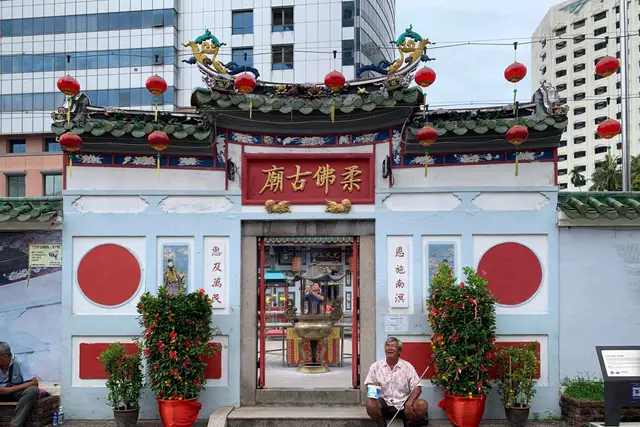
This street works best as part of a loop. A few minutes away on Jalan Trus is the Johor Bahru Old Chinese Temple. Five Chinese dialect groups built it together in the nineteenth century, and it’s still in active use, with incense coils hanging from the rafters.
The Johor Bahru Chinese Heritage Museum, on Jalan Ibrahim, tells the story behind this street. You’ll find the kangchu system, the gambier trade and the early migrant communities there, and it’s worth seeing either before or after your walk. Check its opening days before you go.
Further along, the Sultan Ibrahim Building on Bukit Timbalan, with its tower, rises over the old town and is easy to spot from the surrounding streets. If you walk the full loop and stop to look around, plan on half a day.
Chingay season on the old streets
Timing can change the street completely. Every year, around the twentieth to twenty-second day of the first lunar month, the Old Chinese Temple holds its Chingay procession. Deities are carried through the old town, followed by lion dancers, drummers and floats. It’s one of the biggest events on Johor Bahru’s cultural calendar.
If your trip falls in the weeks after Chinese New Year, look up that year’s dates. On procession nights the old streets are packed, so book your transport and your meal ahead. The rest of the year, the street is much quieter.
Treading lightly on a working street
Remember that people still live and work here. Here’s how to fit in:
- Photograph the facades, not the families. Plenty of upper floors are still homes. If a shopkeeper is sitting in their own doorway, ask before you point a lens at them.
- Keep the five-foot way clear. It’s a public walkway that shops also use for goods and deliveries. Step aside instead of setting up a tripod in the middle.
- Pay the local way. Small shops and kopitiams nearby often want cash in ringgit, though DuitNow QR and Touch ‘n Go eWallet are common. Tipping isn’t expected.
- Order simply. At a kopitiam counter, “kopi” gets you coffee with condensed milk and “kopi O” gets it black with sugar. Add “peng” if you want it iced.
- Dress for temple stops. If you’re adding the Old Chinese Temple, cover your shoulders and step around worshippers at the altar.
A morning start usually suits this walk. The air is cooler, the light on the facades is softer and the shops are just opening their shutters. By early afternoon the heat makes even the shaded arcade hard work.
Before you set off
This is a street, not a ticketed attraction, so there’s no gate to plan around. The shops, cafés and the museum nearby each keep their own hours, and some old-town businesses close on certain days. Check anywhere you specifically want to visit before you leave.
Bring water and your passport for the border crossing. Leave some time to wander the neighbouring lanes. For a traveller with a free morning after the Causeway, the whole old town is quietly rewarding.
Frequently asked questions
How do I get to Jalan Tan Hiok Nee from Singapore?
Cross the Causeway and clear immigration at the Bangunan Sultan Iskandar checkpoint, or arrive at JB Sentral by KTM train. From there it's a walk of about 10 to 15 minutes into the Bandar Johor Bahru old town. Grab is an easy alternative if it's hot.
How long should I spend there?
The street on its own takes under an hour at a slow pace. Add the Johor Bahru Old Chinese Temple on Jalan Trus and the Chinese Heritage Museum on Jalan Ibrahim, and half a day is comfortable.
Who was Tan Hiok Nee?
He was a nineteenth-century Teochew leader whom Maharaja Abu Bakar named Major China, the head of Johor's Chinese community. He was closely tied to the kangchu system of gambier and pepper plantations that funded early Johor Bahru.
What is the best time of day or year to visit?
Mornings are cooler and the light on the shophouse facades is better. For a lively visit, the Old Chinese Temple's Chingay procession around the 20th to 22nd day of the first lunar month fills the old streets. Check that year's dates.
Are there opening hours?
It's a public street, so you can walk it at any time. The shops, cafés and the museum nearby set their own hours, so check any specific place before you go.
Plan your trip to Johor Bahru
Some links above are affiliate links — if you book through them, Wander Atlas earns a small commission at no extra cost to you. It's how we keep every guide free.