
A capital you can only see in miniature
Almost nothing of Karakorum stands above the grass today. Ögedei Khan founded the city around 1235 as the capital of the Mongol Empire. Within a few generations it was abandoned, then sacked, and much of its stone was later reused for Erdene Zuu Monastery next door.
That is why the Kharakhorum Museum matters. It sits on the southern side of modern Kharkhorin, on Khushuu Tsaidam Road, and it holds what archaeologists have dug out of the ground here. If you walk the empty steppe outside without visiting first, you are looking at grass. Afterwards, you know where the streets ran.
What’s in the galleries
The building is modern and low, opened in 2011 with Japanese government support. Inside, the story runs roughly in chronological order. The Orkhon Valley was a seat of power long before Chinggis Khan’s sons, and the displays start well before the Mongols.
Expect material from several eras:
- Prehistoric and Bronze Age finds from the surrounding valley
- Xiongnu, Turkic and Uyghur period objects, from the earlier steppe empires that ruled from this same valley
- Imperial Karakorum itself: ceramics, coins, tools, roof tiles and architectural fragments from the excavations
- Religious objects that reflect the city’s mix of faiths
The collection is not huge, and that suits a road trip. You can read most of the English labels without rushing in about an hour.
The scale model and the silver tree
The model is the centrepiece. A large reconstruction of the walled city sits in the main gallery, laid out from excavation data. You can trace the palace compound, the craftsmen’s quarters and the city gates, then match them against the bumps in the field outside.
Then look for the silver tree. The Flemish friar William of Rubruck visited Karakorum in 1254 and described a silver fountain shaped like a tree, made by a captured Parisian goldsmith. Pipes inside carried different drinks to the khan’s guests. The museum’s depiction of it is the detail most visitors remember, and Rubruck’s account is one of the best descriptions of the city we have.
Getting to Kharkhorin and the museum
Kharkhorin is roughly 360 km west of Ulaanbaatar. The paved road takes most of a day, usually 6–7 hours by car or minibus, with stops. Buses run from Ulaanbaatar’s Dragon bus station; most visitors come on a driver-guided tour through the Orkhon Valley.
Once in town, the museum is easy to find. It is a short drive or a comfortable walk from the centre and from Erdene Zuu’s white stupa walls. Drivers all know it, so “Kharkhorum Museum” is enough to give them.
Moving through the museum
The ticket desk is just inside the entrance, and the current price is posted there. Card machines are common in Ulaanbaatar but less dependable in provincial towns, so carry some tögrög in cash as a backup.
A few habits help:
- Ask about photography at the desk. Mongolian museums often treat it as a separate permission, so don’t shoot until you’ve checked.
- Ask whether an English-speaking guide is on duty. A short guided walk round the model makes the rest of the galleries much easier to follow.
- Start with the model, then circle back. Seeing the layout first makes every roof tile and coin easier to place.
- Keep voices low. Some religious objects are still treated with respect by Mongolian visitors, and the rooms are small enough to carry sound.
Tour groups often move on a set loop: museum, monastery, then lunch. Arriving soon after the 9am opening usually puts you ahead of the groups driving in from overnight camps.
Pairing it with Erdene Zuu
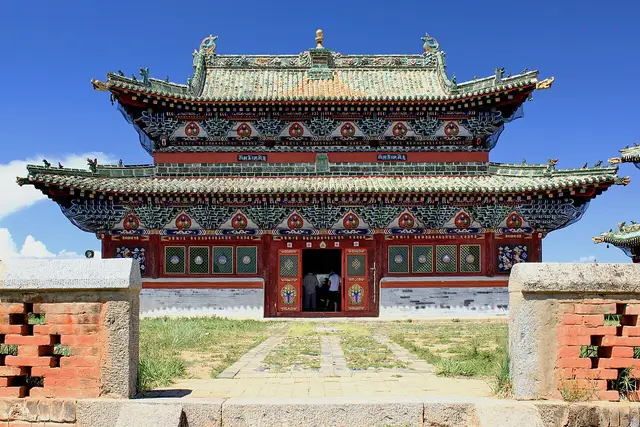
The museum and the monastery belong together. Erdene Zuu was founded in 1585 by Abtai Sain Khan, partly on the ruins of Karakorum. It was one of the first Buddhist monasteries in Mongolia, and its wall of 108 stupas is visible from a long way across the plain.
Do the museum first, then walk the monastery grounds. Once you’ve seen the excavated fragments, the reused stone and the old city’s footprint start to make sense. Both sit inside the Orkhon Valley Cultural Landscape, a UNESCO World Heritage Site.
Nearby, also worth an hour:
- The Turtle Rocks, granite turtles that once marked the city’s boundaries, one of them close to Erdene Zuu
- The Mongol Empire monument on the hill above town, three curved walls mapping the empire’s eras, with a wide view over the valley
- The excavation field between the museum and the monastery, now easy to read
Timing a day in the Orkhon Valley
Summer is the main season, when the roads are easiest and the valley turns green. Winter is very cold here, but the museum is indoors and open year-round, which makes it a good stop on a winter route. Check the hours for the month you’re travelling, though.
At the moment it opens 9am–6pm every day of the week. A good day looks like this: museum at opening, Erdene Zuu late morning, lunch in town, then the monument hill in the afternoon light. If you’re driving in from Ulaanbaatar the same day, you’ll likely arrive late. In that case, save the museum for the next morning rather than rushing it before 6pm.
Frequently asked questions
How long do I need at the Kharakhorum Museum?
Around 1–1.5 hours covers the galleries and the scale model comfortably. Add another 1–2 hours if you're also visiting Erdene Zuu Monastery nearby, which most people do.
What are the opening hours?
At the moment it opens 9am–6pm, Monday to Sunday. Museum hours can change through the year and on holidays, so confirm before travelling, especially outside summer.
How do I get to Kharkhorin from Ulaanbaatar?
It's roughly 360 km west by paved road, usually 6–7 hours. Buses leave from Ulaanbaatar's Dragon bus station; many visitors come on a driver-guided Orkhon Valley tour instead. Drivers in town all know the museum.
Should I visit the museum before or after Erdene Zuu?
Before. The museum's scale model and excavated finds show you the layout of the old Karakorum, which makes the monastery, its reused stone and the empty field outside much easier to understand.
What else is near the museum?
Erdene Zuu Monastery and its wall of 108 stupas, the granite Turtle Rocks that once marked the city's edges, and the Mongol Empire monument on the hill above town are all within a short drive.
Plan your trip to Kharkhorin
Mongolia eSIM & staying connected →
Some links above are affiliate links — if you book through them, Wander Atlas earns a small commission at no extra cost to you. It's how we keep every guide free.
Related guides
 attraction
 Erdene Zuu Monastery: Kharkhorin Travel Guide (4.5★)
 attraction
 Taikhar Rock: Tsetserleg Travel Guide (4.3★)
 attraction
 Amarbayasgalant Monastery: Darkhan Travel Guide (4.6★)
 attraction