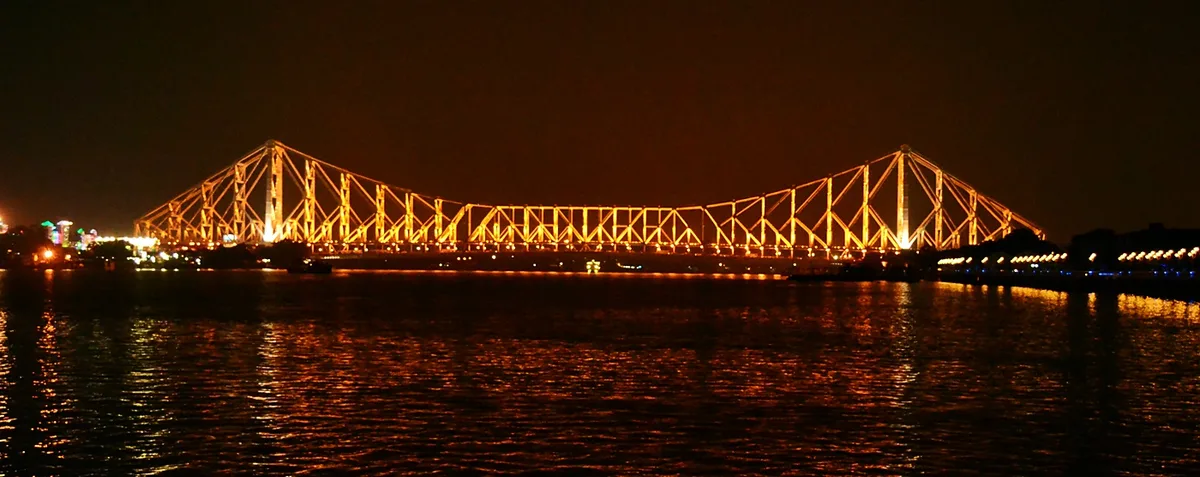
You feel Howrah Bridge before you see it clearly, the low rumble of trucks, the honking, the shuffle of thousands of feet crossing steel grating that has carried Kolkata’s traffic since 1943.
Officially called Rabindra Setu, nobody here calls it that. It’s just “Howrah Bridge,” the riveted cantilever span that ties Howrah’s railway station to the older city across the Hooghly River.
Why it’s worth your time
No pillars touch the river below, the entire span hangs from two towers, a feat of 1940s engineering that still holds. Around 100,000 vehicles and countless pedestrians cross daily.
That volume is the point. This isn’t a quiet monument; it’s a working artery of the city, and watching it move is the experience.
What you actually see and hear
Rivets the size of fists hold together girders painted steel-grey against a sky often hazy with river mist. Below, on the Kolkata bank, the Mullick Ghat flower market spills color and scent onto the steps, marigold, jasmine, rose, stacked in baskets since before dawn.
Ferries chug across the brown water, their horns adding another layer to the noise. Hand-pulled carts, yellow taxis, and trams squeeze past each other on the roadway above.
- Best photo angle: from a ferry or the Millennium Park side, not the bridge itself
- Bring earplugs if traffic noise bothers you. It’s constant
- Wear shoes you can walk in; the pedestrian sections get crowded and uneven

Getting there
Howrah Bridge sits between Howrah railway station and Kolkata’s Burrabazar area, connected by BBD Bagh and MG Road on the city side.
The nearest metro stop is Mahakaran on the Kolkata Metro’s Blue Line (Line 1), a short walk or rickshaw ride to the bridge’s eastern end. If you’re arriving by train, Howrah station itself sits right at the western foot of the bridge.
Taxis and app-based cabs can drop you near either end, though traffic congestion means walking the last stretch is often faster.
When to go
The bridge is open 24 hours, every day, so timing is entirely about crowds and light. Weekends get busy roughly between 9am and 10pm. Avoid that window if you want breathing room.
Early morning, just after sunrise, is when the flower market below is liveliest and the light on the river is softest. Evening brings a different mood: the bridge lit up, reflections breaking on the water, and the temperature finally bearable after a Kolkata afternoon.
Winter months (November to February) are more comfortable for lingering than the humid monsoon or peak summer heat.
How to visit like a local
Nobody strolls Howrah Bridge like a leisurely riverside walk. It’s a crossing, not a park. Locals move with purpose, keep to the pedestrian edge, and don’t stop mid-span for photos.
Since this is a very popular, heavily trafficked landmark, the real trick is avoiding the crowd rather than finding a secret angle. Skip the weekend daytime rush and come at first light or after dark instead.
- Take a short ferry ride from Armenian Ghat or Fairlie Place, this gives you the classic postcard view without fighting foot traffic
- Pay ferry or rickshaw fares in cash; small notes make transactions quicker
- Combine your visit with Mullick Ghat flower market, which sits directly under the bridge’s Kolkata end and is busiest before 8am
- Don’t stop to photograph from the bridge deck itself. It’s technically discouraged and traffic doesn’t slow down for you
Most visitors spend 30 to 60 minutes here, longer if you add the flower market or a river crossing by boat. Either way, you leave with the sense of a city genuinely running through, not around, one 82-year-old bridge.
Frequently asked questions
How do I get to Howrah Bridge by public transport?
Take the Kolkata Metro Blue Line to Mahakaran station and walk a few minutes to the bridge's eastern end, or arrive by train at Howrah station, which sits right at its western foot.
What's the best time to visit to avoid crowds?
Weekends get busy roughly 9am to 10pm, so aim for early morning right after sunrise or after dark for a calmer, more atmospheric visit.
Can I take photos on the bridge?
Photography from the bridge deck itself is discouraged and traffic doesn't stop for pedestrians. Better views come from a ferry on the Hooghly or from Millennium Park on the riverbank.
How long should I plan to spend here?
Most visitors spend 30 to 60 minutes, longer if you combine it with the Mullick Ghat flower market below the bridge or a short river ferry ride.
Is there an entry fee?
No, the bridge is a free public roadway open 24 hours; any cost you'll pay is for a ferry ride, rickshaw, or taxi to get there.
Plan your trip to Kolkata
Some links above are affiliate links — if you book through them, Wander Atlas earns a small commission at no extra cost to you. It's how we keep every guide free.