Why go
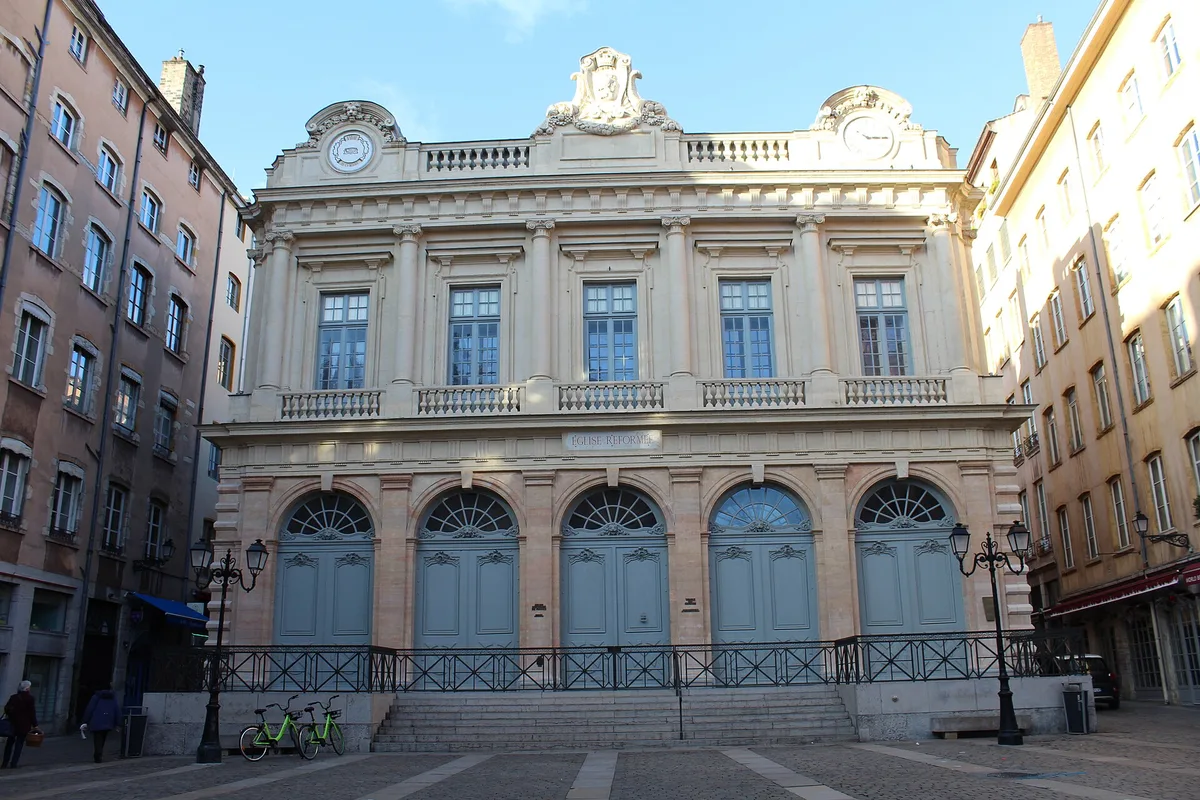
Tucked into a small square in Vieux Lyon, Temple du Change doesn’t look like a church at all. That’s because it wasn’t built as one.
Constructed in the 1740s as Lyon’s silk-trading exchange, the building has a severe, columned facade more suited to commerce than communion. Step inside and you find a surprisingly airy, galleried hall, repurposed as a Protestant temple in the 19th century. The contrast between the stern exterior and the pale, sober interior is what makes it worth the stop.
Getting there
You’re in the Presqu’île’s old quarter, on Place du Change, a few steps from the Saône.
The nearest metro is Vieux Lyon station on Line D, about a five-minute walk through the covered traboules and narrow lanes of the Renaissance district. If you’re already exploring Rue Saint-Jean or Rue du Boeuf, you’ll pass within a block or two without trying.
What to see inside
The building’s past as an exchange still shows in its bones.
Look up: the wooden gallery ringing the upper level was designed for merchants conducting business, not congregants at prayer. Sunlight comes in through tall arched windows, giving the pale stone and timber a soft, even glow rather than the coloured hush of stained glass. There’s no ornate altar or gilding here. The plainness is the point, a marker of Protestant worship in a city long dominated by Catholic churches.
Give it 15 to 20 minutes. It’s a small space, but an unusual one, and worth reading the panels inside that explain the swap from ledger books to hymnals.
When to go
This is the detail that trips people up: Temple du Change keeps genuinely limited hours.
It’s open only:
- Saturday, 3:00–6:00 PM
- Sunday, 10:00–12:30 PM
Closed the rest of the week. Because the opening window is so narrow, check the schedule before you build your day around it. A wasted trip here is easy to avoid with five minutes of planning.
How to visit like a local
Locals treat this as a quiet architectural curiosity rather than a must-see stop, and that’s exactly the right approach.
- Timing: Go early in the Saturday window (soon after 3pm) or right at Sunday opening. Both slots are short, so arriving late can mean rushing.
- Entry: There’s typically no ticket booth or fee to worry about; it functions as an active place of worship, so keep voices low and phones away, especially if a service is in progress on Sunday morning.
- Payment: Bring small change anyway, many small churches in Lyon keep a donation box near the door, and it’s customary to leave a coin or two if you can.
- Etiquette: Dress modestly, as you would for any working church, and avoid visiting mid-service unless you plan to sit quietly at the back.
- The mistake to avoid: Assuming it keeps regular museum-style hours. Most visitors who miss it do so because they show up on a weekday.
Because it’s still under most tourists’ radar, you can usually take your time here without jostling for space, a rarity in this densely visited part of Vieux Lyon.
Nearby, while you’re in the area
Pair the visit with a loop through the surrounding streets rather than treating it as a standalone stop.
- Place du Change itself is worth a slow circle. Note the surrounding Renaissance townhouses.
- Rue du Boeuf and Rue Saint-Jean are a two-minute walk, lined with traboules, bouchons, and small shops.
- Cathédrale Saint-Jean-Baptiste is a short stroll south along the river side of the old town.
- The funicular up to Fourvière is easily reachable from Vieux Lyon station if you want to extend the afternoon with a hilltop view over the city.
Frequently asked questions
What are the opening hours for Temple du Change?
It's open only Saturday 3:00–6:00 PM and Sunday 10:00 AM–12:30 PM. It's closed Monday through Friday, so plan your visit around the weekend.
Is there an entry fee?
There's typically no admission charge since it functions as an active Protestant church, though a small donation is welcome if a box is out.
How do I get to Temple du Change?
Take Metro Line D to Vieux Lyon station, then walk about five minutes through the old town's narrow streets to Place du Change.
How long should I spend there?
Most visitors spend 15 to 20 minutes taking in the interior and reading the historical panels — it's a small, focused stop.
Is it crowded?
No — it stays under the radar even with its narrow opening hours, so you'll usually have a peaceful visit compared to nearby Vieux Lyon landmarks.
Plan your trip to Lyon
Some links above are affiliate links — if you book through them, Wander Atlas earns a small commission at no extra cost to you. It's how we keep every guide free.