Fort Santiago: Manila Travel Guide
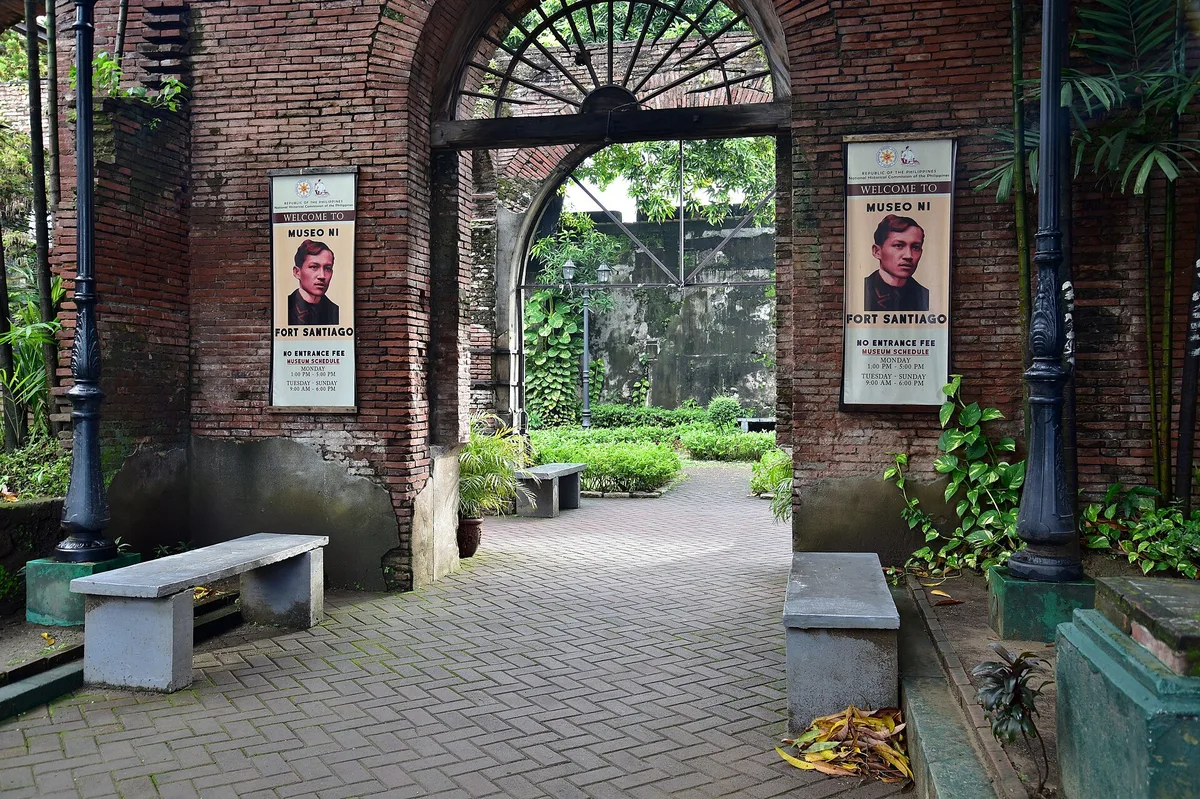
✓ Facts verified via Google Places · Sep 10, 2026
At a glance
Opening hours
- Monday: 8:00 AM – 11:00 PM
- Tuesday: 8:00 AM – 11:00 PM
- Wednesday: 8:00 AM – 11:00 PM
- Thursday: 8:00 AM – 11:00 PM
- Friday: 8:00 AM – 11:00 PM
- Saturday: 8:00 AM – 11:00 PM
- Sunday: 8:00 AM – 11:00 PM
Live foot-traffic data via BestTime.app
How this guide is made
Produced with AI assistance and reviewed against live data sources. Facts such as hours, ratings, and location come from Google Places; images are licensed or public domain. Details can change — please verify before visiting. Editorial policy
You enter through a stone gate carved with a relief of Santiago Matamoros, St. James the Moor-slayer astride his horse, and the noise of Intramuros’ traffic drops away almost immediately. Thick walls of adobe stone, blackened in patches by centuries of tropical rain, rise up on either side. This is Fort Santiago, the citadel the Spanish built in 1571 at the mouth of the Pasig River, and it still carries the weight of everything that happened inside it: colonial rule, Japanese occupation, and the final days of the man Filipinos consider their national hero.
Why go
Fort Santiago isn’t just a photogenic ruin. It’s the place where José Rizal spent his last night before his execution in 1896, and where thousands of civilians and POWs were held and killed during the Japanese occupation of WWII. The Rizal Shrine, housed in what was once part of the fort’s barracks, holds his personal effects, letters, and the room where he wrote his final poem.
Bronze footsteps set into the pavement trace his walk from cell to the firing squad site on the old Plaza de Armas, a simple but genuinely affecting detail that turns an abstract history lesson into something physical you can follow with your own feet.
Getting there
Fort Santiago sits at the northwestern edge of Intramuros, Manila’s walled Spanish-colonial old town, with its entrance facing Anda Circle near the Pasig River. The easiest approach is by taxi or ride-hailing app directly to the fort’s gate, traffic in central Manila can be unpredictable, so build in extra time. If you’re already exploring Intramuros on foot, it’s a straightforward walk from Manila Cathedral or San Agustin Church, both within the same walled district, roughly 10–15 minutes depending on your pace.
Many visitors also arrive via a calesa (horse-drawn carriage), a popular if touristy way to tour Intramuros’ cobbled streets before or after the fort.

What to see and do inside
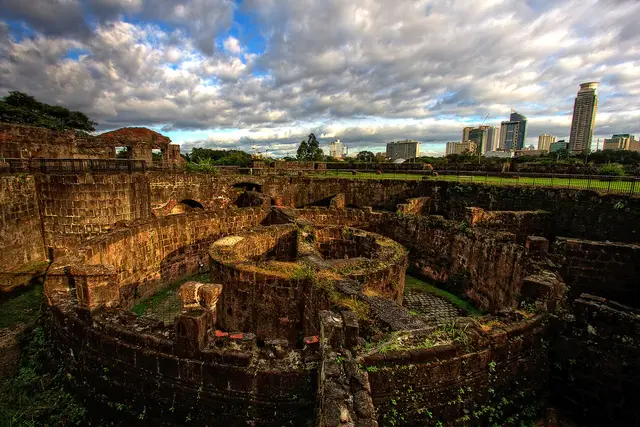
Past the gate, the path opens onto wide lawns and the fort’s outer bulwarks, where you can climb up onto the walls for a view over the Pasig River and, on clearer days, Manila Bay in the distance. Cannons still point out from the ramparts. Below, the Baluarte de Santa Barbara and the old dungeons are worth ducking into, low, damp chambers where prisoners were once held, some of them flooded at high tide in a grim design detail that’s hard to forget once you’ve seen it.
The Rizal Shrine museum is the centerpiece: expect glass cases of Rizal’s writings, personal items, and reproductions of his execution. Set aside at least 45 minutes for the museum alone, and another 45 minutes to an hour for the grounds and walls.
When to go
Fort Santiago is open daily, which makes it one of the few Intramuros sites you can visit well into the evening, when the walls are lit and the crowds thin dramatically. That said, the fort is genuinely one of Manila’s most-visited landmarks, so timing matters. On weekdays, the calmest window is 8–11am, right after opening. On weekends, get there between 8 and 10am if you want the lawns and shrine to yourself, after 3pm on Saturdays and Sundays is when things get busiest, with tour groups and families arriving in waves that can last until closing.
How to visit like a local
Go early. Because this is a heavily visited landmark rather than an under-the-radar spot, the single best move is timing, not secrecy. Arrive right at 8am on a weekday if you can, or by 10am at the latest on weekends, before the tour buses from nearby hotels unload. Bring small bills for the entrance fee (prices are modest but change occasionally, so don’t assume last year’s rate), and note that lines at the ticket booth move fastest in the morning.
Evenings after 6pm have their own appeal (cooler air, floodlit walls, far fewer people) making evening visits a legitimate alternative to the crowded daytime hours if you don’t mind seeing the museum sections closed earlier than the grounds. Wear shoes you can walk cobblestones and uneven stone steps in; the ramparts have no handrails in places.
Combine your visit with San Agustin Church or Casa Manila within Intramuros to make a half-day of it, and treat the fort itself as a place to linger rather than rush, the atmosphere, especially near the execution site at dusk, rewards slowing down.
Frequently asked questions
How much time should I budget for Fort Santiago?
Plan for 1.5–2 hours: about 45 minutes for the Rizal Shrine museum and another 45 minutes to an hour to walk the ramparts, dungeons, and grounds.
When is the quietest time to visit?
Weekdays between 8am and 11am are calmest, and on weekends the 8am–10am window is your best bet before crowds build. Avoid weekend afternoons and evenings, especially 3pm to 10pm, when it's busiest.
How do I get to Fort Santiago?
It's inside Intramuros, Manila's walled old town, near Anda Circle by the Pasig River. Taxi or ride-hailing apps direct to the gate are easiest; on foot it's about 10–15 minutes from Manila Cathedral or San Agustin Church.
What are the opening hours?
Fort Santiago is open daily from 8am to 11pm, including weekends, which makes an evening visit a good option if you want to avoid daytime crowds.
What else is nearby?
San Agustin Church, Manila Cathedral, and Casa Manila museum are all within walking distance inside Intramuros, making it easy to combine into a half-day walking itinerary.
Plan your trip to Manila
Some links above are affiliate links — if you book through them, Wander Atlas earns a small commission at no extra cost to you. It's how we keep every guide free.
Related guides
 attraction
 National Museum of Fine Arts: Manila Travel Guide (4.7★)
 attraction
 José Rizal Monument: Manila Travel Guide (4.6★)
 attraction
 Ayala Triangle Gardens: Manila Travel Guide (4.6★)
 hidden gem
 Baluarte de San Diego: Manila Travel Guide (4.5★)
More Manila guides: Rizal Park 1.6 kmLegazpi Sunday Market 6.9 kmLaLaLa Fest Manila 2026MAMAMOO 2026 World Tour