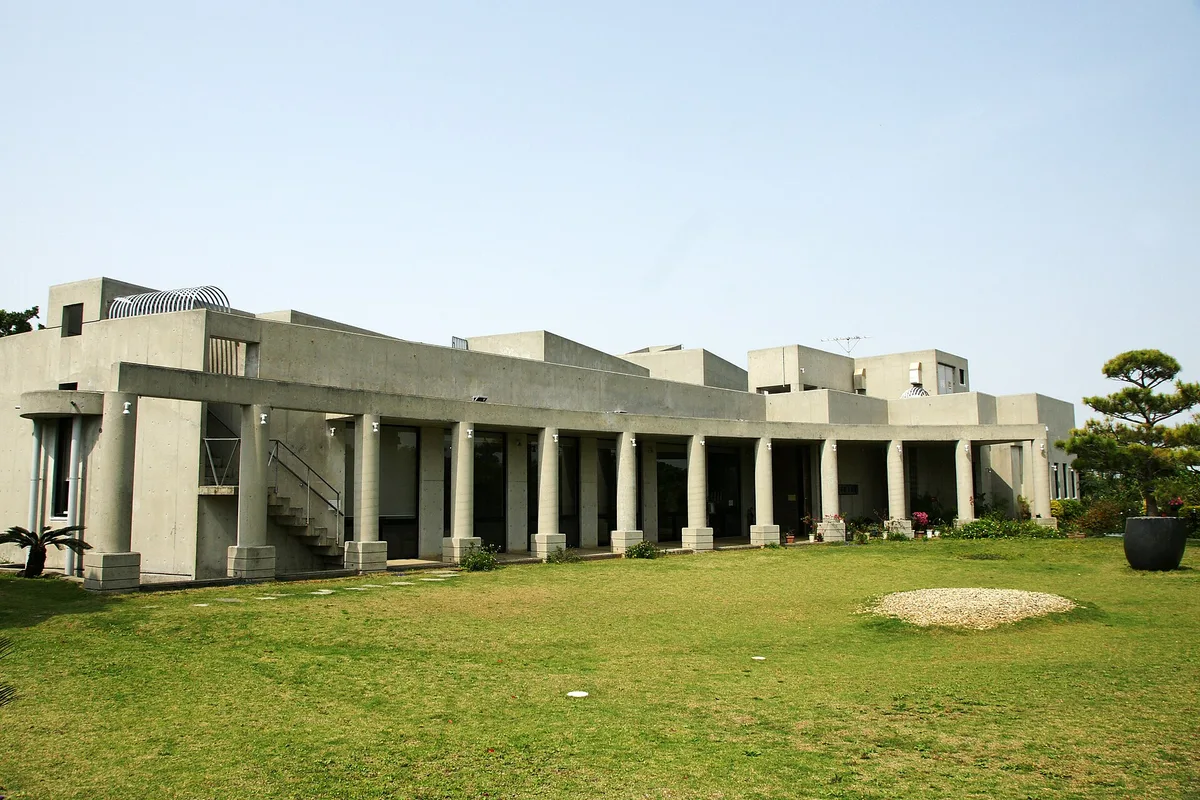
Look over the rooftop wall and there is a chain-link fence, and beyond it the runway of an American air base. That view is the reason Sakima Art Museum exists. Michio Sakima’s family had owned this land in Uehara, Ginowan, before it was absorbed into Marine Corps Air Station Futenma. He negotiated to get a piece back, and in 1994 he opened a museum on it.
It is a small place, and it doesn’t get many visitors compared with Okinawa’s beaches and aquariums. Most people who come have made the trip for one specific reason. The collection is about war, grief and memory. It isn’t a light afternoon out, but it is one of the most affecting hours you can spend on the island.
A museum carved out of Futenma
The location is the point. Ginowan grew up around Futenma, and the base takes a large bite out of the middle of the city. The museum sits right against its boundary, so the fence and the aircraft are part of the visit.
The Sakima family’s turtleback tomb, a traditional Okinawan kamekobaka, also stands on the grounds. It is a reminder that this was ancestral land before it was military land. Treat it as you would any family grave: look, but don’t climb on it or treat it as a photo prop.
In front of the Battle of Okinawa mural
The centrepiece is The Battle of Okinawa (Okinawa-sen no zu) by Iri and Toshi Maruki. The couple are best known for the Hiroshima Panels. It is a vast work, roughly four metres tall and more than eight metres wide, and it fills a wall of its own.
Up close it is crowded with bodies: civilians, soldiers and families. It draws on survivors’ accounts of the 1945 fighting, including the mass suicides in caves. Step back to the far wall first to take in the whole composition, then walk its length slowly. Many visitors sit on the bench and stay longer than they expected.
Kollwitz, Rouault and the quieter rooms
Michio Sakima collected with a theme in mind. Besides the Maruki works, the museum holds prints by Käthe Kollwitz, the German artist whose etchings of mothers, hunger and lost sons came out of two world wars. There are also works by Georges Rouault, whose heavy black outlines and suffering figures sit naturally alongside them.
Not everything is on display at once. The smaller galleries change their selections, so what you see beyond the mural varies between visits. Check the museum’s official site to see what is currently hanging.
The rooftop staircase and June 23
This is where the building stops being just a container for art. The steps up to the rooftop are aligned with the setting sun on June 23, Irei no Hi, Okinawa’s Memorial Day. That date marks the end of organised fighting in the Battle of Okinawa. The architecture makes a calendar of mourning out of concrete and light.
On any ordinary day, the rooftop is where you look out over the base and the city around it. If you’re on the island near June 23, check with the museum about any special access for the sunset alignment. Don’t assume normal hours apply that evening.
Reaching Uehara without a train
Okinawa’s only railway, the Yui Rail monorail, stays within the Naha area and doesn’t reach Ginowan. You have two realistic options:
- Rental car: this is the simplest choice. Driving north from Naha usually takes about 30–45 minutes, depending on traffic on Route 58 or Route 330. Confirm parking with the museum before you go.
- Bus: local buses from Naha Bus Terminal run toward Ginowan and Futenma. Check the current route and nearest stop on the museum’s website or a transit app, then expect a short walk through residential streets in Uehara.
- Taxi: this is practical if you’re combining the museum with other Ginowan stops, and easy to arrange from Futenma Shrine.
At the front desk and in the galleries
This is a quiet, privately run museum, and visitors behave accordingly. Here is how a visit usually goes:
- Tuesdays: at the moment the museum is closed on Tuesdays. It currently opens 9:30am–5pm on every other day, including Mondays, when many Japanese museums are shut. That makes Monday a useful day to come.
- Tickets: you buy admission at the reception desk. Fees are posted there and on the official site. If you rely on a card, ask whether they take one before you queue.
- Photos: rules can vary by room and by artwork. Ask at the desk before you raise your phone, and look for signs.
- Volume: keep your voice low in front of the mural. Some visitors are Okinawans with family connections to the battle.
- Timing: arrive by mid-afternoon at the latest. A 4pm start leaves you rushing the rooftop.
Explanatory text includes some English, but reading up on the Battle of Okinawa beforehand will give the mural far more weight. A guidebook chapter is enough.
Pairing it with the rest of Ginowan
The museum fits naturally into a half-day on the island’s wartime history and on how people live alongside the bases today. Two stops nearby are worth adding:
- Kakazu Takadai Park: a hilltop in Ginowan that was the scene of heavy fighting in April 1945. It now has an observation platform looking directly over the Futenma runway. Go there after the museum and the view takes on a different meaning.
- Futenma Shrine (Futenma-gū): one of the old Ryukyu-era shrines, with a limestone cave behind it. It’s a calmer counterpoint and close by.
For the full arc, continue south another day to the Peace Memorial Park in Itoman, where the battle ended. The Sakima mural works as the emotional introduction to that visit.
Frequently asked questions
How long should I spend at Sakima Art Museum?
Most visitors spend 1–1.5 hours. That gives you time for the Battle of Okinawa mural, the smaller galleries and the rooftop overlooking Futenma Air Station.
Is Sakima Art Museum open on Mondays?
Yes. It currently opens 9:30am–5pm Monday and Wednesday through Sunday, and it is closed on Tuesdays. Hours can change, so check the official site before you go.
How do I get to Sakima Art Museum from Naha?
There's no train to Ginowan. Driving takes roughly 30–45 minutes, depending on traffic. Local buses run from Naha Bus Terminal toward Ginowan and Futenma; check the current route and nearest stop before you leave.
What is the museum best known for?
It is best known for Iri and Toshi Maruki's large mural The Battle of Okinawa. It also holds works by Käthe Kollwitz and Georges Rouault, and the rooftop staircase is aligned with the sunset on June 23, Okinawa Memorial Day.
What else can I see nearby?
Kakazu Takadai Park, a 1945 battle site with a viewpoint over the Futenma runway, and Futenma Shrine are both in Ginowan and easy to combine with the museum.
Plan your trip to Okinawa
Japan eSIM & staying connected →
Some links above are affiliate links — if you book through them, Wander Atlas earns a small commission at no extra cost to you. It's how we keep every guide free.