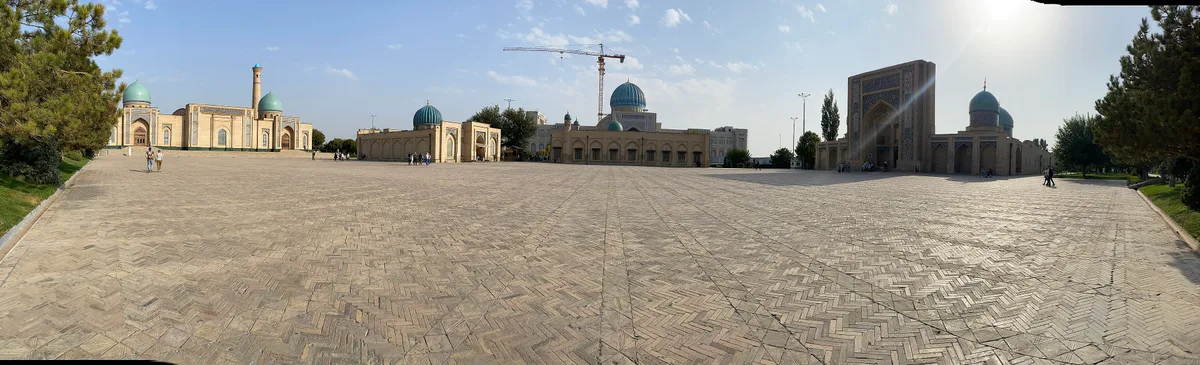
You feel the shift before you see it. The traffic noise of modern Tashkent falls away as you walk into a wide plaza framed by turquoise domes, and suddenly you’re standing somewhere that feels centuries older than the rest of the city.
Hazrati Imam complex is Tashkent’s religious center, built around the tomb of Imam al-Bukhari’s teacher, Kaffal Shashi. The current ensemble is mostly a 2007 reconstruction, but it’s built in the spirit of the older structures it replaced, and it reads as genuinely historic rather than showy.
Why it matters
This is where the Uthman Quran lives, one of the oldest Qurans in the world, kept in a quiet library room within the Muyi Muborak Madrasah. Bloodstains reportedly mark its pages, dating to the caliph’s assassination in the 7th century.
Even if you have no interest in the manuscript itself, the building housing it is worth the visit alone. Light falls through high windows onto worn stone, and the hush inside contrasts sharply with the open plaza outside.
What you’ll see
The complex is really several structures grouped together, not a single building:
- Barak Khan Madrasah – 16th-century, now partly artisan workshops
- Muyi Muborak Madrasah – houses the Uthman Quran
- Hazrati Imam Mosque – the newest and largest structure, with a soaring blue dome
- Tillya Sheikh Mosque – an older Friday mosque still used for prayer
- Kaffal Shashi Mausoleum – the tomb that anchors the whole site
Walk the perimeter first to get your bearings, then work inward toward the Quran room, which tends to have a short queue by late morning.
Getting there
The complex sits in Tashkent’s old city, a short walk from Chorsu Bazaar. If you’re coming by metro, Tashkent’s Chorsu station on the Yunusabad line is your best bet, followed by a 10-15 minute walk north through the old city streets.
Taxis and ride-hailing apps are cheap and simple if you’d rather skip the walk, especially in summer heat. Many visitors pair this stop with Chorsu Bazaar itself, since the two sit close enough to combine in a single morning.
When to go
The complex is open daily from 9am to 9pm, so there’s no need to rush at either end of the day. Early morning, shortly after opening, gives you the best light for photos and the fewest other visitors wandering the plaza.
Midday sees the heaviest footfall, particularly when tour groups from cruise itineraries or organized day trips arrive. Late afternoon is a reasonable second option, with softer light returning as the sun drops toward the domes.
Spring and autumn are the most comfortable seasons weather-wise. Summer in Tashkent gets genuinely hot, and the plaza offers little shade during the middle of the day.
How to visit like a local
Dress modestly, as this remains an active religious site, shoulders and knees covered for everyone, and a headscarf for women entering prayer areas. Shoes come off before entering the mosque interiors, so slip-on footwear saves you time.
Entry to the grounds is generally free, though the Quran room sometimes has a small separate fee. Confirm current details on arrival, since these things shift over time.
Photography is allowed in the courtyards but often restricted inside the room holding the Uthman Quran, watch for posted signs rather than assuming. Friday mornings can be busier with worshippers arriving for prayer, so plan around that if you’d rather explore without disruption.
The mistake most first-time visitors make is treating this as a quick photo stop. Slow down, sit on the plaza benches, and watch how locals actually use the space. It’s a living mosque complex, not a museum set piece.
Cash is useful for the small artisan stalls inside Barak Khan Madrasah, where woodworkers and miniature painters sell directly from their workshops. Card payment isn’t reliably accepted at these smaller stands.
Frequently asked questions
How much time should I budget for Hazrati Imam complex?
Plan on 1.5 to 2 hours to walk the plaza, visit the madrasahs, and see the Uthman Quran without rushing.
Is there an entrance fee?
The main grounds are generally free to enter, though the room holding the Uthman Quran sometimes charges a small separate fee — confirm on arrival.
What's the closest metro station?
Chorsu station on the Yunusabad line, about a 10-15 minute walk north through Tashkent's old city streets.
What should I wear?
Modest clothing covering shoulders and knees, plus a headscarf for women entering prayer areas. Shoes come off before entering mosque interiors.
When is the best time to visit to avoid crowds?
Shortly after the 9am opening is quietest. Midday tends to draw the most tour groups, so aim for morning or late afternoon.
Plan your trip to Tashkent
Some links above are affiliate links — if you book through them, Wander Atlas earns a small commission at no extra cost to you. It's how we keep every guide free.