A forest at the end of downtown
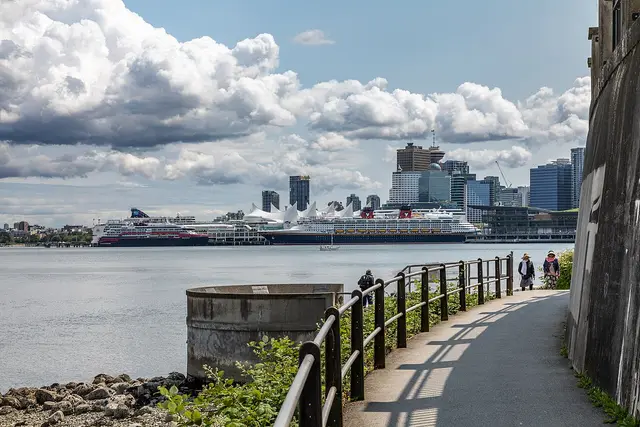
Downtown’s towers stop at Georgia Street and the forest starts. Stanley Park covers about 400 hectares and opened in 1888. Much of it is second-growth cedar, hemlock and Douglas fir, with trails cut through it. Water surrounds it on three sides: Coal Harbour, Burrard Inlet and English Bay.
The way in from the city is past Lost Lagoon. It is a shallow body of water by the Georgia Street entrance, ringed by a walking path. The North Shore mountains rise straight across the inlet.
Around the seawall
The seawall is the reason most people come. It is a paved, flat loop of roughly 9 km, with separate lanes for walkers and wheels. Going clockwise from Coal Harbour, you pass:
- Brockton Point totem poles, the most photographed stop in the park
- The Nine O’Clock Gun, a cannon that still fires every evening at 9pm
- Lions Gate Bridge, which you walk directly beneath near Prospect Point
- Siwash Rock, a basalt stack standing alone off the western shore
- Third Beach and Second Beach, sand and logs facing English Bay
Walking the full loop takes about 2.5–3 hours with stops. By bike it takes around an hour. Inland trails lead to Beaver Lake and the Hollow Tree, and the Vancouver Aquarium sits near the eastern side.

Getting there and in
From downtown you can walk in 15–20 minutes along Georgia Street or Denman Street. TransLink bus 19 runs from downtown into the park, ending at the Stanley Park Loop near the totem poles. Bike rental shops line Denman Street, a block from the entrance.
Parking inside is pay-by-zone. The current rates are posted on the machines and on the Vancouver Park Board site. Park Drive runs counter-clockwise only. At the moment the park is open 6am–10pm. Seasonal hours for the aquarium, the concessions and the attractions inside are on their own official sites.
Seawall rules and timing
Cyclists and skaters must ride counter-clockwise on the seawall, in their own marked lane. Walkers can go either way, but they keep to the inner path. The most common rental-day mistake is riding the wrong direction or drifting into the pedestrian lane, and people will tell you about it.
This is one of Vancouver’s most-visited places, so timing matters:
- Weekdays: quietest 7am–10am and again 9pm–10pm, which happens to be when the Nine O’Clock Gun fires
- Weekends: quietest 7am–9am
- Avoid: weekends 11am–8pm, when the seawall bike lane backs up and the Third Beach parking lots fill
For sunset, sit on the logs at Third Beach or Second Beach facing west. Locals bring a jacket even in summer, because the wind off English Bay cools fast once the sun drops. Leave before 10pm, when the park closes.
Frequently asked questions
When is the quietest time to visit Stanley Park?
On weekdays it's calmest 7am–10am and 9pm–10pm. On weekends, go 7am–9am. Avoid weekends between 11am and 8pm, which is the busiest stretch.
How long does it take to go around the Stanley Park seawall?
The loop is roughly 9 km. Walking it takes about 2.5–3 hours with stops, and cycling takes around an hour.
Which direction do you bike the seawall?
Cyclists and skaters must ride counter-clockwise, in the marked wheeled lane. Pedestrians use the separate inner path.
How do I get to Stanley Park without a car?
Walk 15–20 minutes from downtown along Georgia or Denman Street, or take TransLink bus 19 to Stanley Park Loop. Bike rentals cluster on Denman Street near the entrance.
What are the park's opening hours?
At the moment it's listed as open 6am–10pm. Attractions inside, like the Vancouver Aquarium, set their own seasonal hours, so check their official sites before going.
Plan your trip to Vancouver
Canada eSIM & staying connected →
Some links above are affiliate links — if you book through them, Wander Atlas earns a small commission at no extra cost to you. It's how we keep every guide free.