Museu Nacional d'Art de Catalunya: Barcelona Travel Guide
When to visit Spain: month-by-month weather, crowds and holidays →
✓ Facts verified via Google Places · Aug 28, 2026
At a glance
Opening hours
- Monday: Closed
- Tuesday: 10:00 AM – 8:00 PM
- Wednesday: 10:00 AM – 8:00 PM
- Thursday: 10:00 AM – 8:00 PM
- Friday: 10:00 AM – 8:00 PM
- Saturday: 10:00 AM – 8:00 PM
- Sunday: 10:00 AM – 3:00 PM
How this guide is made
Produced with AI assistance and reviewed against live data sources. Facts such as hours, ratings, and location come from Google Places; images are licensed or public domain. Details can change — please verify before visiting. Editorial policy
Why the Palau Nacional stops people in their tracks
You see it long before you reach it: a domed, honey-stone palace stacked at the top of a long flight of terraces and fountains, built for the 1929 International Exposition and still looking like it was designed to be photographed from below. Climb the steps (or ride the escalators that run alongside them) and the city opens up behind you, Plaça Espanya, the bullring-turned-mall Las Arenas, and on a clear day the towers of the Sagrada Família in the distance.
Most visitors are so busy turning around for the view that they nearly walk backward into the museum’s front doors.
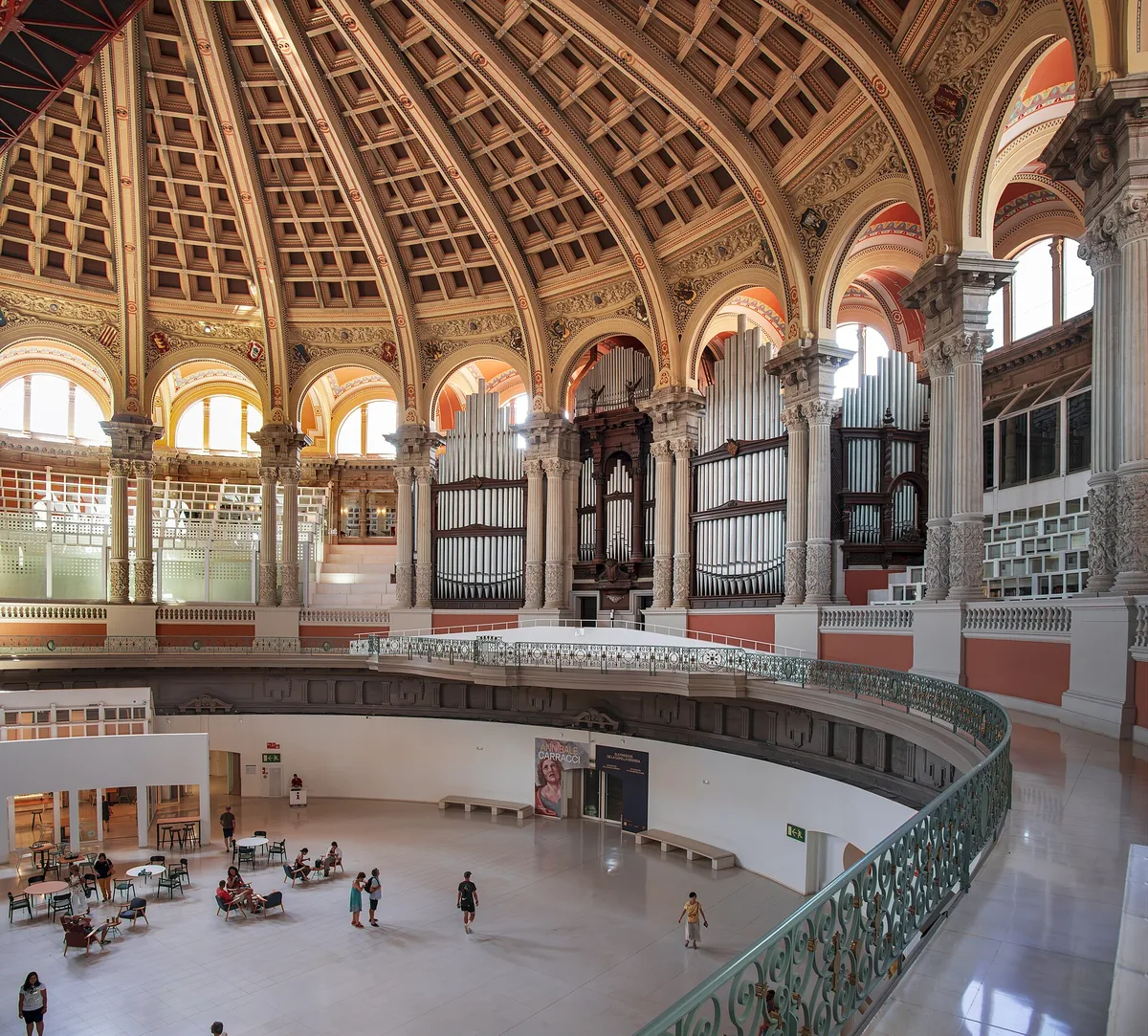
Inside, the building itself keeps performing. The domed central hall, the Oval Room, was built to host events and still gets used for concerts, its scale alone is worth a slow lap before you head into the galleries proper.
What’s actually inside
The MNAC’s reputation rests on one collection above all: its Romanesque art, a series of 11th- and 12th-century murals lifted wholesale, plaster and all, from small Pyrenean churches and reassembled here inside replica apses. Walking between them, you go from one hushed, half-lit chapel space to the next, each dominated by the same wide-eyed, elongated Christ Pantocrator figures painted in ochre, black, and deep red. It’s considered one of the most important collections of its kind anywhere, and it alone justifies the trip up the hill.
The rest of the museum moves chronologically forward: Gothic altarpieces and polychrome wood carvings, then Renaissance and Baroque painting (including a small but genuine cluster of Old Masters. Look for the Cranach and the Zurbarán), and finally the museum’s other strong suit, Catalan Modernisme. This is where you find furniture and paintings connected to Gaudí’s circle, plus a room of luminous, loose-brushed canvases by Ramon Casas and Santiago Rusiñol that capture turn-of-the-century Barcelona café life.
A separate numismatics collection and rotating photography galleries round things out on the lower floor, easy to skip if time is tight.
Getting there and timing your visit
The MNAC sits in Parc de Montjuïc, and the easiest approach is Metro Line 1 or Line 3 to Plaça Espanya, followed by a walk up through the Fira gardens and fountains, about 15 minutes on foot, mostly uphill. Bus routes 150 and 55 both stop closer to the museum entrance if you’d rather skip the climb. On weekend evenings in summer, the Font Màgica fountain show runs on the terraces directly below the museum, so arriving late afternoon lets you combine both without doubling back.
Plan on two to three hours for a proper visit, longer if you want to sit with the Romanesque murals, which reward slow looking more than quick scanning. Check the current website for the exact opening and closing times on the day you’re going, since Sunday hours in particular tend to run shorter than the rest of the week, and the museum does close for at least one day a week.
How to visit like a local
Barcelona regulars treat the MNAC as a late-afternoon outing rather than a morning box to tick: arriving two hours before closing means smaller crowds in the Romanesque rooms and softer light on the front terrace afterward. Buy tickets online in advance to skip the entrance queue, which can build on weekends and holidays. The museum is consistently one of the most-visited sights on the hill, so having a ticket already in hand saves real time.
There’s no tipping expected inside; card payment is standard at the ticket desk and café. Locals also know the trick of asking at the desk about combined access to the Oval Room events calendar and any temporary exhibition, since these sometimes require a separate or upgraded ticket. The biggest mistake visitors make is racing through the Romanesque galleries to get to the “famous” Modernisme rooms. Go slowly there instead; it’s the part of the collection you won’t find replicated anywhere else.
Nearby, while you’re up here
Montjuïc rewards lingering. The Fundació Joan Miró and the Olympic Stadium are both a short walk from the museum, and the cable car up to Montjuïc Castle gives a second, higher vantage point over the port. If your legs are still willing after the museum’s marble staircases, the walk back down through the gardens at dusk, with the fountains lit up below the palace, is its own reward.
Frequently asked questions
How do I get to the MNAC by metro?
Take Metro Line 1 or Line 3 to Plaça Espanya, then walk about 15 minutes uphill through the Fira gardens and fountains to the Palau Nacional. Buses 150 and 55 stop closer to the entrance if you'd rather avoid the climb.
How long should I spend at the museum?
Budget two to three hours for a proper visit, prioritizing the Romanesque murals and the Modernisme rooms. Add extra time if you also want to see the temporary exhibitions or linger on the terrace for the view.
What is the museum most famous for?
Its Romanesque collection — 11th- and 12th-century murals removed intact from small Pyrenean churches and reassembled in replica apses — is considered one of the finest of its kind in the world. The Catalan Modernisme galleries are its other major draw.
When is the best time to go to avoid crowds?
Aim to arrive in the late afternoon, roughly two hours before closing, when tour groups have thinned out. The museum is closed on Mondays, and Sunday hours tend to be shorter than other days, so confirm the current schedule before you go.
What else is nearby on Montjuïc?
The Fundació Joan Miró, the Olympic Stadium, and the cable car to Montjuïc Castle are all within easy walking distance, and the Font Màgica fountain show runs on the terraces below the museum on weekend evenings.
Plan your trip to Barcelona
Some links above are affiliate links — if you book through them, Wander Atlas earns a small commission at no extra cost to you. It's how we keep every guide free.
Related guides
 attraction
 Museu d Art Contemporani de Barcelona: Travel Guide (4.3★)
 attraction
 Christopher Columbus monument: Barcelona Travel Guide (4.5★)
 attraction
 Casa Batlló: Barcelona Travel Guide (4.7★)
 attraction
 Ciutadella Park: Barcelona Travel Guide (4.6★)
This spot is Day 3 of our Barcelona 3-day itinerary