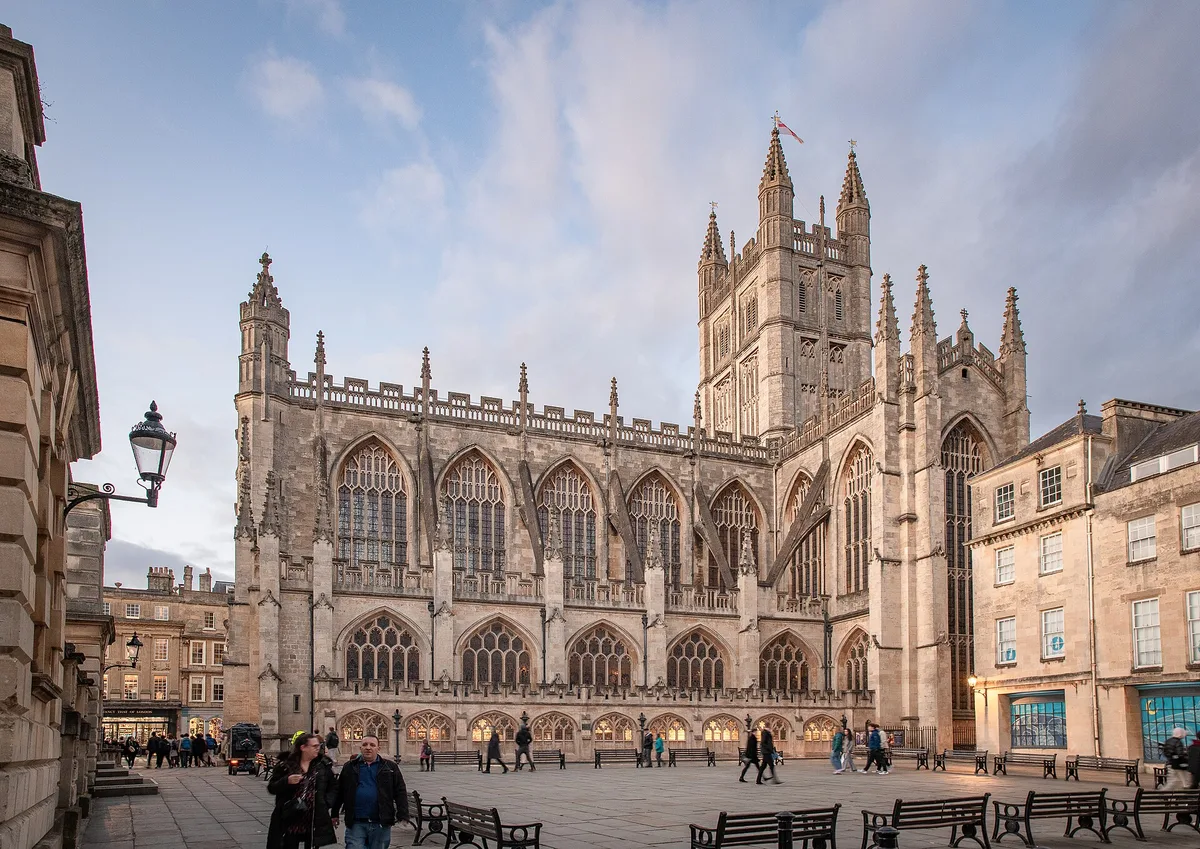
Angels on the west front
Start outside, before you go in. On the west front, carved stone angels climb ladders up the façade toward heaven. Some are going up and some are coming down.
The story says Bishop Oliver King dreamed of angels on a ladder, heard a voice telling him to rebuild, and began work in 1499. Stand in Abbey Churchyard with the Roman Baths behind you and follow the ladders up to the figure of Christ near the top. A few of the angels are climbing head first.
Inside the lantern
Through the doors the light changes. The walls are mostly glass, which is why the abbey has long been called the Lantern of the West. Its tall windows let in far more daylight than you’d expect from a church of this age.
Look up. The fan vaulting spreads overhead like stone palm fronds. The original choir vault was designed by Robert and William Vertue, the royal masons behind the vaulting in Henry VII’s Chapel at Westminster Abbey.
The nave once had a plain ceiling. In the 1860s Sir George Gilbert Scott replaced it with fan vaulting to match, so the whole roof now reads as one continuous sweep from west to east. That Victorian Gothic work is most of what you see today. The medieval shell and the 19th-century restoration fit together closely enough that most visitors never notice the seam.
The walls and floor are covered in memorials. Hundreds of tablets and ledger stones record Georgian visitors who came to take the waters and never left. Reading the inscriptions is a short course in who flocked to 18th-century Bath.
The tower climb
The tower tour is the part people book ahead for. It is guided and climbs the spiral stairs in stages, so it is built for a steady pace rather than a sprint. Along the way you’ll see:
- the bell chamber, home to the ringing bells
- a view from behind the clock face, looking out over Abbey Churchyard
- the roof of the vaulting itself, seen from above
- the open tower top, looking across Bath’s stone terraces to the hills
The steps are narrow and steep, and there’s no lift. Places are limited, and tours sell out on busy days. Check the abbey’s official website for tour times and booking, and the current price for both the tower and general entry.

Timing your visit
Bath Abbey is one of the busiest sights in a very busy city, and the crowd pattern is clear. It is calmest between 10am and 11am, on weekdays and on Saturdays alike. Try not to arrive on a weekend between 1pm and 6pm; that’s when the nave fills and the churchyard turns into a queue.
At the moment, visiting runs 10am–5pm Monday to Friday and 10am–6pm on Saturday. On Sunday it is only 1–3:30pm, so the quiet morning slot doesn’t exist that day.
This is a working church. Hours shift through the year and around services, festivals and events, so check the official site for this month’s times before you set out. Allow 45 minutes to an hour for the interior. Add the tower tour on top if you’ve booked one.
Visiting a working church
Services come first, and the building is run with that in mind. A few habits make the visit smoother:
- Book the tower online rather than hoping for a spot on the day, especially on weekends.
- Keep your voice low during prayers. Short prayers are sometimes said during visiting hours, and the room goes quiet for them.
- Worship is free to attend. Coming for a service such as Choral Evensong is a different way to hear the building, though you won’t be wandering the nave as a sightseer at that time.
- Walk over the floor. The Footprint project re-laid the old ledger stones and added underfloor heating fed by warm water from the nearby hot springs, so the stone underfoot is part of the visit.
Photography for personal use is generally welcome. Put the phone away if a service or private event starts.
Around Abbey Churchyard
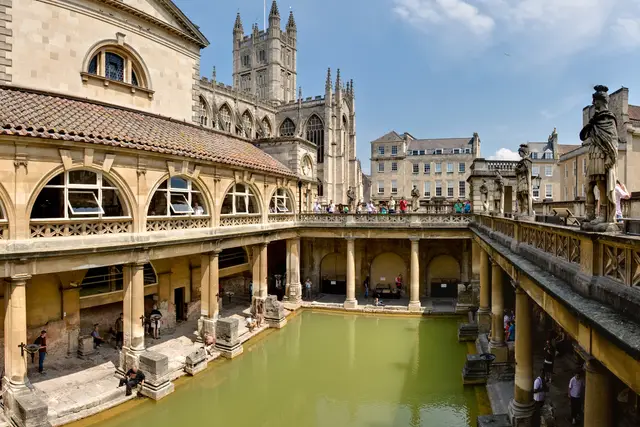
The abbey sits right at the centre of the city’s sights. The Roman Baths entrance and the Pump Room share the same paved square, and buskers often play in front of the west front. Pulteney Bridge and the River Avon are a few minutes’ walk east, with Parade Gardens just below.
Bath Spa railway station is roughly a ten-minute walk south through the pedestrian streets, so you don’t need a car. Parking in the centre is tight, and the park-and-ride sites on the edge of the city are the easier option. A sensible morning: the abbey at 10am, the tower straight after, then the Roman Baths before the afternoon crowds arrive.
Frequently asked questions
When is the quietest time to visit Bath Abbey?
Between 10am and 11am, on weekdays and on weekends. Avoid weekend afternoons from 1pm to 6pm, which are the busiest hours. On Sunday the abbey currently opens only from 1pm to 3:30pm, so Saturday is the only weekend day with a quiet morning.
How do I get to Bath Abbey from the train station?
Bath Spa station is about a ten-minute walk north through the pedestrian centre. The abbey is in Abbey Churchyard, next to the Roman Baths and the Pump Room.
Do I need to book the tower tour?
Yes, booking ahead is wise. Tours are guided with limited places and often sell out on weekends. The climb is on narrow spiral stairs with no lift. Book, and check the current price, on the abbey's official website.
How long should I spend at Bath Abbey?
Allow 45 minutes to an hour for the interior, the fan vaulting and the memorials. Add the length of the tower tour if you've booked one.
What is near Bath Abbey?
The Roman Baths and the Pump Room share the same square. Pulteney Bridge, Parade Gardens and the River Avon are a few minutes' walk east.
Plan your trip to Bath
United Kingdom eSIM & staying connected →
Some links above are affiliate links — if you book through them, Wander Atlas earns a small commission at no extra cost to you. It's how we keep every guide free.