You feel the scale of the place before you understand its geometry. Walking north from the South Gate along the raised Danbi Bridge, really a long stone causeway rather than a bridge, the ground rises almost imperceptibly beneath you, lifting you toward heaven, at least symbolically, by the time you reach the inner altars. Cypress trees, some planted more than five centuries ago, close in on either side, their bark cracked and silvered, and the traffic noise of Dongcheng District falls away behind you.
Why go
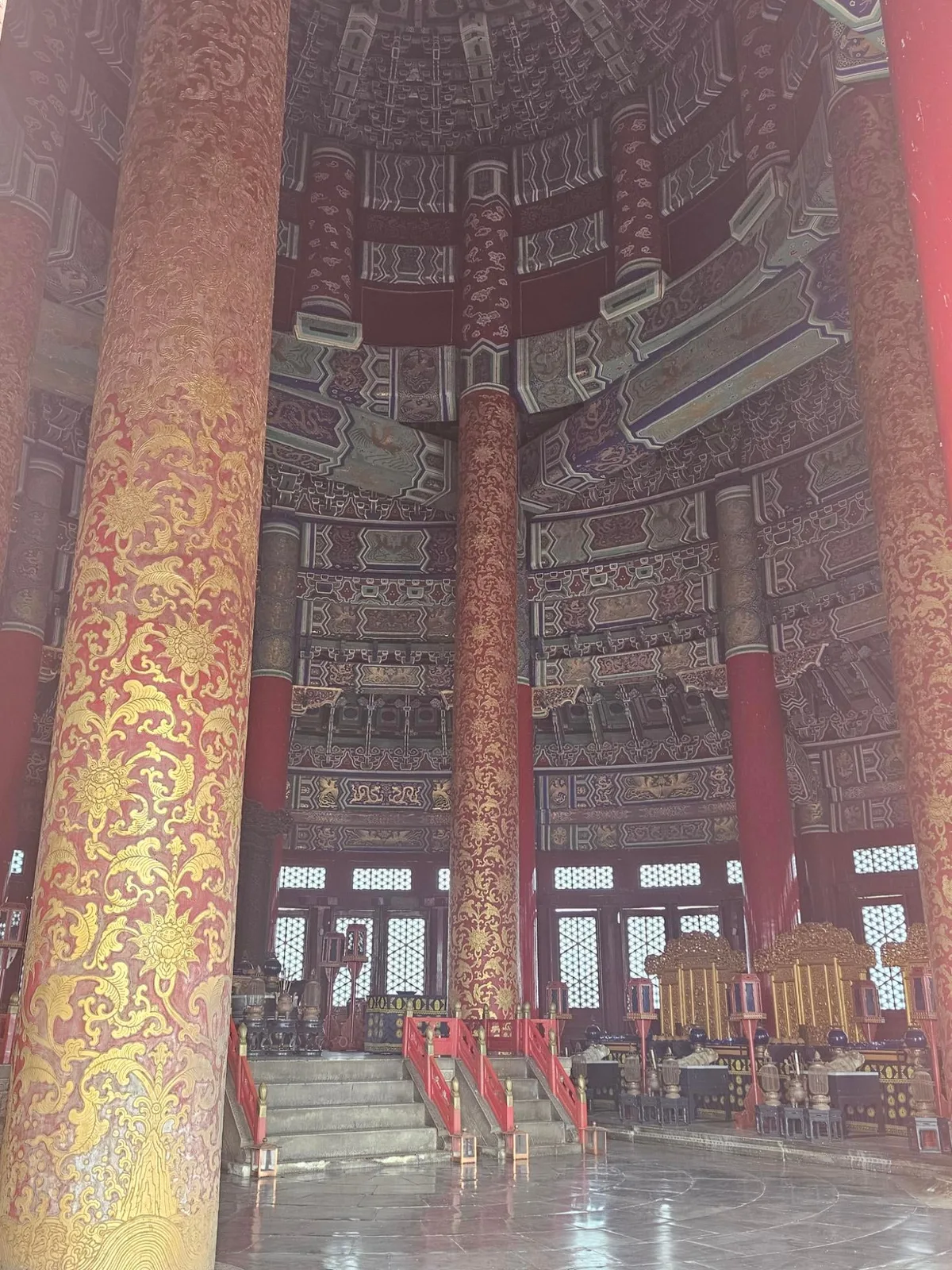
Built in 1420 during the Yongle Emperor’s reign, the Temple of Heaven isn’t a single building but a complex of altars where Ming and Qing emperors came each winter to perform rites for good harvests. Its defining structure, the Hall of Prayer for Good Harvests, is instantly recognizable: a triple-eaved circular hall in indigo blue, gold, and deep red, built entirely without a single nail, timber joinery holds the whole thing together.
The circular-versus-square design running through the complex is deliberate: round represents heaven, square represents earth, and the whole site is a physical expression of that cosmology, distinct from the rectilinear symmetry of the Forbidden City.
Getting there
The temple sits in Dongcheng District, south of the city center. Take Beijing Subway Line 5 to Tiantiandong Gate (Temple of Heaven East Gate) station, which puts you right at the East Gate. Line 8 also stops nearby. Most first-time visitors prefer entering through the South Gate to walk the historic north-south axis in its intended order (Round Altar, Imperial Vault of Heaven, Danbi Bridge, then the Hall of Prayer for Good Harvests), but any of the four gates (north, south, east, west) gets you into the park itself.

What to see and hear
Inside the Imperial Vault of Heaven courtyard, find the Echo Wall, a smooth circular enclosure where a whisper against the stone is said to carry clearly to someone standing on the opposite side, a quirk of the wall’s curvature rather than any mystical acoustics. Nearby, the Triple Sound Stones produce a distinct echo when you clap or speak from specific spots on the steps; locals test it constantly, so don’t be surprised by a small crowd doing the same.
The Round Altar itself, a three-tiered marble platform, is where the emperor once stood at the winter solstice to pray for good harvests. Beyond the monuments, the surrounding park, technically Tiantan Park, is where the complex earns its “popular park” reputation: retirees practicing tai chi, groups playing cards or Chinese chess under the cypresses, and choirs singing revolutionary-era songs in the open air, especially on weekend mornings.
When to go
Early morning, shortly after opening, is calmest. This is also when the park’s social life is most visible, since that’s when local residents come to exercise. Spring (April–May) and autumn (September–October) bring mild temperatures and clearer skies; summer is hot and humid, winter is dry and cold but atmospheric, with fewer crowds around the marble terraces. Budget two to three hours minimum; add another hour if you want to sit in the park itself rather than just tour the monuments.
How to visit like a local
Buy your ticket in advance if possible, a combined ticket covers entry to the park and the inner sites (Hall of Prayer, Echo Wall, Round Altar), while a cheaper park-only ticket exists but won’t get you into the main halls, which trips up a lot of first-timers. Payment on-site and at nearby vendors is almost entirely by mobile apps (Alipay or WeChat Pay) these days, so have one set up before you arrive rather than relying on cash.
This is a well-visited, well-known landmark rather than an under-the-radar spot, so the real local skill is timing: arrive right at opening or after 4pm to avoid the tour-group crush that peaks midmorning through early afternoon. Keep your voice low inside the halls, this remains an active place of cultural and quasi-religious significance, not just a photo backdrop. Wear comfortable shoes for the walk between gates; the complex is larger than it looks on a map, and the distance from South Gate to North Gate alone is close to a kilometer.
Frequently asked questions
How do I get to the Temple of Heaven by subway?
Take Beijing Subway Line 5 to Tiantiandong Gate (Temple of Heaven East Gate) station, which lets you out right at the East Gate; Line 8 also serves the area nearby.
How much time should I plan for a visit?
Two to three hours covers the main axis (South Gate, Round Altar, Imperial Vault, Hall of Prayer for Good Harvests); add extra time if you want to sit in the surrounding park like local visitors do.
Do I need a special ticket to enter the halls?
Yes — a park-only ticket exists but won't admit you to the inner monuments. Buy the combined ticket that includes the Hall of Prayer for Good Harvests, Echo Wall, and Round Altar.
When is it least crowded?
Right at opening in the early morning, or after about 4pm, are calmest; tour groups tend to fill the site from mid-morning into early afternoon.
What's nearby if I want to combine this with another sight?
The Temple of Heaven sits south of the Forbidden City and Tiananmen Square along Beijing's historic axis, making it easy to pair with a full day exploring central Dongcheng District.
Plan your trip to Beijing
China eSIM & staying connected →
Some links above are affiliate links — if you book through them, Wander Atlas earns a small commission at no extra cost to you. It's how we keep every guide free.