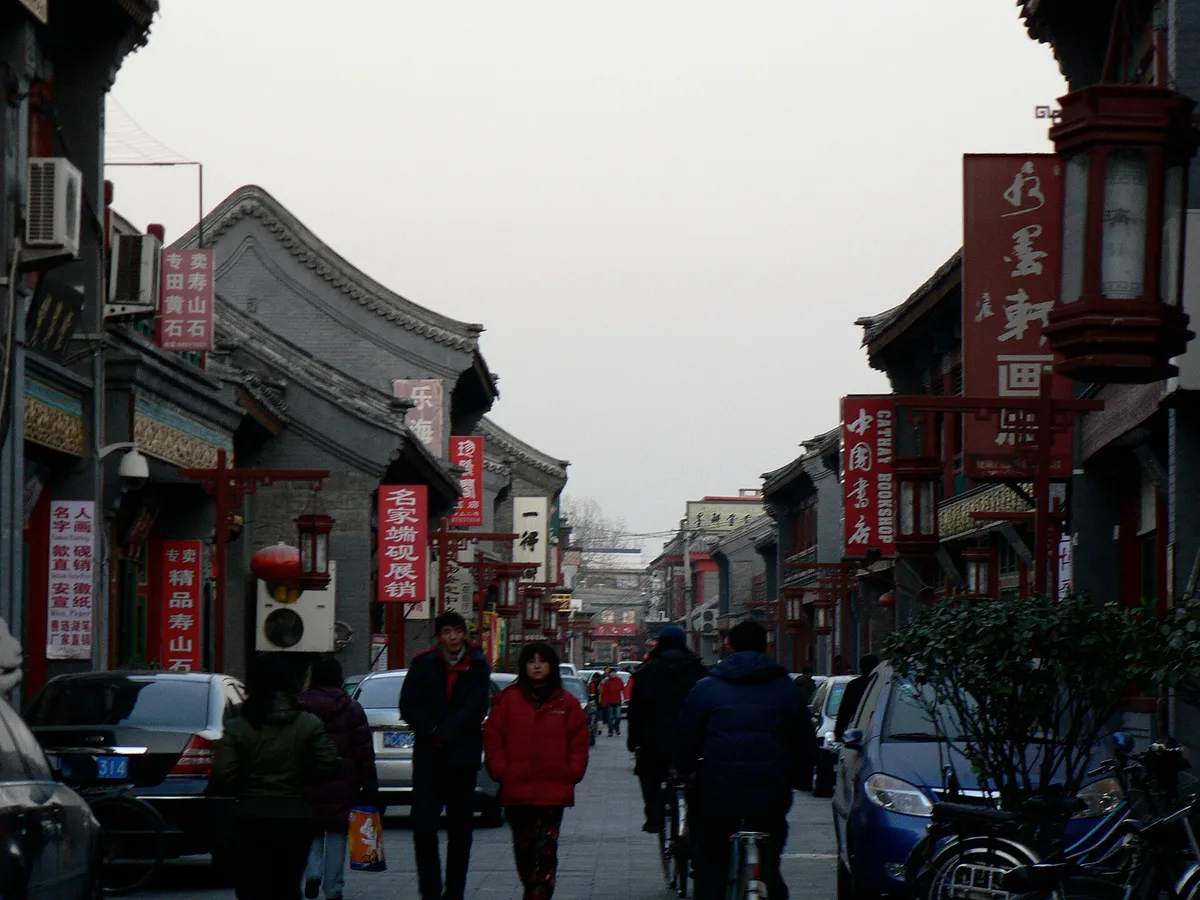
A street named for roof tiles
The name tells you where the street started. Liulichang means “glazed tile works”. In the Ming dynasty, kilns here fired the coloured roof tiles used on imperial buildings across the city.
The kilns moved out long ago. In the Qing dynasty, scholars in Beijing for the imperial examinations lodged in this part of the Outer City, and booksellers followed them. Dealers in paintings, rubbings and antiques came after the books. Today the street still trades in those same things.
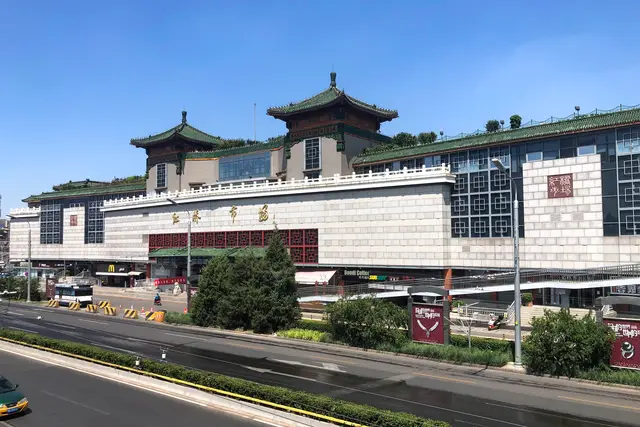
What you walk through now is mostly a rebuilding from around 1980. It has grey-brick shopfronts, painted eaves and carved wooden signboards, and lacquered name plaques hang over the doors. It is a reconstruction rather than the original fabric. Still, the trade inside is real, and it is centuries old.
East and West, split by a main road
Nanxinhua Street cuts across Liulichang and splits it in two. You get West Liulichang on one side and East Liulichang on the other. You cross at the traffic lights, and the halves feel different enough to be worth seeing both.
Here is what you are walking past:
- Shops selling brushes, hanging on racks by size, from fine hair-thin tips to brushes as thick as a wrist
- Stacks of rice paper and xuan paper, sold by the sheet or in bundles
- Carved inkstones and ink sticks in presentation boxes
- Seal-carving stalls, where a name can be cut into a stone chop
- Scroll paintings, calligraphy and reproduction woodblock prints
- Antique and curio shops full of jade, ceramics, bronzes and old coins
The pace is slow. You won’t find the crowds of the big Qianmen shopping streets here. Most shops are narrow, one-room affairs, and browsing without buying is normal.
Rongbaozhai and the four treasures
If you step into one shop, make it Rongbaozhai. It is the best-known name on the street and has been selling painting and calligraphy supplies for well over a century. It is also known for its woodblock watermark printing, a craft used to reproduce classical Chinese paintings.
Chinese scholars called brush, ink, paper and inkstone the “four treasures of the study” (wenfang sibao). Liulichang is the best place in Beijing to see them sold side by side, in every grade from student practice sets to collector pieces. A decent brush or a small seal makes a gift that is light to carry and has a clear link to this street.

Bargaining among the brushes
Shopping here works by a few simple rules. Learn them before you reach for your phone.
- Pay by phone. Alipay and WeChat Pay are standard, and both now accept many foreign cards once linked. Some bigger shops take bank cards. Small stalls may not.
- Haggle in the antique shops, not the stationers. Supply shops and places like Rongbaozhai usually have fixed, marked prices. In curio shops, the first price is an opening move.
- Assume “antique” means reproduction. Most of the old-looking pieces are modern. Buy something because you like it, not as an investment. Genuine antiques need paperwork to leave China legally.
- Ask before photographing inside. Many owners don’t mind, but paintings and seal-carvers at work are a courtesy question.
- Watch a seal being carved. Tell the carver your name, or have a Chinese version written for you, and agree the price before the knife touches the stone.
A few words of Mandarin help: duōshao qián? (how much?) and piányi yìdiǎn (a little cheaper).
Getting there, and where to walk next
The easiest route is the subway. Take Line 2 to Hepingmen Station. Leave on the south side and walk south along Nanxinhua Street for about ten minutes, until the traditional shopfronts start on both sides.
From East Liulichang the lanes lead east into the Dashilan (Dashilar) area. There you’ll find old pharmacies, silk shops and Yangmeizhu Xiejie, a narrow lane of small boutiques and cafés. Carry on and you reach Qianmen Street, with Qianmen gate and Tiananmen Square beyond. The whole walk makes an easy half-day on foot.
How long, and when
Most visitors need an hour or two for Liulichang itself. Serious calligraphy buyers can easily spend longer. Shops keep their own hours and nobody publishes a single schedule, so check before you make a special trip.
Daytime is the time to go, because shop owners tend to shut up in the evening. Weekdays are usually calmer than weekends, when Beijing families and art students come to shop.
Spring and autumn are the easiest seasons for walking between Liulichang and Dashilan. Winter works too. Most of the browsing happens indoors, and the grey lanes look good in low sun.
Frequently asked questions
How do I get to Liulichang by subway?
Take Line 2 to Hepingmen Station, leave on the south side and walk south along Nanxinhua Street for about ten minutes. The street runs off both sides of that road as East and West Liulichang.
How long should I spend at Liulichang?
An hour or two covers both halves of the street at a browsing pace. Add a couple more hours if you walk on through Dashilan to Qianmen Street.
Are the antiques at Liulichang real?
Most old-looking items are modern reproductions, so buy what you like rather than as an investment. Genuine antiques need official paperwork to be taken out of China.
What is worth buying at Liulichang?
Calligraphy brushes, ink sticks, inkstones, xuan paper, woodblock prints and a hand-carved name seal are the classic buys. Rongbaozhai is the best-known shop for painting and calligraphy supplies.
What is near Liulichang?
Dashilan and Yangmeizhu Xiejie are a short walk east, and Qianmen Street and Qianmen gate are just beyond them. Tiananmen Square is further north past Qianmen.
Plan your trip to Beijing
Some links above are affiliate links — if you book through them, Wander Atlas earns a small commission at no extra cost to you. It's how we keep every guide free.