Lama Temple: Beijing Travel Guide (4.7★)
When to visit China: month-by-month weather, crowds and holidays →
✓ Facts verified via Google Places · Sep 19, 2026
At a glance
Opening hours
- Monday: 9:00 AM – 5:00 PM
- Tuesday: 9:00 AM – 5:00 PM
- Wednesday: 9:00 AM – 5:00 PM
- Thursday: 9:00 AM – 5:00 PM
- Friday: 9:00 AM – 5:00 PM
- Saturday: 9:00 AM – 5:00 PM
- Sunday: 9:00 AM – 5:00 PM
How this guide is made
Produced with AI assistance and reviewed against live data sources. Facts such as hours, ratings, and location come from Google Places; images are licensed or public domain. Details can change — please verify before visiting. Editorial policy
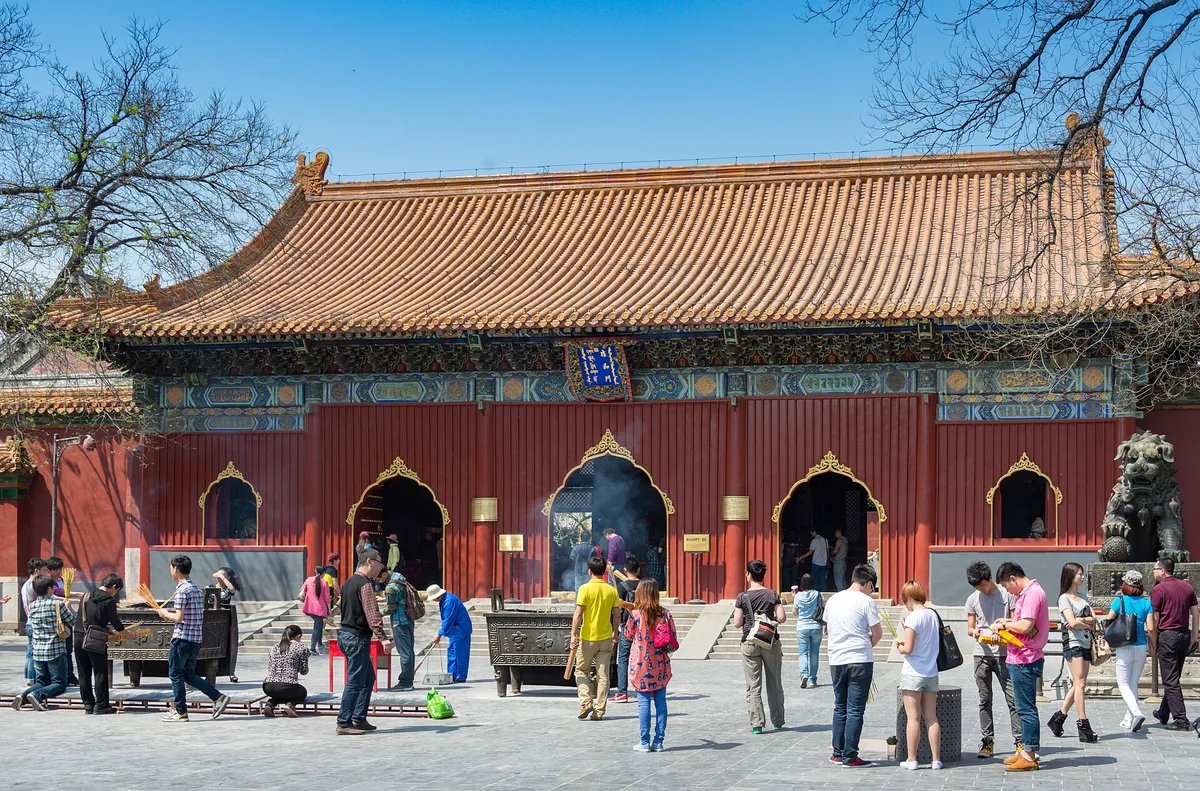
Yonghegong, known in English as the Lama Temple, is the largest and most complete Tibetan Buddhist monastery outside Tibet proper still functioning inside a major Chinese city. It began in 1694 as a residence for court officials, later became the boyhood home of the Yongzheng Emperor, and was converted to a lamasery in 1744. That imperial pedigree explains the yellow-glazed roof tiles, normally reserved for the palace, and the scale of the halls that follow one after another down a long north-south axis.
You enter from the south through a sequence of gates and courtyards that get progressively grander, a deliberate architectural build-up mirroring the Forbidden City’s own layout a couple of kilometers south. Incense smoke drifts across the courtyards from large bronze burners where visitors light bundles of sticks before each hall. The smell of sandalwood and the murmur of chanting from resident monks give the place a working-temple atmosphere rather than a museum one.
The five halls, one after another
The complex is organized as a straight line of five main halls, each larger than the last.
- Hall of the Heavenly Kings – the entry hall, guarded by the four Heavenly Kings and a smiling Maitreya Buddha
- Hall of Harmony and Peace – the main hall, with three bronze Buddha statues representing past, present and future
- Hall of Everlasting Protection – smaller, once the private quarters of the Yongzheng Emperor
- Hall of the Wheel of the Law – home to a large bronze statue of Tsongkhapa, founder of the Gelug school
- Pavilion of Ten Thousand Happinesses – the finale, housing an 18-meter sandalwood Maitreya Buddha carved from a single tree trunk
That last statue is listed in Guinness World Records for the largest single-piece sandalwood carving anywhere, and the pavilion’s roof was actually built up around it after the wood arrived from Tibet, since it was too tall to fit through the door.
The single-tree Buddha and why the roof is odd
Stand back in the courtyard before entering the final pavilion and look at the roofline: it’s noticeably taller and more elaborate than the halls before it, a giveaway that the building was engineered around this one statue rather than the other way around. Inside, the Buddha rises through three stories, visible from a narrow gallery on the upper floor if you want a closer look at the face and crown.
Photography rules are stricter in this hall than elsewhere in the complex, so check the posted signage before raising a phone.

When to go
Lama Temple opens daily from 9am to 5pm, with last entry typically around 4:30pm. Arriving right at 9am is the surest way to walk the courtyards with some breathing room before tour groups arrive later in the morning. The complex is popular enough that midday, especially on weekends and around Chinese New Year, gets genuinely crowded around the main incense-burning stations.
Late afternoon, after about 3:30pm, is the other quiet stretch, though you’ll want to move briskly to see all five halls before closing. Weekday mornings outside major holidays remain a reasonably calm option even at a well-known site like this one.
Lighting incense the right way
Incense burning here isn’t a photo prop, it’s an active devotional practice, and following the same steps as everyone else around you keeps things running smoothly.
- Buy or collect incense sticks near the entrance rather than bringing your own
- Light three sticks at a time (a number with symbolic weight in Chinese Buddhist practice) at the designated burners, not at random spots
- Hold the sticks with both hands, bow once toward each hall, then place them upright in the burner’s sand or ash
- Move in the same direction as the crowd around each courtyard rather than cutting across
Nobody will stop a visitor doing this slightly wrong, but watching for a beat before joining in avoids bumping into someone mid-bow.
Getting there and getting around
The temple has its own subway stop, Yonghegong Lama Temple, served by Lines 2 and 5, with an exit that puts you almost directly across from the main entrance gate. This makes it one of the easiest major sights in Beijing to reach without a taxi or rideshare.
Just across the street sits the Confucius Temple and Guozijian, the old imperial academy, on the hutong-lined lane the address references. Pairing the two makes sense: the contrast between Yonghegong’s incense-thick devotional energy and the quiet, scholarly courtyards of the Confucius Temple next door is worth the extra half hour. Guozijian hutong itself is worth a slow walk, lined with old grey-brick courtyard walls and small shops.
Planning around the crowds and the calendar
Because Yonghegong remains an active place of worship, it draws large crowds of devotees, not just sightseers, especially on the first and fifteenth days of the lunar calendar month and around Chinese New Year, when incense burning intensifies dramatically. If your visit happens to land on one of those dates, expect a much thicker crowd and plan for extra time or consider shifting to another day if you’re mainly after a quieter architectural visit.
Outside those peak dates, the site’s popularity is steady rather than overwhelming, and a two-hour visit on an ordinary weekday still feels unhurried. Wear layers you don’t mind smelling faintly of incense smoke by the time you leave; it clings to fabric more than most visitors expect.
Frequently asked questions
How do I get to Lama Temple by subway?
Take Line 2 or Line 5 to Yonghegong Lama Temple station; an exit leads almost directly to the main entrance on Yonghegong Dajie.
How long should I spend at Lama Temple?
Plan on 90 minutes to two hours to walk through all five halls, including time to burn incense and look around the final pavilion.
What is the quietest time to visit?
Right at opening (9am) or after about 3:30pm tend to be calmer than midday, especially on weekends and around Chinese New Year.
What else is nearby worth seeing?
The Confucius Temple and Guozijian imperial academy sit directly across the street on the same hutong, and pair well with a Lama Temple visit.
Do I need to buy my own incense to burn?
No, incense sticks are available to buy near the entrance; visitors typically light three sticks at a time at the designated burners in each courtyard.
Plan your trip to Beijing
Some links above are affiliate links — if you book through them, Wander Atlas earns a small commission at no extra cost to you. It's how we keep every guide free.