One block, laid in stone
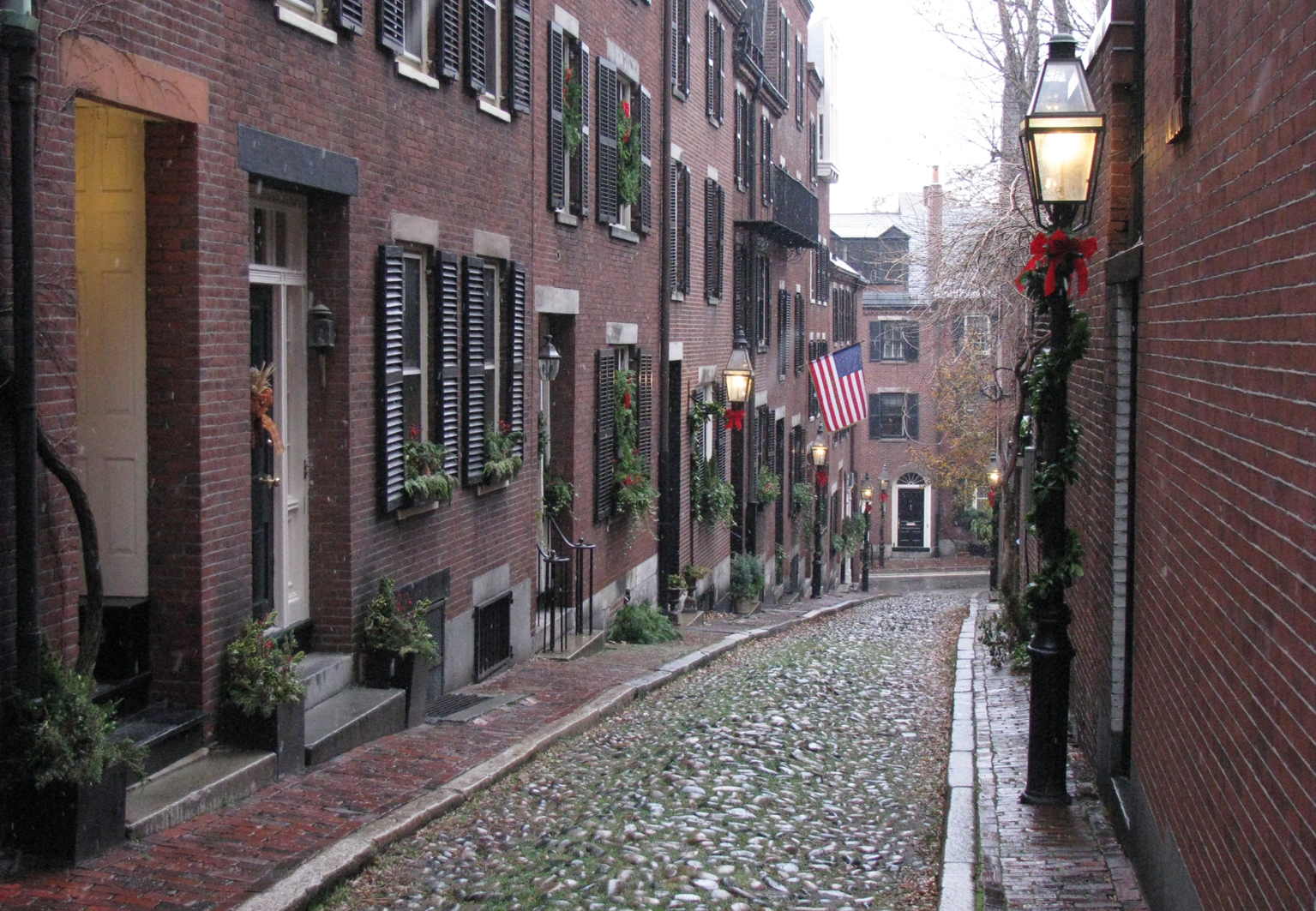
Acorn Street is short enough to take in from one end. Two rows of red-brick houses face each other across a lane barely wider than a carriage. Underfoot, rounded stones sit tight together, set lower than the brick sidewalks on either side.
The houses have black shutters, painted doors and brass hardware. Window boxes and seasonal wreaths are up to the residents, so the look changes through the year. Iron lamps are mounted along the walls. Look down the slope and the lane frames a sliver of the streets below.
Who built it, and for whom
The lane dates from the early 19th century, when Beacon Hill was being laid out as a place for Boston’s wealthy families. The grand houses went up on Chestnut Street and Mount Vernon Street nearby. Acorn Street was a service lane.
Its narrow houses are generally described as homes for the coachmen and household workers of those larger properties. That is why everything feels so compact. Today these are private homes, among the most sought-after addresses on the Hill.
Getting up the hill
You reach Acorn Street on foot. There is no parking to speak of on Beacon Hill, and the lane is far too narrow for a coach to stop in, so take the T.
- Charles/MGH (Red Line): the closest station. Walk south down Charles Street, then turn uphill on Chestnut Street or Mount Vernon Street. Willow Street and West Cedar Street both run into Acorn.
- Park Street (Red and Green Lines): cross the top of Boston Common past the Massachusetts State House, then drop west through the streets of the Hill.
- Arlington (Green Line): walk through the Public Garden and cross Beacon Street to climb in.
Beacon Hill is steep, and the brick sidewalks buckle where tree roots push up. The stones on Acorn Street itself are uneven and slick when wet. Shoes with some grip matter here more than usual, and even more so after a winter freeze.
Photographing a street people live on
Every photo of the lane you’ve seen was taken from someone’s doorstep. The houses are occupied, and the people inside come and go, walk dogs and take in deliveries all day. Keep that in mind and your visit goes smoothly.
- Stay off the steps and stoops. Don’t lean on doors, railings or window boxes.
- Leave doorways and the narrow sidewalks clear. Step aside quickly when a resident needs to pass.
- Skip the tripod and the big group shoot. The lane has no spare width, so a setup blocks it completely.
- Keep your voice down. Sound carries between facing brick walls, especially early.
- Take the shot and move on. Two minutes is plenty for the classic downhill view.
Your best chance of an empty lane is early morning, before daily life on the Hill picks up. Low sun also lights the brick better than harsh midday light does. Autumn and the December holidays, when doors get wreaths, are the most photogenic seasons.
Stretching it into a Beacon Hill walk
On its own, Acorn Street takes a quarter of an hour. The good part is how much is within five minutes of it. Build a loop:
- Louisburg Square: a private, fenced green ringed by bowed brick townhouses, just uphill between Mount Vernon and Pinckney Streets.
- Mount Vernon Street: wide and grand, the street the service lanes were built to serve.
- Charles Street: the flat street at the foot of the Hill, lined with antique shops, cafés and small groceries. It’s the place to sit down afterwards.
- Massachusetts State House: the gold dome at the top of the Hill, facing Boston Common.
- Black Heritage Trail: it starts on the Hill’s north slope and traces Boston’s 19th-century free Black community and the abolitionist movement.
- Boston Common and the Public Garden: the green open space at the bottom, a natural finish.
Allow an hour or two for the loop, depending on how often you stop. The Freedom Trail also passes the State House, so you can easily start or finish your route there.
Why it still feels like a find
Acorn Street is famous in photographs, yet in person it’s easy to walk right past. It’s tucked between two quiet side streets, and there’s no sign or ticket booth. Many visitors to Beacon Hill stick to Charles Street and the Common without ever turning in. Arrive early, walk it slowly from top to bottom, and you’ll often have the stones mostly to yourself.
Frequently asked questions
What is the nearest T station to Acorn Street?
Charles/MGH on the Red Line is the closest. Walk down Charles Street and turn uphill on Chestnut or Mount Vernon Street to reach Willow or West Cedar Street, which both meet Acorn. Park Street (Red and Green Lines) also works via Boston Common and the State House.
How long should I spend on Acorn Street?
The lane itself takes 15 to 20 minutes. Most people pair it with Louisburg Square, Mount Vernon Street and Charles Street for a one to two hour walk around Beacon Hill.
What's the best time of day to photograph Acorn Street?
Early morning is best. The lane is usually emptier, and the low light is kinder to the brick. Autumn and the December holidays, when many doors have wreaths, are the most photogenic seasons.
Can I park near Acorn Street?
Realistically, no. Beacon Hill has very little parking, and the lane is too narrow to stop in. Take the T to Charles/MGH or Park Street and walk up.
Are the houses on Acorn Street open to visitors?
No. They are private homes. Stay on the lane, keep off steps and stoops, and leave doorways clear for the residents.
Plan your trip to Boston
Some links above are affiliate links — if you book through them, Wander Atlas earns a small commission at no extra cost to you. It's how we keep every guide free.