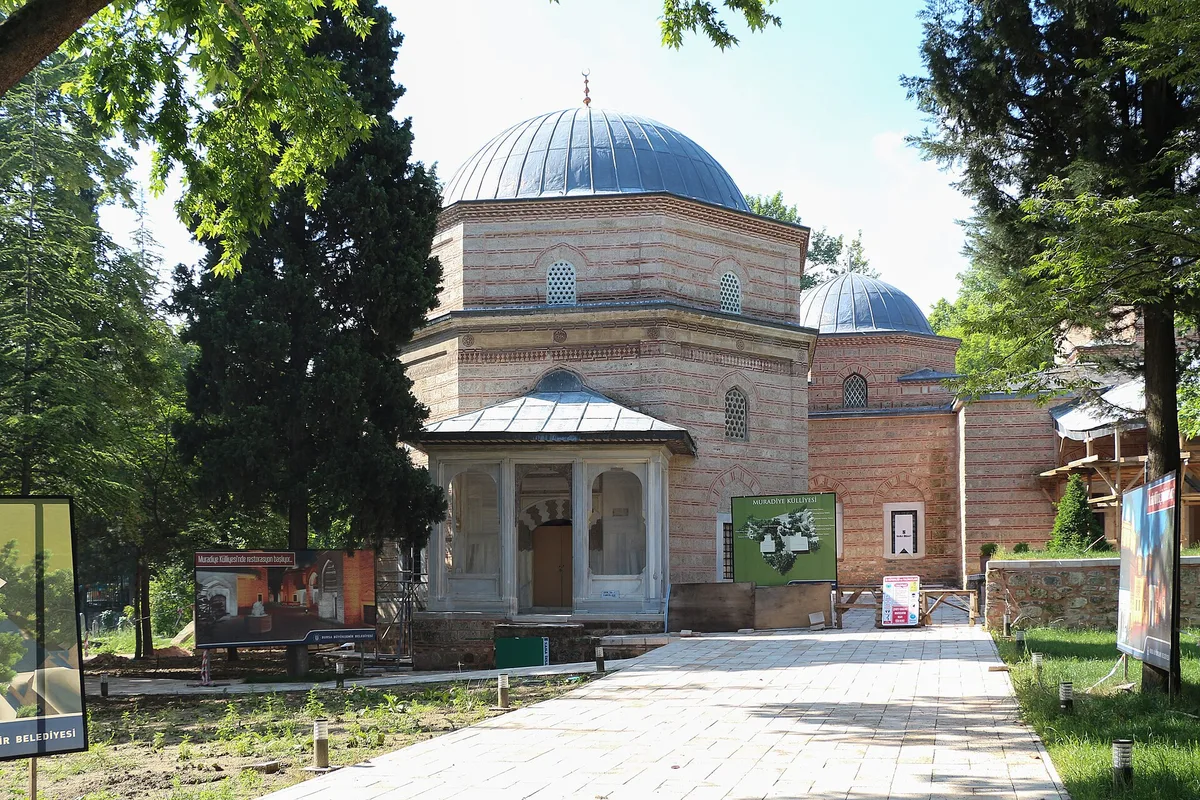
A garden full of princes
Behind the wall, the street noise drops away. Murad II founded this complex in the 1420s: a mosque, a madrasa, a bathhouse and a soup kitchen. Over the following century it became a dynastic burial ground, and a dozen domed tombs now stand among cypresses and clipped shrubs.
Most of the people buried here are princes. Several of them lost the brutal Ottoman succession struggles, and walking from one tomb to the next is a lesson in how the early empire handled rival heirs. The complex is one of the sites listed under UNESCO’s “Bursa and Cumalıkızık: the Birth of the Ottoman Empire” inscription from 2014.
The tombs worth slowing down for
Four tombs reward most of your attention. Each has its own personality.
- Murad II’s tomb. It is the plainest building here, and he wanted it that way. The sultan asked for a simple grave open to the sky, so an opening in the dome lets rain fall straight onto it.
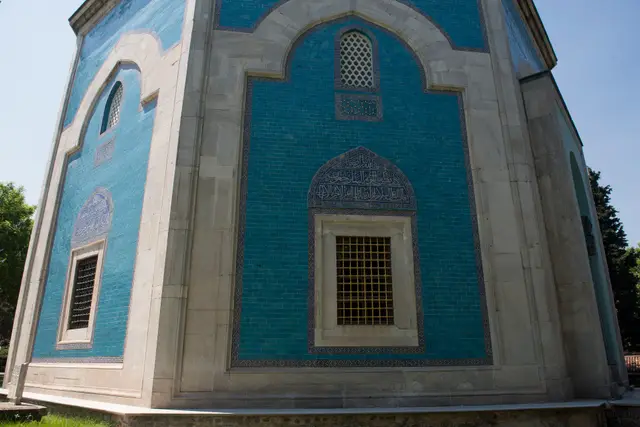
- Şehzade Mustafa’s tomb. This is the son of Süleyman the Magnificent, executed in 1553. His tomb is lined with İznik tiles in blues and turquoise.
- Cem Sultan’s tomb. Cem was Mehmed II’s son, who spent years in exile in Europe. His walls are covered in painted decoration rather than tile.
- Şehzade Ahmed’s tomb. It is another tile-rich interior, and the contrast with Murad’s bare dome is the point.
Some tomb doors are kept shut and opened by a custodian. If one is closed, ask at the nearest open tomb rather than assuming it is off limits.
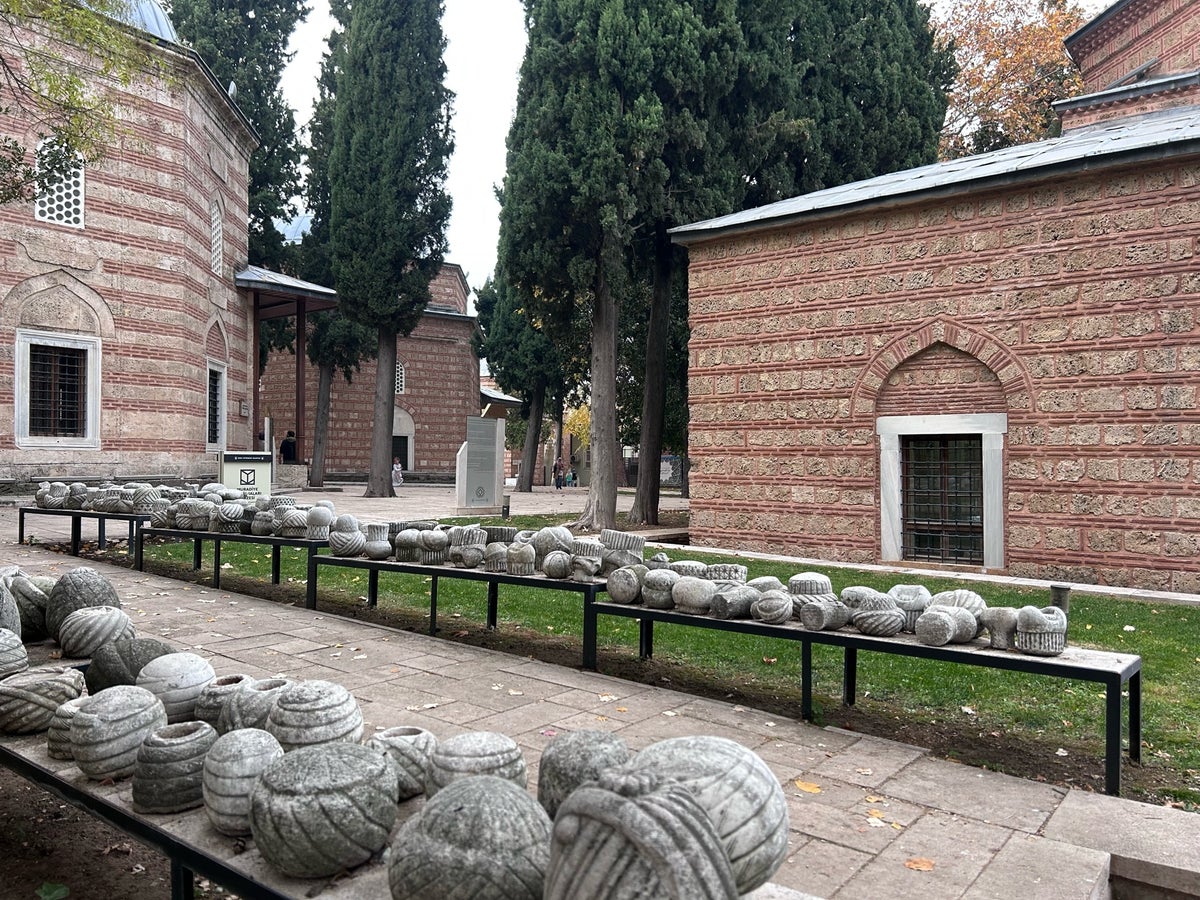
Shoes off, voice down
These are graves and a working mosque, so treat them as sacred space.
- Take off your shoes at the threshold of the mosque and of every tomb. Plastic shoe covers or racks are usually provided at the door.
- Women should cover their hair, and everyone should cover shoulders and knees. A light scarf in your bag solves this.
- Photography is generally fine. Skip the flash and step aside for anyone praying at a grave.
- Stay out of the mosque during prayer times, especially the Friday midday prayer, when the hall fills.
Entry to the mosque is free. If there is a ticket for the tomb area, the price is posted at the gate. A donation box near the tombs is a common sight at Turkish religious sites, and giving is optional.
When the courtyard is calm
Timing makes a big difference here. The site currently opens 8am–6pm every day of this week’s schedule. Hours at historic sites shift through the year, though, so check the Bursa municipality or museum listings for the current month.
It is usually calmest from 8am to 11am on both weekdays and weekends. Try not to arrive between 1pm and 6pm on weekends: that is when local families and tour groups typically pack the paths, and the queues at the small tomb doors get slow. An early start also catches the softer light under the trees.
Getting there from the centre
The Muradiye district sits on a slope west of Bursa’s old core. You can walk there from the Tophane area, where the tombs of Osman and Orhan Gazi stand, in roughly 20–25 minutes. The walk climbs gently through residential streets.
Taxis from the Ulu Camii area are short and cheap. City buses and dolmuş minibuses marked “Muradiye” also run up the hill. The address to show a driver is Prf. Dr. Halil İnalcık Sokak, Osmangazi.
Around the complex
The streets directly around Muradiye keep some of Bursa’s best-preserved Ottoman timber houses. Pair your visit with one of these:
- The Ottoman House Museum (Osmanlı Evi Müzesi). It sits on the square just in front of the complex, in a restored 17th-century house.
- Hüsnü Züber House. This is a nearby wooden mansion known for its carved woodwork collection.
- Tophane and the tombs of Osman and Orhan. Here you can see where the dynasty’s founders lie, and it makes a logical first stop on the way.
- Çekirge. The thermal-spa district lies further west if you want a hamam afterwards.
A sensible half day runs like this: Tophane at opening, the walk over, Muradiye before 11am, then tea in one of the small cafés on the square.
Frequently asked questions
When is the quietest time to visit the Muradiye Complex?
It is usually quietest from 8am to 11am on both weekdays and weekends. Avoid weekend afternoons from 1pm to 6pm, which are typically the busiest.
What are the opening hours?
At the moment the site opens 8am–6pm every day. Hours at historic sites can change with the season and on holidays, so check the official listing for the current month. The mosque also pauses for prayer times.
How long should I spend there?
Allow 1–1.5 hours to see the mosque and the main tombs of Murad II, Şehzade Mustafa, Cem Sultan and Şehzade Ahmed. Add another hour if you visit the Ottoman House Museum across the square.
How do I get to Muradiye from central Bursa?
Walk about 20–25 minutes west from the Tophane area, where the tombs of Osman and Orhan are, or take a short taxi ride. City buses and dolmuş minibuses marked Muradiye also go up the hill.
Is there a dress code?
Yes. Cover your shoulders and knees, women should cover their hair, and you remove your shoes before entering the mosque or any tomb.
Plan your trip to Bursa
Turkey eSIM & staying connected →
Some links above are affiliate links — if you book through them, Wander Atlas earns a small commission at no extra cost to you. It's how we keep every guide free.