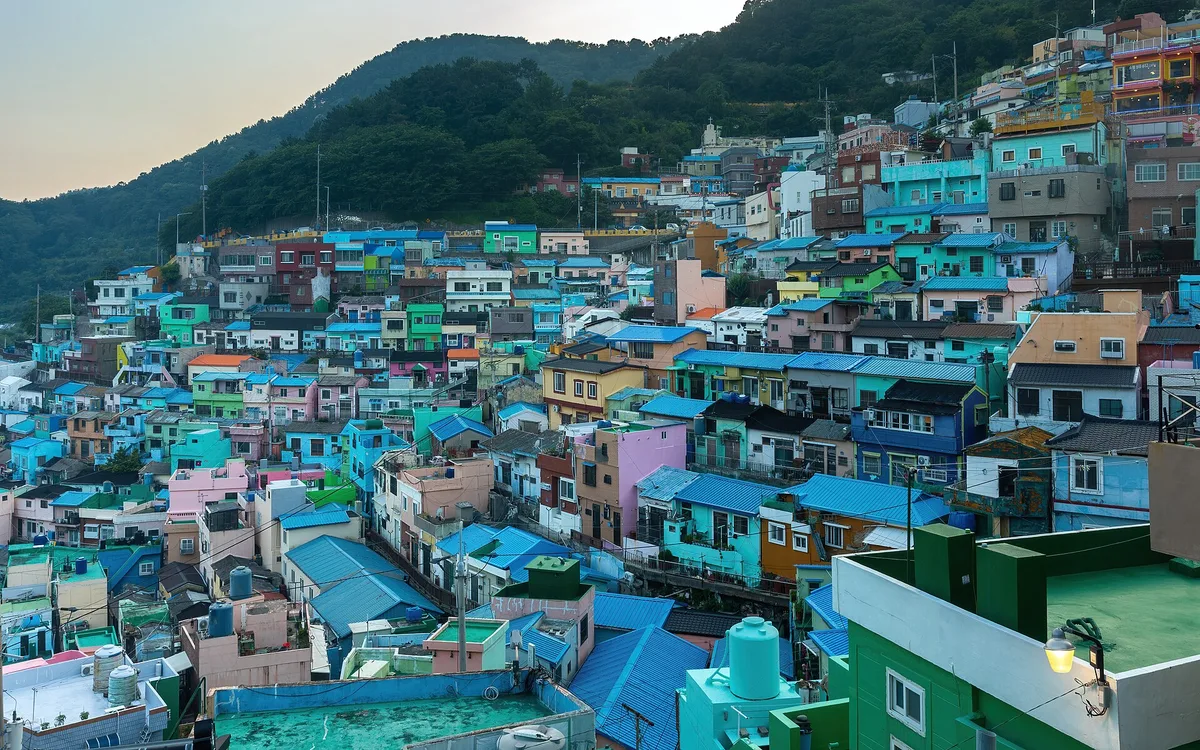
Why go
Gamcheon Culture Village earns its 4.4-star rating and near-33,000 reviews for good reason: it’s one of the most photogenic corners of Busan, a hillside maze of blue, pink, and yellow houses stacked above the harbor, laced with painted stairways, murals, and pocket-sized galleries. The village began as a refugee settlement in the 1950s (many residents were followers of the Taegeukdo religion who fled during the Korean War), and its current identity as an “art village” dates to a 2009 public arts project that invited students and artists to repaint facades and install sculptures throughout the maze of alleys.
It’s not a museum piece, people still live here, which gives the murals and rooftop views a lived-in texture you don’t get in a purpose-built attraction.
Getting there
The village sits at 203 Gamnae 2-ro, Saha-gu, on a steep hillside inland from Busan’s coast. The most reliable route is Busan Metro Line 1 to Toseong Station, Exit 6, then either a short taxi ride (roughly 10 minutes) or the local Saha-gu shuttle/village bus that loops up toward the entrance, signs and taxi stands near the exit point toward Gamcheon.
Several city buses (including routes that stop at “Gamcheon Culture Village” or “Gamcheon Elementary School”) also run from Toseong and nearby Jagalchi/Nampo areas; a taxi is worth the small fare given how steep the walk up is. Because the site is one large open-air neighborhood rather than a gated attraction, there’s no single “front door”, most visitors enter near the information center at the top of the main road and work downhill.

What to see and do
Start at the information center to pick up (or buy, if still offered) a stamp-tour map, a self-guided trail linking painted walls, small sculptures, and photo spots, including the well-known Little Prince and fox statue overlooking the rooftops. Wander the narrow stepped alleys (labeled with directional fish or star markers) to find murals, tiny craft shops, and independent cafés tucked into former homes.
The Gamcheon Culture Village Art Space and several small galleries display work from resident and visiting artists, most charge a small admission or request a donation. Rooftop viewpoints scattered through the village give sweeping views over the terraced houses down to the harbor; sunset and the “blue hour” just after are especially flattering for photos. Budget 2–3 hours minimum; photographers and slow wanderers can easily spend half a day.
When to go
Weekday mornings are calmest, before tour buses and photo groups arrive. Late afternoon, roughly 90 minutes before sunset, gives warm light on the pastel walls without the midday crush. Spring (cherry blossoms nearby) and autumn offer the most comfortable walking weather for the hill’s many stairs; summer is hot and humid with little shade, and winter can be windy on exposed viewpoints. Weekends and Korean public holidays draw the heaviest crowds. Expect queues at the most Instagrammed mural spots.
How to visit like a local
Treat this as a residential neighborhood first, attraction second: keep voices down in the narrow lanes, don’t peer into open doors or windows, and stay off private stairs and rooftops that aren’t marked as public viewpoints. Most cafés, shops, and small galleries accept card or mobile payment (T-money and standard Korean card readers are common), though carrying some cash helps for tiny stalls and donation boxes at galleries.
There’s no ticket booth or entry fee for the village itself, only optional paid sites like the small museum spaces, so skip anyone offering to “sell” general admission. The biggest visitor mistake is arriving mid-morning to early afternoon on a weekend and getting stuck in single-file lines at the two or three most famous mural corners; walking the stamp trail counterclockwise or starting from the bottom of the hill often bypasses the worst bottlenecks.
Wear real walking shoes. The entire village is stairs and sloped alleys, and rain makes the tile-painted steps slick.
Nearby
Combine the visit with Jagalchi Fish Market or Nampo-dong’s shopping streets, both roughly 15–20 minutes away by taxi, or Songdo Beach and its cliff skywalk a short ride further along the coast.
Frequently asked questions
How do I get to Gamcheon Culture Village without a car?
Take Busan Metro Line 1 to Toseong Station, use Exit 6, then catch a short taxi or the local village bus/shuttle up the hill — it's too steep and far to comfortably walk from the station.
Is there an entrance fee?
The village itself is free to walk through since it's a residential neighborhood; only specific small galleries or museum spaces inside may charge a small admission or request a donation.
How much time should I budget?
Plan on 2–3 hours to follow the stamp map and see the main mural spots and viewpoints; photographers or slow explorers can spend 4+ hours.
When is it least crowded?
Weekday mornings right after opening, or roughly 90 minutes before sunset, are calmest. Weekends and Korean public holidays are the busiest.
What else is nearby?
Jagalchi Fish Market and Nampo-dong's shopping streets are about 15–20 minutes away by taxi, and Songdo Beach with its coastal skywalk is a bit further along the coast.
Plan your trip to Busan
South Korea eSIM & staying connected →
Some links above are affiliate links — if you book through them, Wander Atlas earns a small commission at no extra cost to you. It's how we keep every guide free.
Related guides
This spot is Day 1 of our Busan 3-day itinerary