
The steps where a government ended
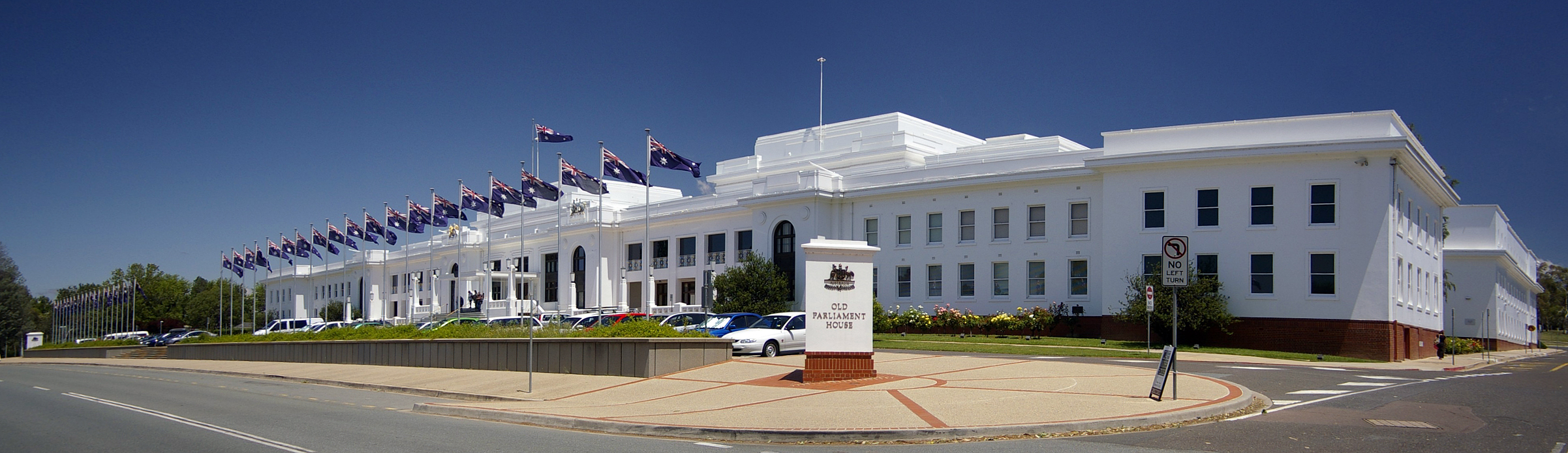
Start outside, on the front steps. In November 1975, Gough Whitlam stood here after his government was dismissed and told the crowd that nothing would save the Governor-General. Those steps face down the land axis toward Lake Burley Griffin. Behind you, the flagpole of the current Parliament House rises from Capital Hill.
The building is long, low and painted white. People often call it the wedding cake. It opened in 1927 as a temporary home for Parliament, then served for 61 years until Parliament moved up the hill in 1988. Today it holds the Museum of Australian Democracy, at 18 King George Terrace in Parkes.
Inside the chambers
The rooms still look as though a sitting has just adjourned. That is the main reason to come. You walk on the floors where national budgets were argued, wars were debated and prime ministers rose and fell.
Places to find once you are inside:
- King’s Hall, the timber-panelled central foyer just past the entrance
- The House of Representatives, upholstered in green leather, following Westminster tradition
- The Senate, in red, on the other side of King’s Hall
- The Prime Minister’s suite, kept with period office furniture
- The press gallery corridors, where journalists worked in cramped rooms above the chambers
The museum exhibitions fill the spaces around these rooms. They deal with voting, protest and how Australian democracy works, and many are hands-on, which suits children better than you might expect.
Across the road: the Tent Embassy
Step back out the front door and look across the lawns. The Aboriginal Tent Embassy has stood there since 1972, making it one of the longest-running protest sites in the world. It is a living site with a permanent presence, not an exhibit.
Seeing the two together is the point. One side holds the formal machinery of government. The other is a continuing challenge to it. Many visitors walk over after the museum. If you do, treat it as you would someone’s home: be respectful and ask before taking photos of people.
Timing your visit
The doors open at 9am and close at 5pm every day of the week, with the same hours on weekends. Most people need two to three hours to see the chambers and the main exhibitions properly. Allow longer if you join a guided tour or have children who stop at every interactive display.
Weekdays are quiet right through opening hours, from 9am to 5pm. Weekends are mostly calm too, with one exception: 12pm to 3pm is the busiest window. Arrive at opening on a Saturday or Sunday and you will have seen the chambers before the lunchtime crowd fills them.
Moving through the Parliamentary Triangle
Getting here is simple, and it fits easily into a day of museums. The building sits in the Parliamentary Triangle, south of the lake. From the city centre it is a walk of roughly 30 to 40 minutes across Commonwealth Avenue Bridge. Transport Canberra buses also run from the City interchange toward Parkes and the Parliament area.
If you drive, there is paid parking around the Triangle, and the signs show how it is charged. Check the current rate on the meter or app before you leave the car.
Within walking distance:
- National Portrait Gallery and National Gallery of Australia, both beside the lake
- Questacon, the science centre, a good choice with kids
- National Library of Australia, west along the lakeshore
- Old Parliament House Rose Gardens, on either side of the building
- Parliament House, up the hill behind you, where you can watch Parliament sit today
Getting the most from King’s Hall onward
This is one of Canberra’s most visited museums, and it rewards a plan. Admission details and tour times are on the Museum of Australian Democracy’s official website. Check there before you go, because this guide does not list prices.
A few habits help:
- Join a guided tour. Guides open doors and tell the stories behind the chambers, which the signage alone cannot do.
- Do the chambers first. Exhibitions change, but the House and Senate are why you came, and they are quietest early.
- Sit on the benches where you are allowed to. Seeing the chamber from a backbencher’s seat makes the room’s scale clear.
- Save the rose gardens for last. They are a calm place to sit after a few hours indoors.
Australians usually pay by card or tap-and-go, and the café and shop work the same way. Tipping is not expected.
Frequently asked questions
When is the quietest time to visit Old Parliament House?
Weekdays are quiet right through opening hours, 9am to 5pm. Weekends are generally calm too, but 12pm to 3pm is the busiest window, so arrive at 9am on a Saturday or Sunday.
What are the opening hours?
Every day of the week, 9am to 5pm, with the same hours on weekends.
How long should I spend there?
Two to three hours covers the House of Representatives, the Senate, King's Hall, the Prime Minister's suite and the main exhibitions. Allow longer if you join a guided tour.
How do I get to Old Parliament House from the city centre?
Walk about 30 to 40 minutes across Commonwealth Avenue Bridge to Parkes, or take a Transport Canberra bus from the City interchange toward the Parliamentary Triangle. Paid parking is available nearby if you drive.
What else is nearby?
The Aboriginal Tent Embassy is on the lawns opposite. The National Portrait Gallery, National Gallery of Australia, Questacon, the National Library and today's Parliament House are all within walking distance.
Plan your trip to Canberra
Some links above are affiliate links — if you book through them, Wander Atlas earns a small commission at no extra cost to you. It's how we keep every guide free.
Related guides
 attraction
 National Museum of Australia: Canberra Travel Guide (4.5★)
 attraction
 Australian War Memorial: Canberra Travel Guide (4.8★)
 attraction
 National Arboretum: Canberra Travel Guide (4.7★)
 restaurant