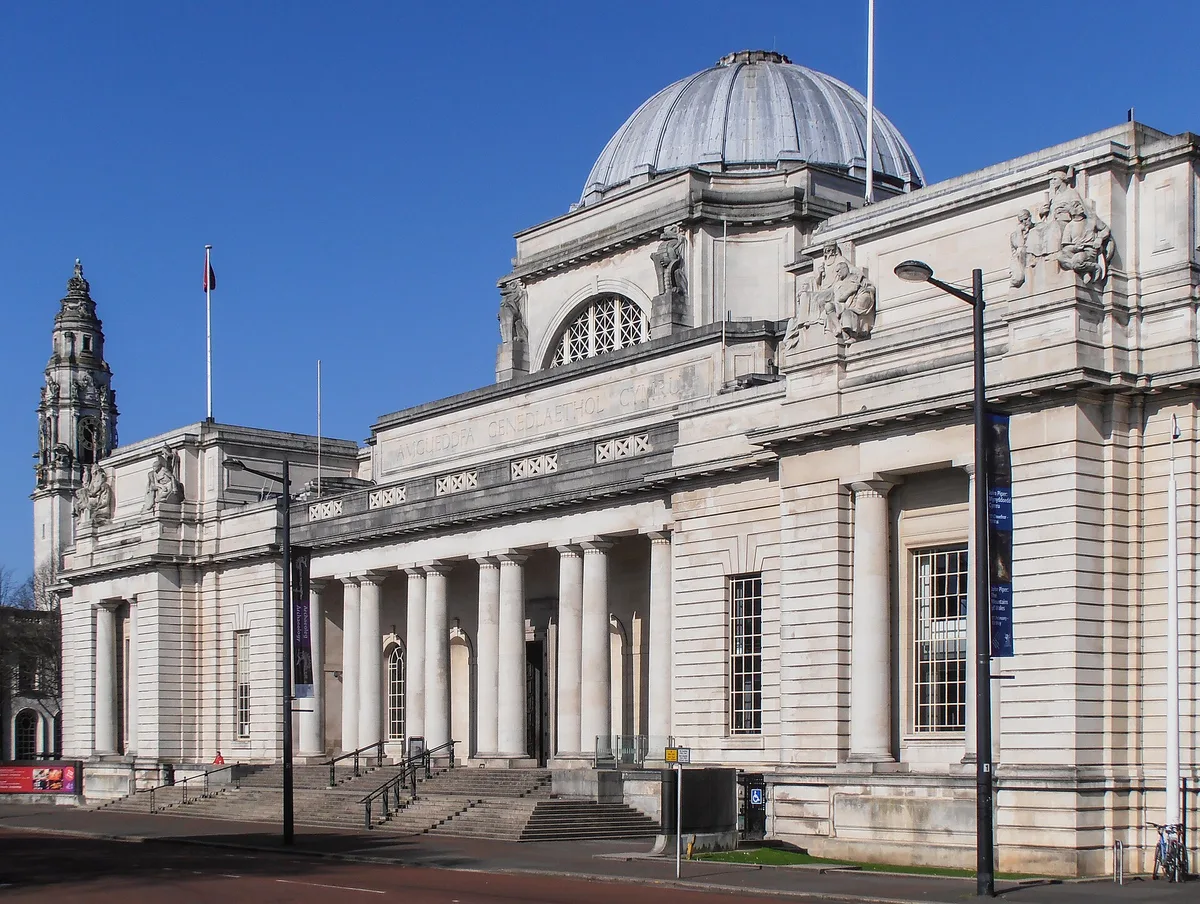
Cross the lawns of Cathays Park and the museum stands to your left of City Hall, both in pale Portland stone. It has a columned portico and a copper-green dome. The two buildings were designed to read as a pair. Together they make up the Edwardian civic centre Cardiff built when it was at its richest.
A palace for Wales on Cathays Park
The museum opened in the 1920s. Its Welsh name, Amgueddfa Genedlaethol Caerdydd, is on the signs beside the English one, and every label inside is bilingual. Through the doors is a tall domed main hall with marble floors and balconies. Most visitors stop here to work out which way to go.
The editorial line sums it up well: archaeology, art and natural history, plus visiting exhibitions, all in one grand setting. It is one of the most-reviewed attractions in the city and is consistently well rated. Expect company, especially on wet days, when half of Cardiff seems to come indoors.
Upstairs: the Davies sisters’ paintings
The art galleries are the reason many people come. Gwendoline and Margaret Davies were granddaughters of a Welsh coal and railway magnate. They bought French Impressionist and Post-Impressionist work early, then left it to the nation. Their bequest is the core of one of the best collections of its kind in Britain.
Paintings to look for:
- Renoir, La Parisienne, the full-length woman in blue, often called “The Blue Lady”
- Monet’s water lilies and his views of Rouen Cathedral and Venice
- Van Gogh, Rain at Auvers, painted in the last weeks of his life
- Cézanne landscapes and still lifes
- Rodin bronzes, including a version of The Kiss
Around these are galleries of Welsh art. Look for Gwen John and Augustus John, and for Richard Wilson’s eighteenth-century landscapes. Older Welsh portraits and silver round them out.

Downstairs: dinosaurs, mammoths and a turtle
The natural history floors run as a single walk, the Evolution of Wales. It starts with the Big Bang and rocks billions of years old. Then come dinosaur skeletons and Ice Age mammoths, with models standing in moody lighting. Children tend to drag adults through this part first.
Near the marine displays hangs the leatherback turtle found on Harlech beach in 1988, recorded as the largest ever found. Its size stops most people. The archaeology galleries trace Wales from early settlers through the Romans, with gold and bronze work that is easy to walk past too quickly.
Getting to Cathays Park
The address is Cathays Park, Cardiff CF10 3NP. From the city centre it is an easy walk.
- Cardiff Queen Street station: roughly a 10–15 minute walk north-west
- Cathays station: the closest stop, a few minutes’ walk from the back of the civic centre
- Cardiff Central: about 20 minutes on foot through the shopping streets
- From Cardiff Castle: cross the road at the castle’s north-east corner and walk up past the Gorsedd Gardens
Parking in the civic centre is limited and the city centre is compact. Unless you need a car for access, walking or the train is simpler.
Using the free entry well
Because general admission costs nothing, you don’t have to see everything in one visit. Many Cardiff residents drop in for an hour to see one gallery and leave. You can do the same: pick a floor, see it properly, and come back another day. Temporary exhibitions are sometimes ticketed, so check the official site for what is on and whether it needs booking.
Practical habits that help:
- There is a donation box by the entrance. Contributing is optional, but people do give.
- Ask at the front desk for a floor plan. The galleries loop in ways that are easy to get lost in.
- Large bags may need to go in the cloakroom. Travelling light makes the stairs and lifts easier.
- In term time, school groups use the natural history floors, so the art galleries are often the calmer place to start.
- Last-minute arrivals lose out. The doors currently close at 5pm, so arriving after 3:30pm leaves too little time for both floors.
The museum is currently closed on Mondays, which catches visitors out. Opening hours can change on bank holidays and in some seasons, so check Amgueddfa Cymru’s website for this month’s times.
After the museum: the rest of the civic centre
Just outside the doors are the Gorsedd Gardens, a small circle of standing stones among flower beds. City Hall is next door, and the Welsh National War Memorial stands in Alexandra Gardens just behind. Cardiff University’s main building fills the north side of the park.
Walk south and Cardiff Castle is a few minutes away, with Bute Park running along the River Taff behind it. With the museum, castle and park you have a full day without catching a single bus.
Frequently asked questions
How long should I spend at National Museum Cardiff?
Two to three hours covers the Impressionist galleries upstairs and the Evolution of Wales natural history walk downstairs. Since general admission is free, you can also split it over two shorter visits.
Is National Museum Cardiff open on Mondays?
No. At the moment it is closed on Mondays and open Tuesday to Sunday, 10am–5pm. Hours can change around holidays, so check the official Amgueddfa Cymru website before you go.
What is the nearest train station?
Cathays station is the closest. Cardiff Queen Street is about a 10–15 minute walk, and Cardiff Central is about 20 minutes on foot.
What are the highlights of the collection?
Renoir's La Parisienne, Monet's water lilies, Van Gogh's Rain at Auvers and other paintings left by the Davies sisters. Downstairs are dinosaur and mammoth displays and the giant leatherback turtle found on Harlech beach in 1988.
What else is nearby?
City Hall and the Gorsedd Gardens are next door, the Welsh National War Memorial is in Alexandra Gardens behind them, and Cardiff Castle and Bute Park are a short walk south.
Plan your trip to Cardiff
United Kingdom eSIM & staying connected →
Some links above are affiliate links — if you book through them, Wander Atlas earns a small commission at no extra cost to you. It's how we keep every guide free.