A king in gold, mid-stride
He wears a Roman breastplate and no helmet. Augustus the Strong, Elector of Saxony and King of Poland as August II, sits on a rearing horse covered in gold leaf. The whole figure stands on a tall stone plinth in the middle of Neustädter Markt.
Behind you, the Augustusbrücke runs south across the Elbe toward the Altstadt. In front of the horse, the plane-tree avenue of Hauptstraße heads north. The statue sits on the hinge between Dresden’s two halves, and most visitors reach it on foot, coming off the bridge.
Dresdeners call it the Goldener Reiter. The name is on tram maps, café signs and postcards, so it’s worth knowing.
The man under the gilt
Augustus earned his nickname partly from stories of his physical strength. Mostly, though, he’s the ruler who turned Dresden into a Baroque showpiece. The Zwinger and much of the court splendour across the river come from his reign, along with the collecting habit that later filled the Green Vault.
The statue went up in 1736, a few years after his death. Jean Joseph Vinache designed it and the court smith Ludwig Wiedemann made it, hammering it out of copper and gilding it. He’s shown as a Roman Caesar, the standard way for an absolutist ruler to present himself at the time.
Its survival is part of the story. The statue was taken down and stored during the Second World War, so it missed the 1945 firebombing that flattened the city centre around it. A full restoration and fresh gilding finished in 2003, and that’s why it still shines like new metal.
Gold leaf and the low sun
The gilding is the reason to come, and it changes with the light. Gold leaf is thin enough to look dull under flat grey cloud. When the sun is low, the horse’s flanks and the king’s raised arm light up.
Early morning gives you that low light and an empty square together. On grey days, come anyway: the detail on the harness and the folds of the cloak reads better without the glare.
Walk all the way round the plinth. The horse’s tail, the snake under its hooves and the king’s face each look different from each side. One circuit takes about ten minutes, and most people stay 15–30 minutes, including photos.
Seven o’clock on Neustädter Markt
The crowd figures here are measured foot traffic, and they’re clear about when to come:
- Quietest on weekdays: 7am–8am
- Quietest on weekends: 7am–9am
- Busiest: weekends from 12pm–9pm
That weekend stretch is long. It covers lunchtime, the afternoon walk over the bridge and the evening crowd heading into the Neustadt bars. Try not to plan a weekend photo stop after noon. People stand in front of the plinth taking selfies, and tour groups gather at the base while their guide explains the king.
The square is open ground, open 24 hours as currently listed, so an early start won’t run into a locked gate. You also get the Hauptstraße avenue almost to yourself before the shops open.
Standing at the plinth: tickets, bikes and manners
This is a working city square, not a fenced monument. A few habits keep you out of trouble:
- Tram tickets: Dresden’s DVB trams run on an honour system. Buy a ticket from the machine at the stop, on board or in the DVB app, and validate paper tickets before you ride. Inspectors do check.
- Bike lanes: The paths across the Augustusbrücke and around the square are busy with cyclists. Stop to take photos on the pavement, not in the red-paved lane.
- The plinth: Don’t climb it, even when you see someone else doing it. The base is a protected monument.
- Group stops: If a tour group has the front, walk round to the side or back. The sides are often the more interesting angle anyway.
Most cafés on Hauptstraße take cards these days. Some smaller kiosks and bakery counters in Saxony still prefer cash, so keep a few coins on you.
Getting to the Golden Rider
The simplest way is to walk. From the Frauenkirche or the Hofkirche (the Catholic court church), head down to the Augustusbrücke and cross the Elbe northward. The statue is straight ahead as you step off the bridge, about a ten-minute walk from Schlossplatz.
By tram, get off at Neustädter Markt, which is served by lines 4, 8 and 9 and puts you right beside the square. If you’re coming from Dresden-Neustadt station, Hauptstraße and the Albertplatz end of the avenue are a short ride away. You can also walk down the avenue from there and reach the statue from behind.
Hauptstraße, the Elbe and what comes next
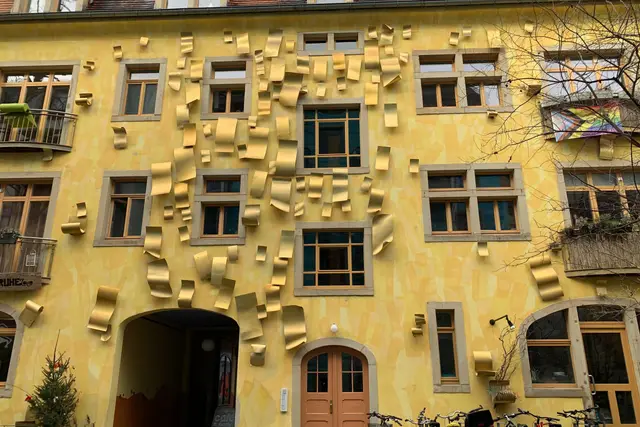
Use the statue as a starting point. Hauptstraße runs north from it as a wide pedestrian boulevard lined with plane trees. Halfway along is the Dreikönigskirche, where you can climb the tower. The avenue ends at Albertplatz, on the edge of the Äußere Neustadt with its bars and the courtyards of the Kunsthofpassage.
Turn the other way and walk down to the Elbe meadows on the Neustadt bank. This is where you get the skyline Canaletto painted. From left to right, you see the Hofkirche, the Semperoper behind it and the Frauenkirche’s dome across the water. Go there after the statue and you’ll see why Augustus put his city on this river.
Nearby, also worth a look:
- Japanisches Palais: a palace a few minutes west along the river, built for Augustus’s porcelain collection.
- Blockhaus: the restored building on the bridgehead beside the square.
- Jägerhof: home to the Museum of Saxon Folk Art, a short walk east along Köpckestraße.
- Zwinger and the Semperoper: back across the bridge, for the rest of the Augustan story.
Museums and palaces change their hours with the season. Check their official sites before you build a day around them. The statue itself is the easy part: it’s there whenever you are.
Frequently asked questions
When is the quietest time to visit the Golden Rider?
Early morning. It's calmest from 7am–8am on weekdays and 7am–9am on weekends. Avoid weekends from 12pm–9pm, when the square is at its busiest.
How do I get to the Golden Rider by tram?
Get off at Neustädter Markt, served by tram lines 4, 8 and 9. Or walk across the Augustusbrücke from the Altstadt, about ten minutes from Schlossplatz.
How long should I spend at the statue?
Most people stay 15–30 minutes. That's enough to walk round the plinth, take photos and read up on the history. Add an hour or two if you carry on along Hauptstraße or down to the Elbe meadows.
Can I visit the Golden Rider at night?
Yes. It stands in an open public square, currently listed as open 24 hours, so you can walk past at any time on your way to or from the Neustadt.
Who is the Golden Rider?
Augustus the Strong, Elector of Saxony and King August II of Poland. He's shown as a Roman Caesar on horseback. The gilded copper statue dates from 1736 and was regilded in a restoration finished in 2003.
Plan your trip to Dresden
Germany eSIM & staying connected →
Some links above are affiliate links — if you book through them, Wander Atlas earns a small commission at no extra cost to you. It's how we keep every guide free.