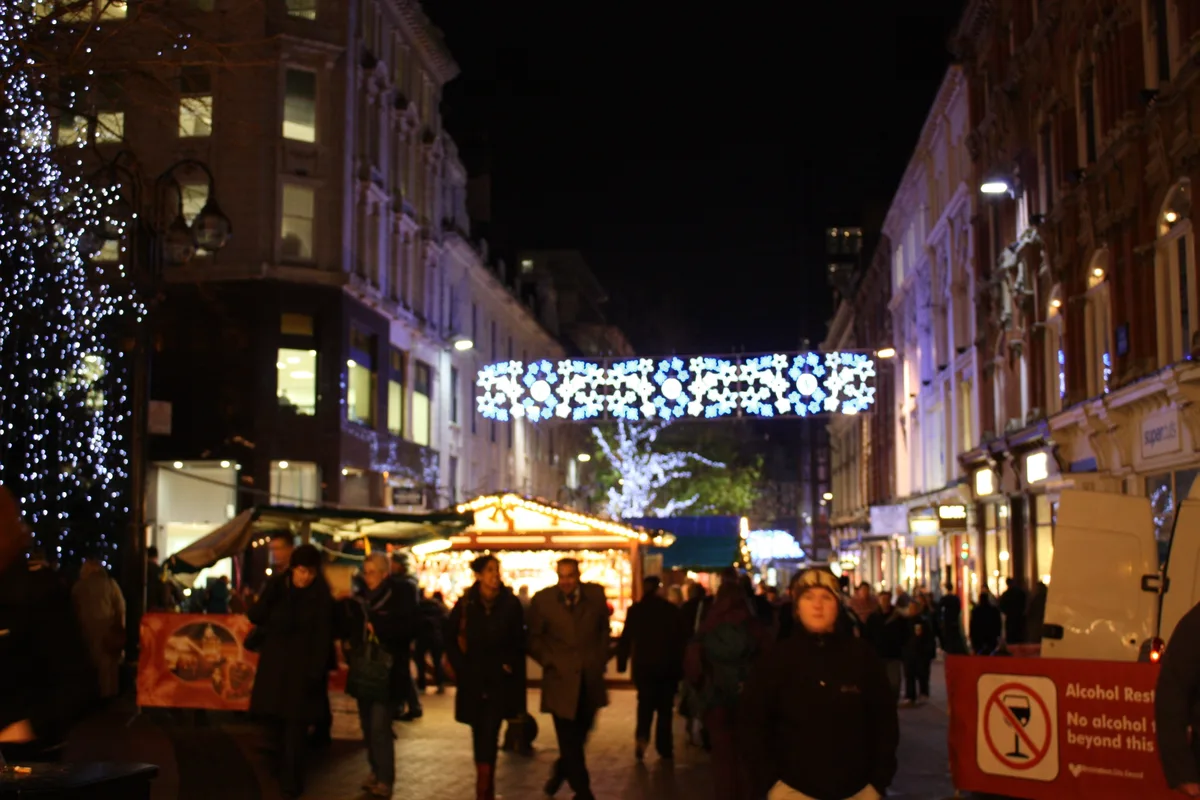
Frankfurt has held a Christmas market since 1393, which makes it one of the oldest in Germany. In 2026 it runs from November 23 to December 22. It spreads across six squares and streets of the old town and along the river: over 200 stalls in all, with a 26-metre Christmas tree on Römerberg at the centre.
Six squares, one walk
The market is a route, not a single square. It runs from the shopping streets around Hauptwache down to the bank of the Main, and most visitors walk the whole stretch in an evening.
The six sites are:
- Römerberg: the old town square, home to the big tree
- Paulsplatz: beside the Paulskirche, where Germany’s first national parliament met in 1848
- Friedrich-Stoltze-Platz: a small square between Hauptwache and the old town
- Hauptwache and Roßmarkt: on the busy shopping axis around the Zeil
- Mainkai: the riverside embankment below Römerberg
From Hauptwache down to the river is roughly a 10–15 minute walk without stops. With food and browsing, most people spend two to three hours.
Römerberg under the 26-metre tree
This is the postcard square. On the west side stands the stepped-gable façade of the Römer, Frankfurt’s city hall since the 15th century. Facing it is the Ostzeile, a row of half-timbered houses rebuilt in the 1980s after wartime destruction.
The 26-metre tree stands between them, with wooden stall roofs packed in around its base. The small Alte Nikolaikirche, a red sandstone church, closes the south side of the square. Frankfurt Cathedral’s tower rises just beyond it, behind the rebuilt lanes of the Neue Altstadt.
Römerberg is the densest part of the market. Many visitors start at the quieter edges and treat it as the finale.
Bethmännchen, Brenten and hot Äppler
Frankfurt has its own Christmas sweets, and they are what set this market apart from Nuremberg or Dresden. Look for them among the gingerbread.
- Bethmännchen: little marzipan-and-almond balls, each pressed with three almond halves. They are tied to the city’s Bethmann banking family.
- Brenten: flat, stamped almond-marzipan biscuits with old-fashioned patterns
- Quetschemännchen: small figures made from dried prunes and nuts, sold as good-luck charms
- Heißer Äppler: hot apple wine. It is Frankfurt’s answer to Glühwein, made from the cider the city drinks all year.
The standard Glühwein is everywhere too, along with grilled Bratwurst, roasted almonds and potato pancakes. Sweets travel well, so many visitors buy Bethmännchen and Brenten in paper bags to take home.
Dates, tickets and how the days run
There is no ticket and no gate. The market is in public squares and anyone can walk in during opening hours. “Tickets” only applies to the extras: the carousels and rides are paid for at each ride, and stall prices are shown on boards at the counter.
The 2026 run opens on Monday, November 23 and closes on December 22, so it ends before Christmas Eve. Daily opening times and the stall map appear on the official Frankfurt Christmas market website. The stalls usually trade on Sundays as well, which is unusual for German retail.
Evenings bring the after-work crowd from the city’s offices, and weekends bring day-trippers from the wider Rhine-Main region. Weekday afternoons tend to be easier for anyone who mainly wants to browse.
Getting into the Altstadt
Public transport is the practical way in. Parking in the old town is scarce, and the market squares are pedestrian zones.
- Dom/Römer (U4, U5) is the closest U-Bahn station to Römerberg.
- Hauptwache is served by most S-Bahn lines and by U-Bahn lines U1–U3 and U6–U8. You come out at the northern end of the market.
- From Frankfurt Hauptbahnhof, any S-Bahn heading east into the city tunnel reaches Hauptwache in a few minutes.
- From the airport, S-Bahn lines S8 and S9 run straight to Hauptwache.
Hauptwache works well as a start. Walk south through Friedrich-Stoltze-Platz and Paulsplatz to Römerberg, then go down to Mainkai.
Mugs, deposits and the stall counter
Hot drinks come in ceramic mugs, not paper cups. You pay a deposit, called Pfand, on top of the drink price. Hand the mug back at any stall that uses the same design and you get the deposit refunded.
Each year’s mug has its own design, and plenty of visitors keep theirs as a souvenir instead of claiming the deposit back. That is perfectly normal and nobody will stop you.
A few other habits help:
- Cash is still the default at many stalls. Card and phone payment are common but not universal, so locals usually keep coins and small notes handy.
- Ordering: say “Einen Glühwein, bitte” or “Einmal heißer Äppler”. You pay right away, before you step aside.
- Queues at the counters are loose. Wait your turn, order, and move to a standing table, because the counter isn’t for lingering.
- Tipping is small: people usually round up or tell the vendor to keep the change.
- Standing tables are shared. Joining strangers at a high table is expected, and a nod is enough of a greeting.
Down to the river at Mainkai
The Mainkai section feels different from the old town squares. Stalls line the embankment with the river Main beside them, and the skyline across the water is lit up after dark.
The Eiserner Steg, Frankfurt’s iron pedestrian bridge from 1869, crosses the river just here. Plenty of visitors walk out onto it with a hot drink in hand. From the bridge you can see the market lights, the cathedral and the bank towers of the financial district in one view.
The far bank is Sachsenhausen, home to the city’s traditional apple wine taverns and the Museumsufer, a row of museums along the river. It’s a natural next stop when the stalls start to wind down for the evening.
Frequently asked questions
When is the Frankfurt Christmas Market in 2026?
It runs from November 23 to December 22, 2026, across Römerberg, Paulsplatz, Mainkai, Hauptwache, Friedrich-Stoltze-Platz and Roßmarkt. It closes before Christmas Eve. Daily opening times are on the official Frankfurt Christmas market website.
Do I need tickets for the Frankfurt Weihnachtsmarkt?
No. The market is in public squares and entry is free. You only pay for what you buy at the stalls and for rides such as the carousels. Prices are shown at each stall.
Which station is closest to the Christmas market?
Dom/Römer (U4, U5) is closest to Römerberg and the big tree. Hauptwache, served by most S-Bahn lines and U-Bahn lines U1–U3 and U6–U8, puts you at the northern end of the market. From the airport, S8 and S9 run direct to Hauptwache.
How long does it take to see the whole market?
Walking from Hauptwache to the river takes about 10–15 minutes without stopping. With food, drinks and browsing across all six sites, most visitors spend two to three hours.
What should I eat and drink at the Frankfurt Christmas Market?
Try the local specialities: Bethmännchen and Brenten (both almond-marzipan sweets), Quetschemännchen prune figures, and Heißer Äppler, which is hot apple wine. Drinks come in ceramic mugs with a refundable deposit (Pfand), or you can keep the mug as a souvenir.
Plan your trip to Frankfurt
Germany eSIM & staying connected →
Some links above are affiliate links — if you book through them, Wander Atlas earns a small commission at no extra cost to you. It's how we keep every guide free.
Related guides
 Ended
Frankfurt Marathon: Dates, Tickets & Venue (Frankfurt am Main)
 Ended
Frankfurter Buchmesse: Dates, Tickets & Venue (Frankfurt am Main)
 Ended
NCT 127 & WayV Tour: Dates, Tickets & Venue (Frankfurt)
 Ended