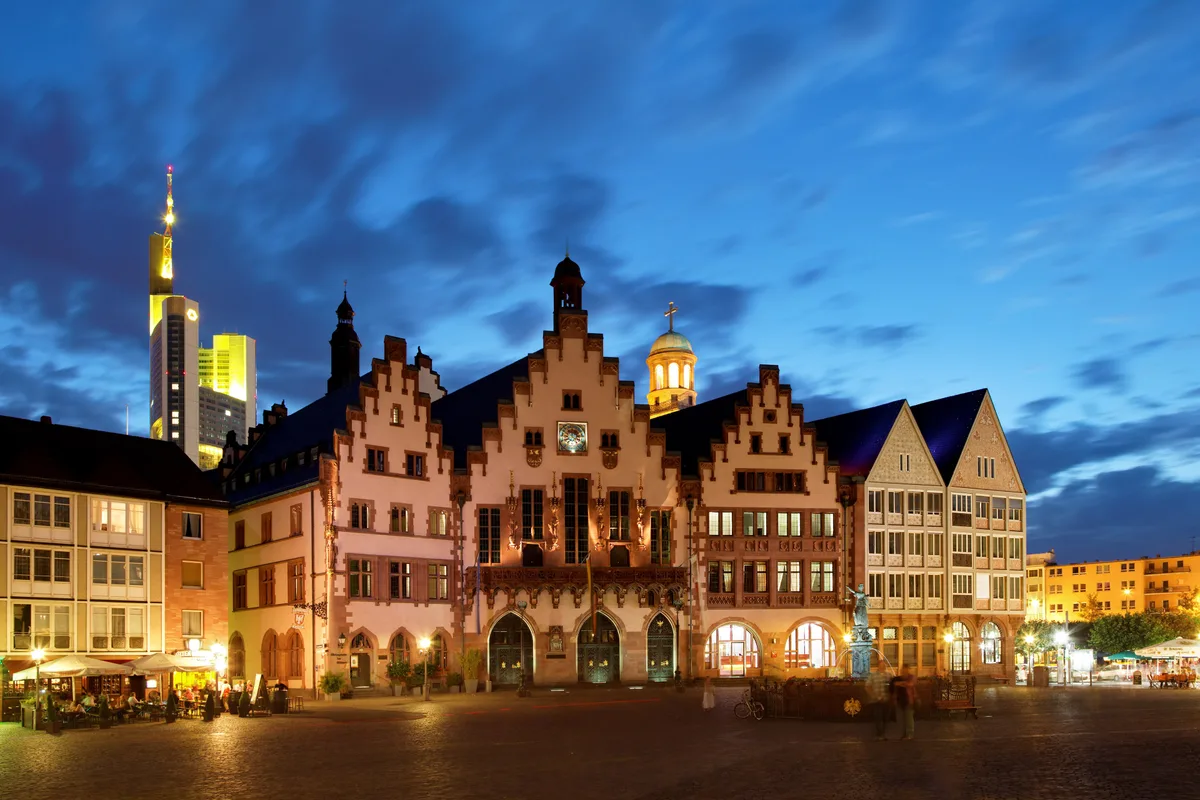
Count the gables first. On the west side of the square, three stepped facades rise side by side in shades of rose and sandstone. That is the Römer, Frankfurt’s city hall since 1405. Turn around and six half-timbered houses face it, their timber frames painted in dark red and slate, their upper floors jutting out over the cobbles.
Between the two stands the Justitia fountain. Its figure of Justice holds her scales and sword, and unusually she wears no blindfold. Everything else in Frankfurt’s old centre takes its bearings from this square.
Six houses that are younger than they look
Most of what you see was rebuilt. Allied air raids in 1944 destroyed nearly all of Frankfurt’s medieval Altstadt, and for decades the east side of Römerberg was rubble and then a stretch of postwar modernism.
The row of half-timbered houses opposite the Römer, known as the Ostzeile, was reconstructed between 1981 and 1983 from old plans and photographs. The Römer’s facades were restored after the war too. Knowing this changes how you look at the place. The carved beams and slate roofs are careful copies, not survivors.
The real survivor is a few steps away. Haus Wertheym, a half-timbered house by the Fahrtor near the river end of the square, is one of very few old-town buildings that came through the bombing intact.
The church, the museum and the hall of emperors
The square has three anchors besides the houses.
- Alte Nikolaikirche: the small Gothic church of red sandstone on the south side, once the chapel of the city council. Its interior is plain and quiet, a contrast to the square outside.
- Historisches Museum Frankfurt: the city museum, built around the medieval Saalhof by the river. Go here if you want the full story of the bombing and rebuilding.
- Kaisersaal: the hall inside the Römer where coronation banquets were held. Its walls carry portraits of the emperors of the Holy Roman Empire. Access is limited and depends on city events, so check the city’s official site before you plan around it.
Opening times for the church and the museum change through the year. The square never closes, but these buildings do, so look up the current hours before you go.
Walking the Krönungsweg
Römerberg makes most sense as half of a route. For more than two centuries, from 1562 to 1792, emperors of the Holy Roman Empire were crowned in the Kaiserdom St. Bartholomäus. They then walked in procession to the Römer for the banquet.
That path is the Krönungsweg, the coronation route. Head east out of the square behind the Ostzeile and you enter the New Altstadt. This district was rebuilt in the 2010s as the Dom-Römer project and finished in 2018. Its narrow lanes, the little Hühnermarkt square and its reconstructed houses fill the gap between the Römer and the cathedral’s red sandstone tower.
Walk it in both directions. Going toward the Dom, the tower rises over the rooftops ahead of you. Coming back, the lane opens onto the Römer’s gables. It takes about ten minutes without stopping, and much longer if you stop, which you will.

Getting to the square
The U-Bahn is easiest. Dom/Römer station, on lines U4 and U5, comes up right beside the New Altstadt. Follow the signs for Römer and you are on the cobbles within a couple of minutes.
Trams 11 and 12 stop at Römer/Paulskirche, close to the north side of the square. From the Hauptwache shopping area it’s an easy walk south past the Paulskirche, where Germany’s first freely elected national assembly met in 1848.
If you’re driving, leave the car outside the centre. The old town is built for walking, and the streets around the square get crowded with pedestrians.
Cobbles, Glühwein mugs and the Römer balcony
You’ll enjoy the square more if you know how it works.
- Look up at the balcony. The Römer’s balcony is where Frankfurt celebrates. Eintracht Frankfurt’s footballers have shown off trophies there to a square packed with fans. On those days nobody gets across Römerberg quickly.
- Expect weddings. The Römer still houses the city’s civil registry. On a wedding day you may find a party gathering on the steps, so keep your camera off other people’s guests.
- The mug has a deposit. At the Christmas market, hot drinks come in a ceramic mug with a deposit (Pfand) added to the price. Take it back to any stall for a refund, or keep it as a souvenir. Many people collect a mug from each year.
- Carry some cash. Market stalls and small kiosks don’t all take cards.
- Mind the cobbles. The stones are uneven and can be slippery in winter. Wheeled suitcases rattle and stick on them.
Römerberg is one of Frankfurt’s most visited places, not a secret. Tour groups, river-cruise passengers and day-trippers all pass through, and they tend to arrive in the middle of the day. Since the square never closes, you can avoid them: come early in the morning, when the gables are lit and almost nobody is there, or late in the evening.
When the square changes
Römerberg looks different through the year.
In winter, the Frankfurt Christmas market fills the square and the streets around it from late November until just before Christmas. A tall decorated tree stands in front of the Römer. At these times the square is at its busiest of the year, and weekday mornings are the easiest time to look at the houses.
The rest of the year the square is more open. It still holds festivals, concerts and civic events, so ask at the tourist information office on the square or check its listings for what’s on.
Across the river and back
When you leave, walk south. Through the Saalhof area you reach the Main riverbank and the Eiserner Steg, an iron footbridge from 1869. The bridge has views back to the Dom tower and ahead to the Sachsenhausen bank.
Sachsenhausen is where Frankfurt drinks Apfelwein, the local cider, poured from a grey stoneware jug called a Bembel. Order Grüne Soße, a cold sauce of seven herbs served with eggs and potatoes, or Handkäs mit Musik, sour-milk cheese marinated with onions. That makes Römerberg the first stop of an evening rather than the whole of it.
Frequently asked questions
How do I get to Römerberg by public transport?
Take U-Bahn line U4 or U5 to Dom/Römer station and follow the signs for Römer. You'll reach the square in a couple of minutes. Trams 11 and 12 stop at Römer/Paulskirche, close to the north side of the square.
Is Römerberg open at night?
Yes. The square is a public space and is open 24 hours. The Alte Nikolaikirche, the Historisches Museum and the Kaisersaal keep their own hours, which change through the year, so check their official sites before you go.
How long should I spend at Römerberg?
One hour is enough for the square, the Alte Nikolaikirche and the walk along the Krönungsweg to the Kaiserdom. Allow two to three hours if you add the Historisches Museum and a walk over the Eiserner Steg to Sachsenhausen.
When is the Frankfurt Christmas market on Römerberg?
It runs from late November until just before Christmas, around the square and nearby streets. Exact dates change each year, so check the city's official listings. Hot drinks come with a mug deposit that you get back when you return the mug.
Are the half-timbered houses original?
Mostly not. The Ostzeile row was rebuilt between 1981 and 1983 after the old town was destroyed in 1944. Haus Wertheym, near the Fahrtor at the river end of the square, is one of the few old-town buildings that survived.
Plan your trip to Frankfurt
Germany eSIM & staying connected →
Some links above are affiliate links — if you book through them, Wander Atlas earns a small commission at no extra cost to you. It's how we keep every guide free.
Related guides
 hidden gem
 Palmengarten: Frankfurt Travel Guide (4.7★)
 attraction
 Frankfurter Römer: Frankfurt Travel Guide (4.7★)
 trendy
 Kaffeehaus Goldene Waage: Frankfurt Travel Guide (4.6★)
 attraction