A yellow castle on a wooded knoll
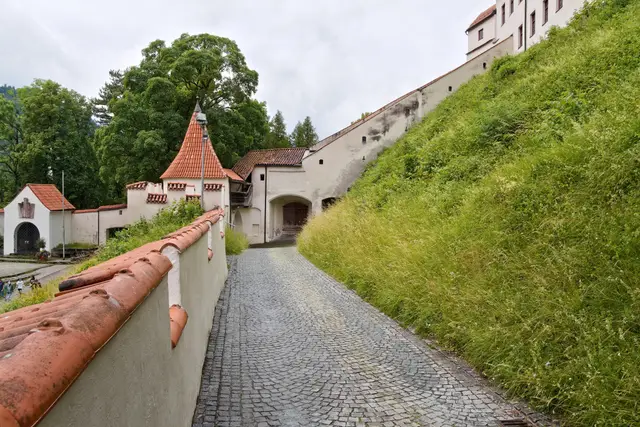
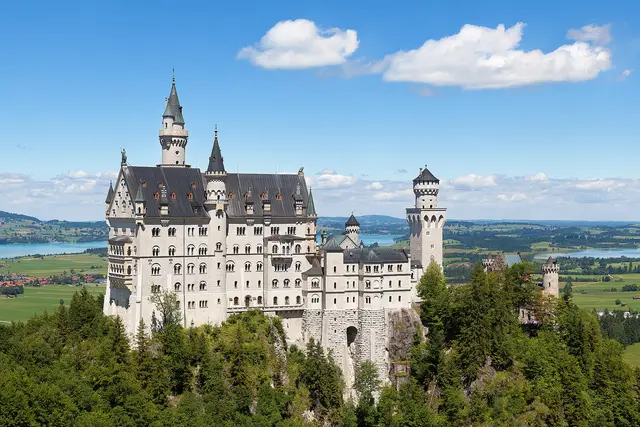
From the village car parks, Hohenschwangau looks warm rather than grand. It sits on a forested hill above the Alpsee: ochre walls, crenellated towers and white-framed windows. Across the valley, Neuschwanstein’s pale limestone towers rise against the Tegelberg slopes. Most visitors photograph that one. This is the one Ludwig II actually grew up in.
Crown Prince Maximilian, later King Maximilian II of Bavaria, rebuilt the castle in the 1830s on the ruins of the medieval Schwanstein fortress. He gave it the romantic Neo-Gothic look of the period. It became the royal family’s summer residence. Young Ludwig spent long stretches of his childhood here, surrounded by painted knights and swans. You can see those images later turning up across the valley.
Inside the state rooms
Visits are by guided tour only, and the tours are short and tightly timed. A guide leads your group through a series of furnished rooms, explains each one, and moves you along. Plan on roughly half an hour inside. Photography is not permitted in the interiors, so look properly while you’re there.
What to watch for:
- The swan motif, which repeats through the rooms. It refers to the Swan Knight Lohengrin, the legend the castle’s name (“Swan Region”) echoes.
- The wall paintings of German sagas and medieval heroes, which cover entire rooms.
- Ludwig’s bedroom, with a night sky painted across the ceiling.
- The music room, linked to Ludwig’s friendship with Richard Wagner, who visited the castle.
Unlike Neuschwanstein, which Ludwig never finished, these rooms were furnished and lived in by the family. That’s the real difference between the two tours. Here you’re walking through a home rather than a stage set.
Getting to Hohenschwangau
The castle is at Alpseestraße 30, in the small village of Hohenschwangau in the municipality of Schwangau. Füssen is the nearest town. Regional trains run from Munich to Füssen station, usually with a change at Buchloe, and the trip takes about two hours.
From the bus stops outside Füssen station, local buses (lines 73 and 78) run the few kilometres to Hohenschwangau. Drivers will find several paid car parks in the village. From the village, the castle is a steep walk of about 15 to 20 minutes on a paved path. Horse-drawn carriages also run up when they’re operating.

The ticket centre comes first
Don’t walk up to the castle gate expecting to buy entry. Tickets for both Hohenschwangau and Neuschwanstein are sold at the Hohenschwangau Ticket Center down in the village. Each ticket has a fixed entry time, and turnstiles at the castle only let you through at your slot.
- Book online in advance through the official castle ticketing site, especially in summer. Same-day slots can run out by late morning.
- Leave time for the climb. If you miss your slot, you’ve missed your tour.
- Pick the right language. Tours run in English and German, and audio guides cover other languages.
- Combined tickets cover both castles, with gaps between the slots that are built to allow for the walk.
Current prices and combination options are posted on the official ticketing site and at the ticket centre.
Beating the queues at a very busy castle
This is one of the most visited sights in Bavaria, and there’s no quiet corner of it. Timing is your best tool. The listed hours are 9am to 4:30pm every day of the week.
It’s calmest between 9am and 11am on weekdays. At weekends the quiet window is shorter, from 9am to 10am. Try not to come on a weekend between 12pm and 4pm, when the tour groups and day-trippers from Munich all overlap. That’s when the walk up and the ticket queues are at their worst.
- Do Hohenschwangau first. Book the earliest slot you can get, then cross to Neuschwanstein later, when the morning crowd has moved on.
- Stay the night in Füssen or Schwangau and you’ll be at the gate before the first trains from Munich arrive.
- Expect German, then English. In shops and cafés, a “Grüß Gott” (the Bavarian greeting) goes down well. Cards are widely accepted, but small cafés and carriage drivers may prefer cash.
The Alpsee and the view across the valley
The castle’s best feature might be what lies around it. The Alpsee spreads out right below the castle hill, a clear, dark lake ringed by forested mountains. A level path runs all the way around it. It’s an easy walk of about an hour and a half, and almost none of the castle crowds carry on past the first viewpoint.
From the castle terraces and gardens you can look straight across to Neuschwanstein on its ridge. Stories say Ludwig watched his dream castle going up from here. Whatever the truth, the view makes the link between the two buildings obvious. By the lakeshore, the Museum of the Bavarian Kings fills in the family story the tour only touches on.
How long to give it
Allow about two hours for Hohenschwangau alone. That covers the ticket centre, the climb, the tour and a look around the gardens. Add the Alpsee loop and the museum, and it becomes a comfortable half day.
Most people pair it with Neuschwanstein, which makes a full day from Munich. If you can, start the day here. You’ll see the castle as Ludwig knew it before you see the one he dreamed up.
Frequently asked questions
When is the quietest time to visit Hohenschwangau Castle?
Between 9am and 11am on weekdays, and between 9am and 10am at weekends. Avoid weekends from 12pm to 4pm, which is the busiest stretch.
Can I buy tickets at the castle itself?
No. Tickets with timed entry are sold at the Hohenschwangau Ticket Center in the village and on the official online ticketing site. Booking online ahead is strongly advised, especially in summer.
How do I get to Hohenschwangau from Füssen?
Take bus 73 or 78 from outside Füssen station to Hohenschwangau, a few kilometres away. From the village it's a steep walk of about 15 to 20 minutes up to the castle, or you can take a horse-drawn carriage when they're running.
How long does the castle visit take?
The guided tour lasts about half an hour. With the ticket centre, the climb and the gardens, plan on about two hours. Add the Alpsee walk or Neuschwanstein to make it a half or full day.
Should I visit Hohenschwangau or Neuschwanstein?
Ideally both, on a combined ticket. Hohenschwangau is the furnished family home where Ludwig II grew up. Neuschwanstein is the unfinished castle he built himself across the valley.
Plan your trip to Füssen
Germany eSIM & staying connected →
Some links above are affiliate links — if you book through them, Wander Atlas earns a small commission at no extra cost to you. It's how we keep every guide free.