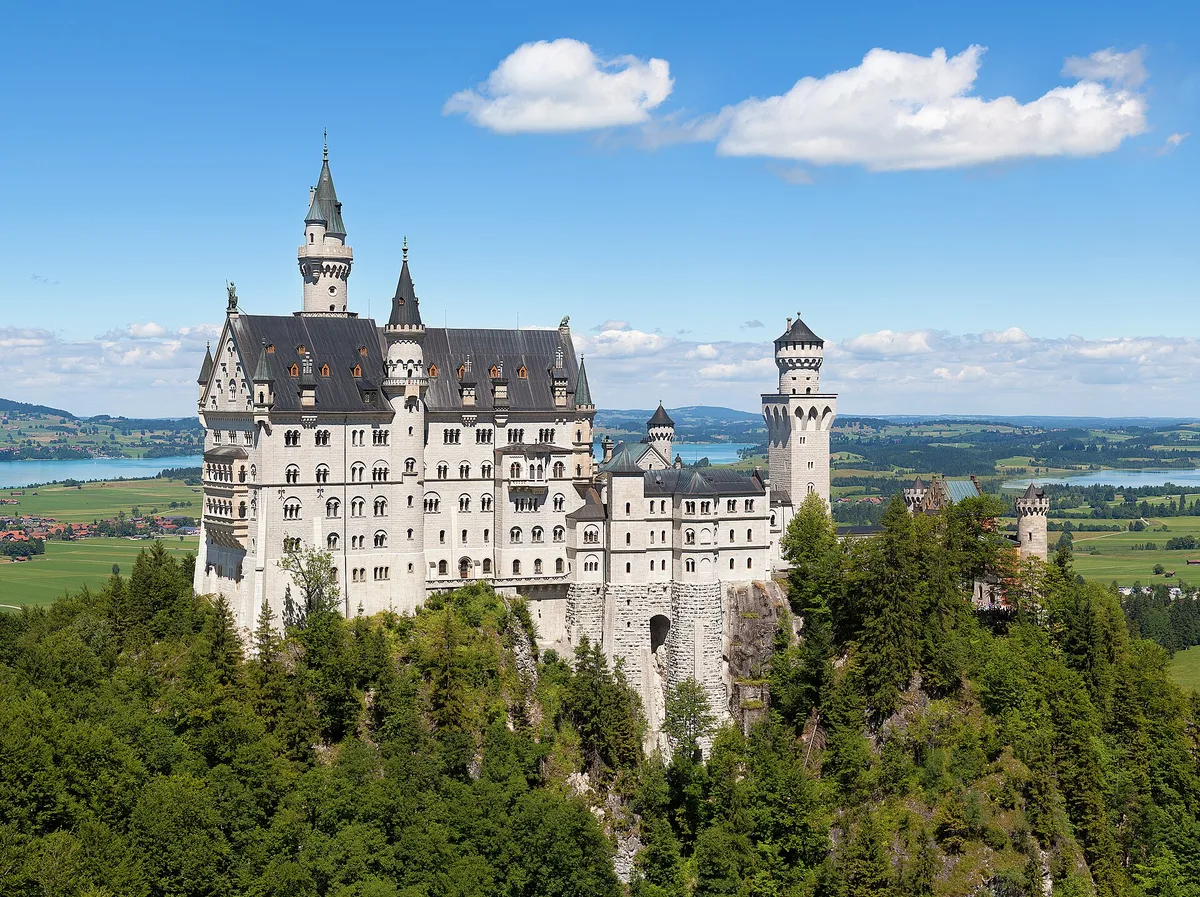
A castle built for one man
Ludwig II never saw it finished. Construction began in 1869, and the king died in 1886 with only around fifteen rooms completed. He spent just a few months living in them. What you see from the valley is pale limestone walls, slim turrets and a gatehouse in red brick. It sits on a rocky spur above the Pöllat Gorge, with the Alps behind it.
That outline went on to inspire Disney’s Sleeping Beauty Castle, which helps explain the crowds. This is among the most-reviewed sights in Germany, and it’s consistently well rated. Don’t expect solitude. Expect a well-run operation that rewards planning.
Getting from Füssen to the gate
Most people arrive by regional train from Munich, which takes about two hours, ending at Füssen station. From the bus stop outside, buses 73 and 78 run to Hohenschwangau in roughly ten minutes. The address is Neuschwansteinstraße 20, Schwangau, but the village below is where everything starts.
From Hohenschwangau you have three ways up:
- On foot: a steady uphill road of about 30 to 40 minutes. It’s paved, shaded in parts and steeper than it looks.
- Horse carriage: these drop you just below the castle, leaving a short final climb.
- Shuttle bus: stops near Marienbrücke, so you walk downhill to the castle afterward.
Leave plenty of slack. Tour times are strict, and the climb is longer than the map suggests.
Inside the furnished rooms
You can only see the interior on a guided tour, which runs about 30 minutes and climbs a lot of stairs. Groups move through the rooms on a fixed schedule. Photography is not allowed inside.
Two rooms tend to stay with people. The Throne Room rises two storeys and has a mosaic floor, but no throne: it was never delivered. The Singers’ Hall fills most of an upper floor and is painted with scenes from the legends Wagner used in his operas. Ludwig was devoted to Wagner, and his tastes show in nearly every room.
Marienbrücke and the view everyone wants
The famous postcard angle comes from Marienbrücke, or Mary’s Bridge. This iron footbridge spans the Pöllat Gorge just above the castle. It’s about a 15-minute walk from the castle along a forest path.
The bridge gets crowded and is sometimes closed in winter or for repairs. Check its status before you build your day around it. If it’s open, go either before your tour or straight after. That way you don’t have to climb back up later.
Booking, timing and the queue at Hohenschwangau
Tickets are timed and tied to a tour slot, and summer days sell out. Book online in advance through the Bavarian Palace Administration’s official site, which also posts current prices. Collect or confirm your tickets at the ticket centre in Hohenschwangau, not up at the castle.
Timing matters more here than almost anywhere in Bavaria:
- Weekdays are calmest across the full opening window, 9am–6pm.
- Weekends get crowded from 11am–4pm. Try not to start your climb in that window, or you’ll queue at the shuttle stops and on the bridge.
- Opening hours are listed daily from 9am to 6pm. Hours often shorten in winter, so check the official site before an off-season trip.
At your entry time, a turnstile at the gate scans your ticket. If you’re late, you miss the tour. Germans tend to arrive early and wait patiently, and doing the same saves you a lot of stress.
Rounding out the day below
Before you head back to Füssen, look around the valley floor. Hohenschwangau Castle is the yellow palace where Ludwig spent his childhood. It has its own guided tour, and seeing it explains a lot about the son who built Neuschwanstein. The Museum of the Bavarian Kings sits on the shore of the Alpsee, a clear lake with a lakeside path.
Seeing both castles, the bridge and a stretch of the Alpsee fills a full day without hurry. If you only see Neuschwanstein, allow about four hours from Hohenschwangau and back.
Frequently asked questions
When is the quietest time to visit Neuschwanstein Castle?
Weekdays are calmest across the full opening window of 9am–6pm. On weekends it's busiest between 11am and 4pm, so try to avoid that stretch.
How do I get to Neuschwanstein from Füssen?
Take bus 73 or 78 from Füssen station to Hohenschwangau, which takes about 10 minutes. From there, walk uphill for 30 to 40 minutes, take a horse carriage, or ride the shuttle bus to near Marienbrücke.
Do I need to book tickets in advance?
Yes, especially in summer and on weekends. Tickets are timed to a guided tour slot. Book through the Bavarian Palace Administration's official site, which also posts current prices, and collect them at the ticket centre in Hohenschwangau.
How long should I plan for a visit?
Allow about four hours from Hohenschwangau and back. That covers the climb, the roughly 30-minute tour and Marienbrücke. Add Hohenschwangau Castle and the Alpsee and you have a full day.
Can I take photos inside?
No, photography isn't allowed inside the castle. You can take photos freely outside, and the best-known view is from Marienbrücke above the Pöllat Gorge.
Plan your trip to Füssen
Some links above are affiliate links — if you book through them, Wander Atlas earns a small commission at no extra cost to you. It's how we keep every guide free.