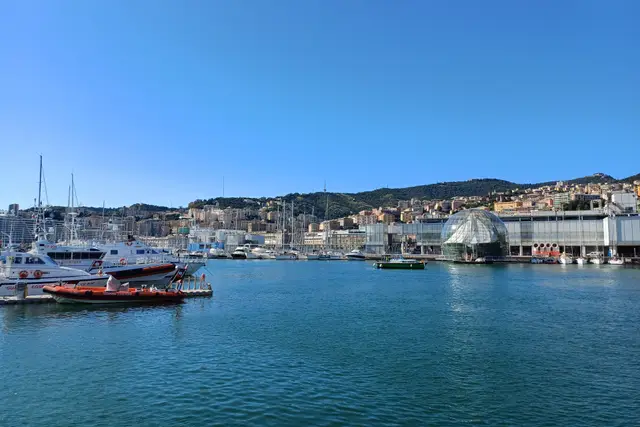
Genoa’s harbour and its old town meet along one broad strip of paving, and that strip is Piazza Caricamento. On one side are masts, the Aquarium and Renzo Piano’s white Bigo crane. On the other, tall painted buildings rise over a deep line of arches. Overhead, a concrete road carries traffic past on stilts.
The name is literal. Caricamento means “loading”, and this was where cargo came off and went onto the ships. The goods have gone and the square is still a working crossroads. It is a place you pass through on your way to somewhere else, and it rewards you for slowing down.
A square built for cargo
The piazza makes more sense once you know it is reclaimed port land. Genoa was one of the great maritime republics, and its wealth came ashore right here. The waterfront was reshaped for the 1992 Expo marking 500 years since Columbus sailed. Piano’s redesign opened the old docks back up to the city.
What you get today is a wide, flat, pedestrian space with room to stand back. That matters in Genoa, where most of the old town is a maze of caruggi, lanes so narrow that you rarely see a whole façade. Here you can take in the buildings, the harbour and the hills behind in one turn of the head.
Palazzo San Giorgio and its prisoner
The most striking building on the square is Palazzo San Giorgio. Its seaward façade is covered in painted figures and architectural trompe-l’oeil. The palace dates to the 13th century and was later home to the Banco di San Giorgio, one of Europe’s earliest banks. Today it houses the port authority.
The best story attached to it involves Marco Polo. After Genoa beat Venice at the Battle of Curzola in 1298, he was held prisoner in the palace. While he was there, he dictated his travels to a fellow inmate, Rustichello da Pisa. The result became Il Milione, the book that shaped Europe’s picture of Asia for centuries.
Stand back towards the water to see the painted front whole. The rear of the building is plainer and older, and the contrast between the two is worth the walk around.
Life under the Sopraelevata
The raised road overhead is the Strada Sopraelevata Aldo Moro, built in the 1960s along the harbour front. People argue about it. It cuts the old town off from the sea, and it is also one of the fastest ways across the city. Driving it gives you a strange, first-floor view into the palazzi.
At ground level it shapes the whole square. The pillars break the space into bays, and the shade underneath gives you somewhere to stand out of the sun. Cafés, bus stops and pedestrian crossings all fit around the concrete legs. The traffic noise never quite stops, and the gap between medieval stone and 1960s road is exactly what makes this corner of Genoa feel like Genoa.

Frying under Sottoripa’s arches
The inland side of the square is lined by the Portici di Sottoripa. These medieval arcades are among the oldest public porticoes in Italy. Under them runs a string of small shopfronts, and many of them are friggitorie, Genoese fry shops with counters open to the arcade.
This is where the market side of Caricamento lives. Look for:
- Farinata, a thin chickpea-flour pancake baked in wide copper pans
- Panissa, chickpea batter set, sliced and fried into chips
- Fried anchovies and calamari, served in a paper cone
- Focaccia, the local flatbread, oily and salted
Ordering works counter-style. Point at what’s behind the glass or name it, say how much you want, and pay on the spot. Small counters sometimes prefer cash, although cards are increasingly accepted, so carry a little of both. Nobody expects a tip at a takeaway counter.
Most people eat standing under the arches or carry their cone across to the harbour edge. If you want to sit down, pick a café table and order there. Carrying food from a fry shop to someone else’s table is bad form.
Getting to Caricamento
The square is easy to reach and completely walkable once you are there:
- Metro: San Giorgio station on Genoa’s single metro line is at the square. Darsena, one stop along, also puts you on the harbour front.
- From Genova Piazza Principe station: take the metro or walk along the harbour.
- From Genova Brignole station: the metro runs through to San Giorgio.
- On foot from the old town: Via San Lorenzo drops straight down from the cathedral to the square.
Driving into the centro storico is more trouble than it’s worth. The lanes around here are narrow, partly restricted and hard to park in.
Day, night and the harbour light
Because it is an open public square, Caricamento never closes. Timing is about what you want to see, not access.
In the daytime the square belongs to people heading to the Aquarium and the Porto Antico. Weekends and school holidays bring families and school groups through. Arriving earlier in the day usually means fewer of them. The fry counters do their busiest trade around the Italian lunch hour.
After dark the harbour lights come on and Palazzo San Giorgio is lit up. Keep an eye on your bag, as you would in any busy port area. The deeper caruggi behind Sottoripa feel different at night, so if you’re not sure of the lane, stick to the lit harbour front.
Where to walk next
Caricamento is a starting point, and almost everything nearby is within ten minutes on foot:
- Acquario di Genova, one of Europe’s largest aquariums, along the Porto Antico quay
- The Bigo, Piano’s crane-like structure with a rotating panoramic lift
- Cattedrale di San Lorenzo, with its black-and-white striped marble, up Via San Lorenzo
- Piazza Banchi, the old merchants’ square, just behind the arcades
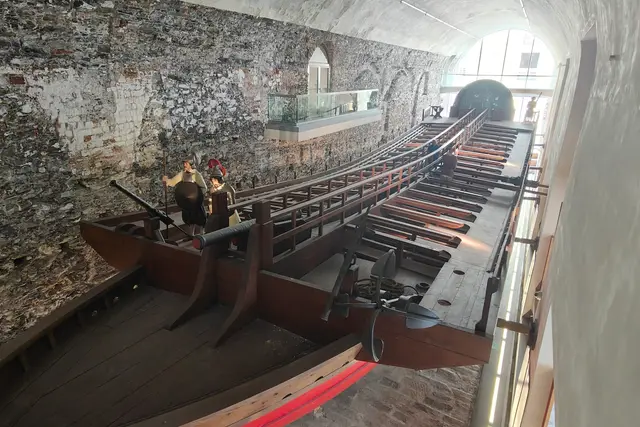
- Galata Museo del Mare, the maritime museum, further along the harbour towards Darsena
The easiest loop is Sottoripa, then the cathedral, then back down to the water. Do it that way and the square comes last, when you can see what the whole old port is built around.
Frequently asked questions
How do I get to Piazza Caricamento?
Take the Genoa metro to San Giorgio station, which is at the square. Darsena is one stop along. From Piazza Principe or Brignole railway stations the metro is the simplest option. From the cathedral, just walk down Via San Lorenzo.
How long should I spend there?
Allow 30 to 60 minutes for the square itself, Palazzo San Giorgio's façade and a snack under the Sottoripa arcades. Add more time if you are going on to the Aquarium or the old town.
What should I eat at Caricamento?
Head for the friggitorie under the Portici di Sottoripa. Look for farinata (a chickpea pancake), panissa, fried anchovies or calamari in a paper cone, and Genoese focaccia. Order and pay at the counter.
Is it open at night, and is it safe?
It's a public square and open 24 hours. At night the harbour front is lit and Palazzo San Giorgio is illuminated. Watch your belongings as you would in any port area, and stay on well-lit routes if you don't know the lanes behind the arcades.
What is nearby?
The Acquario di Genova, the Bigo panoramic lift, the Galata Museo del Mare, Piazza Banchi and the Cattedrale di San Lorenzo are all a short walk away.
Plan your trip to Genoa
Some links above are affiliate links — if you book through them, Wander Atlas earns a small commission at no extra cost to you. It's how we keep every guide free.