Two stone towers rise from the end of a narrow Genoese street, with a pointed arch between them. Via del Campo is barely wide enough for a delivery van, and it runs straight into that arch. Walk through and the medieval city ends. On the far side are the traffic of the port road and the open sky over the harbour.
That sudden change is the reason to come. Porta dei Vacca gets far less attention than Porta Soprana, its better-known twin up the hill. Its location helps: it sits on the working edge of the old town, not on a postcard piazza.
A gate built against an emperor
The gate belongs to the walls Genoa put up in 1155, when the city feared an attack by Frederick Barbarossa. Locals still call them the Mura del Barbarossa. The walls were raised quickly, and the city’s gates were their most heavily defended points.
Porta Soprana guarded the road from the east. Porta dei Vacca guarded the western approach along the coast. The two gates share the same basic design: rounded flanking towers, a single arch, and battlements along the top. If you see both on the same day, the family resemblance is plain.
The gate was first known as Porta di Santa Fede, after a nearby church. The name it has now is usually traced to the Vacca family, who are linked to collecting tolls at the gate. That name still appears on local street signs and maps.
How the towers sit in the street
Look at the towers from inside Via del Campo first. Later houses were built right up against the medieval stone, so the towers seem to grow out of the terraces around them. Shutters and washing lines hang only a few metres from battlements that are close to nine centuries old.
Then walk under the arch and turn around. From the seaward side you get the classic view:
- both towers standing clear, with the arch framed between them
- the height of the gate compared with the street behind it
- the gap between the caruggi (the old town’s alleys) and the modern port road
Go early or late in the day, when low sun lights the stone and brings out its texture.
Via del Campo and the song
The street behind the gate has a fame of its own. Fabrizio De André, Genoa’s great singer-songwriter, named a song after it on his 1967 album. The song celebrates the people living on the margins of this quarter. For many Italians, the words “Via del Campo” bring the song to mind before the street itself.
Admirers of De André leave notes and small tributes along the street. At Via del Campo 29 rosso, a small space is dedicated to him and to the Genoese school of songwriters. Check its hours separately, because they are not the gate’s hours. Walking the length of the street to reach the arch is the best way to arrive.

Sunday and Monday only
The timing is unusual, and it matters. The gate’s listed hours are Sunday and Monday, 9am to 5pm. It is listed as closed Tuesday through Saturday. Plan your visit for one of those two days and get there well before 5pm, so you have enough light and time to explore.
That listing is the only schedule we can confirm. If you are in Genoa midweek, move your old-town walk to the weekend and stop here as part of it. Check the listing again shortly before you go, because heritage sites in the city sometimes change their access.
Getting there from the port and Principe
Genova Principe, the main station for trains from Milan and the Riviera, is roughly ten minutes away on foot. Head downhill toward the sea and follow Via Gramsci or Via Prè east. The towers come into view from the port road.
On the metro, get off at Darsena, the stop by the old dock, and walk a few minutes toward Via del Campo. From Porto Antico and the Acquario di Genova, walk northwest along the waterfront. The walk takes about ten minutes. For the best approach, start in Piazza Fossatello and walk down the whole of Via del Campo to the arch.
Walking the caruggi with the Genoese
The streets around the gate are a neighbourhood where people live, not a museum set. Here is how to fit in:
- Keep to one side. Via del Campo is narrow, and residents with shopping bags and scooters have right of way. Step into a doorway to take photos.
- Photograph the stone, not the people. People sitting in doorways and at shop counters did not agree to be in your picture.
- Order coffee standing up. At the bars nearby, most people drink an espresso at the counter. In busier places you often pay at the till first and hand over the receipt.
- Say the name properly. Locals say “POR-ta dei VAK-ka”. Asking for “la Porta dei Vacca” gets you pointed the right way.
The west side of the old town is rougher around the edges than the streets near Piazza De Ferrari. It is lively during the day. After dark, stick to the main streets and keep your phone in your pocket, as you would around any port.
Beyond the arch
The gate works best as one stop on a walk through the western old town. Nearby:
- Commenda di San Giovanni di Prè, a Romanesque church and pilgrims’ hostel linked to the crusades, a few minutes further west
- Via Prè, a long, lively street of small grocers and street-food counters
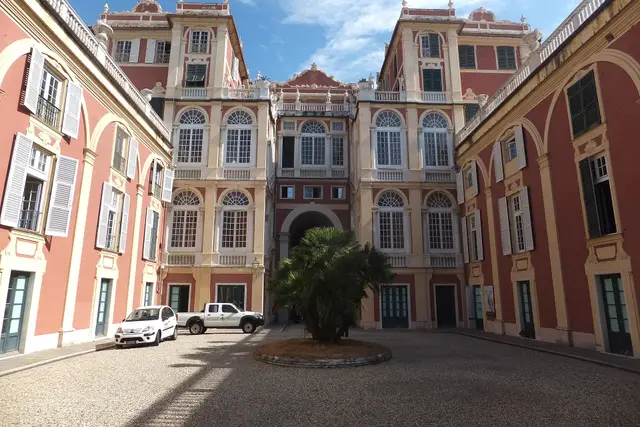
- Palazzo Reale on Via Balbi, uphill toward Principe, with its gilded rooms and terrace garden
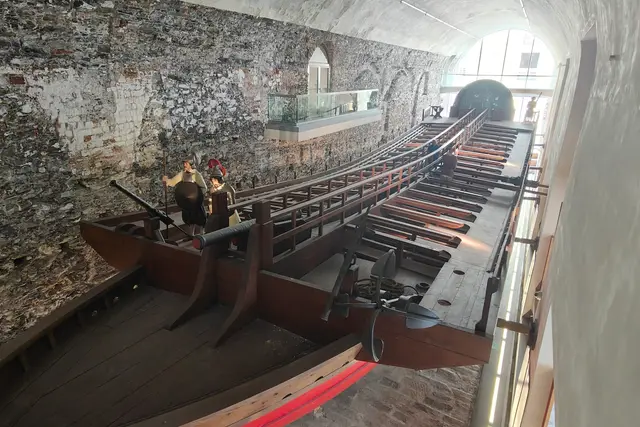
- Galata Museo del Mare by the Darsena, Genoa’s maritime museum
- Porta Soprana, the gate’s twin, across the old town near Piazza Dante, if you want to compare them
Walking the whole loop from Via del Campo through the gate to the Commenda and down to the Darsena takes an easy hour or two.
Frequently asked questions
When is Porta dei Vacca open?
Its listed hours are Sunday and Monday, 9am to 5pm. It is listed as closed Tuesday to Saturday, so plan your visit for a Sunday or Monday and check the listing shortly before you go.
How do I get to Porta dei Vacca?
It is at the western end of Via del Campo in Genoa's old town. Genova Principe station is roughly a ten-minute walk away, and Darsena metro stop is a few minutes away. From Porto Antico and the Aquarium, walk northwest along the waterfront.
How long should I spend there?
Allow 20 to 30 minutes for the gate itself. Allow an hour or two if you combine it with Via del Campo, Via Prè, the Commenda di San Giovanni di Prè and the Darsena.
What is the connection to Fabrizio De André?
The gate stands at the end of Via del Campo, the street De André named a song after on his 1967 album. At Via del Campo 29 rosso, a small space is dedicated to him and the Genoese songwriters. Check its hours separately.
How is it different from Porta Soprana?
Both gates were part of the 1155 Barbarossa walls and share the same design of a single arch between two towers. Porta Soprana guarded the eastern approach. Porta dei Vacca guarded the western coastal approach and is tucked among houses at the working port edge of the old town.
Plan your trip to Genoa
Some links above are affiliate links — if you book through them, Wander Atlas earns a small commission at no extra cost to you. It's how we keep every guide free.