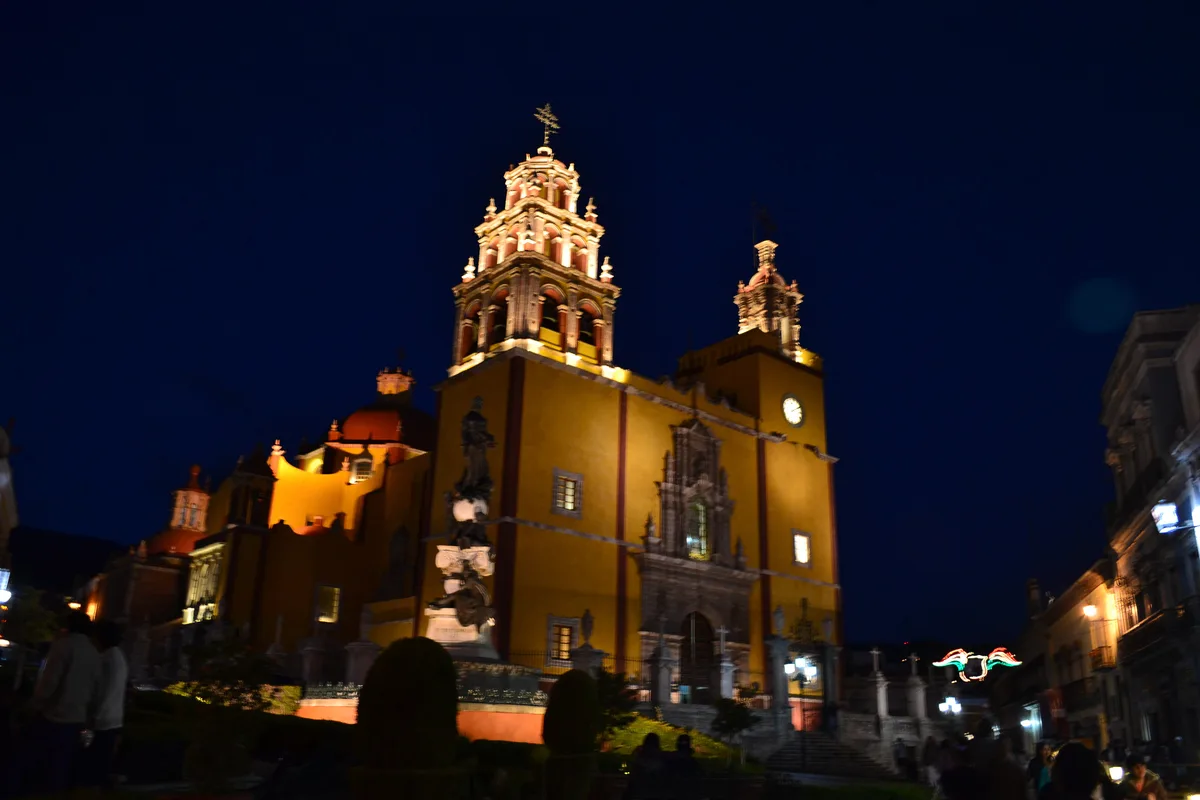
A yellow front on Plaza de la Paz
Look up from Plaza de la Paz and the basilica fills the whole north side. Its façade is painted a deep ochre-yellow with red trim, and it rises above a short flight of steps. Guanajuato sits in a narrow ravine, so the church can’t stand back from the city. The plaza runs right up to it and the hillside houses crowd in behind.
This is the city’s main church. It is a 17th-century Baroque building, finished in the 1690s, and the parish was later raised to the rank of basilica. People cross the plaza in front of it all day: students heading to the university, office workers, families on their way to the market. You don’t have to go looking for it. Most walks through the old centre take you straight past its steps.
The Virgin who came from Granada
The reason to go inside is a single carved figure. Nuestra Señora de Guanajuato, the Virgin on the high altar, is believed to date from the 8th century. That makes her one of the oldest Christian images in the Americas.
Here is the story the city tells:
- The statue was carved in Spain and venerated in Granada.
- Christians hid it in a cave during the Moorish period, and it was recovered centuries later.
- In the 16th century the Spanish Crown sent it to Guanajuato as a gift. The city was then a fast-growing silver town.
The statue is small and dark, and she wears embroidered robes and a crown. To see her properly, walk the full length of the nave toward the altar. From the door she is little more than a glint of gold.
Inside the nave
The building is Baroque, but much of the interior was refitted in the neoclassical style. Expect pale columns, gilded detail and white altars, not dense gold carving. Light falls into the nave from the windows high in the walls and from the dome over the crossing.
Side altars line both walls, and many have candles and handwritten petitions left in front of them. Twenty minutes is enough for a slow walk around. Allow longer if you want to sit and take in the altar, or if a service is on.

Getting to Plaza de la Paz
Leave the car behind. Most of central Guanajuato’s traffic runs through underground tunnels, and the streets at surface level are a maze of steep, narrow lanes. Walking is the way to get around.
- From Jardín de la Unión: walk west along Avenida Juárez for a few minutes and the plaza opens up on your right.
- From the bus station: the Central de Autobuses is well outside the centre. Take a taxi or a city bus marked for the Centro, then finish on foot.
- From Mercado Hidalgo: follow Avenida Juárez east, uphill toward the plaza. The walk takes roughly ten to fifteen minutes.
The street address is C. Ponciano Aguilar 7. If a map app tries to send you into a tunnel, give it “Plaza de la Paz” as the destination.
Timing around a short weekday window
The posted hours are short, so plan around them. At the moment the doors open at 9:30am. They close at 4pm Monday to Friday and at 12:30pm on Saturday. Google currently lists Sunday as closed, which is unusual for a parish church. Don’t plan a Sunday visit without checking first.
These are the visiting hours Google shows this week. Mass times and feast days can change what is open and when, so check with the basilica or the local tourist office before you build a day around it. A weekday morning gives you the most room. You won’t be up against a closing time, and you can carry on to the museums nearby, which keep their own hours.
The city’s big moment for the Virgin comes in early August. That is when Guanajuato marks her arrival with processions and celebrations around the basilica. Expect the plaza to be full, and the inside to be busy with worshippers, not sightseers.
Mass, cameras and the collection box
This is a working parish, and it has been one for centuries. Behave as you would in any church where people are praying.
- Dress: cover your shoulders and avoid beachwear. Men usually take off their hats at the door.
- During Mass: stay at the back, or wait until the service ends before walking up the nave toward the altar.
- Photos: quiet photos without flash are generally tolerated outside services. Never photograph people who are kneeling in prayer.
- Giving: there is a donation box near the entrance, and local churchgoers often drop in a coin or light a candle. Any amount is fine. Small peso coins are handier than cards.
People here call the church simply “la Basílica”. Ask for that and anyone in the centre will point you to it.
Within five minutes’ walk
The basilica sits on the busiest crossroads of the old town, so it’s easy to combine with other stops.
- Teatro Juárez and Jardín de la Unión: the columned theatre and the shady triangular garden are a short walk east.
- Universidad de Guanajuato: the long white flight of steps in front of the main university building is just uphill behind the plaza.
- Templo de la Compañía de Jesús: a large Jesuit church with a carved pink-stone front, next to the university.
- Callejón del Beso: the famously narrow alley where balconies almost touch. It’s a short climb southwest through the lanes.
- Museo del Pueblo de Guanajuato and Casa Diego Rivera: two museums on the streets north of the plaza, good stops if you started the basilica in the morning.
Many visitors finish with a seat on a bench in Plaza de la Paz, looking back at the yellow façade.
Frequently asked questions
Where exactly is the Basílica Colegiata de Nuestra Señora de Guanajuato?
It is at C. Ponciano Aguilar 7, on the north side of Plaza de la Paz in Guanajuato's Zona Centro. That's a few minutes' walk west of Jardín de la Unión and Teatro Juárez along Avenida Juárez.
What are the opening hours?
At the moment Google lists 9:30am–4pm Monday to Friday and 9:30am–12:30pm on Saturday, with Sunday shown as closed. Mass times and feast days can change this, so check locally before you go.
How long should I spend inside?
Allow about 20–40 minutes. That covers walking the nave, seeing the 8th-century Virgin on the high altar up close and looking at the side altars. Stay longer if a service is on.
Is there a dress code?
It's a working church. Cover your shoulders, skip beachwear, and men usually take off their hats. Keep quiet and stay at the back during Mass.
What else is nearby?
Teatro Juárez, Jardín de la Unión, the steps of the Universidad de Guanajuato, the Templo de la Compañía de Jesús and the Callejón del Beso are all a short walk from Plaza de la Paz.
Plan your trip to Guanajuato
Mexico eSIM & staying connected →
Some links above are affiliate links — if you book through them, Wander Atlas earns a small commission at no extra cost to you. It's how we keep every guide free.
Related guides
 attraction
 Monumento Al Pipila: Guanajuato Travel Guide (4.7★)
 hidden gem
 Mercado Hidalgo: Guanajuato Travel Guide (4.5★)
 attraction
 Cañada de la Virgen: San Miguel de Allende Travel Guide
 attraction