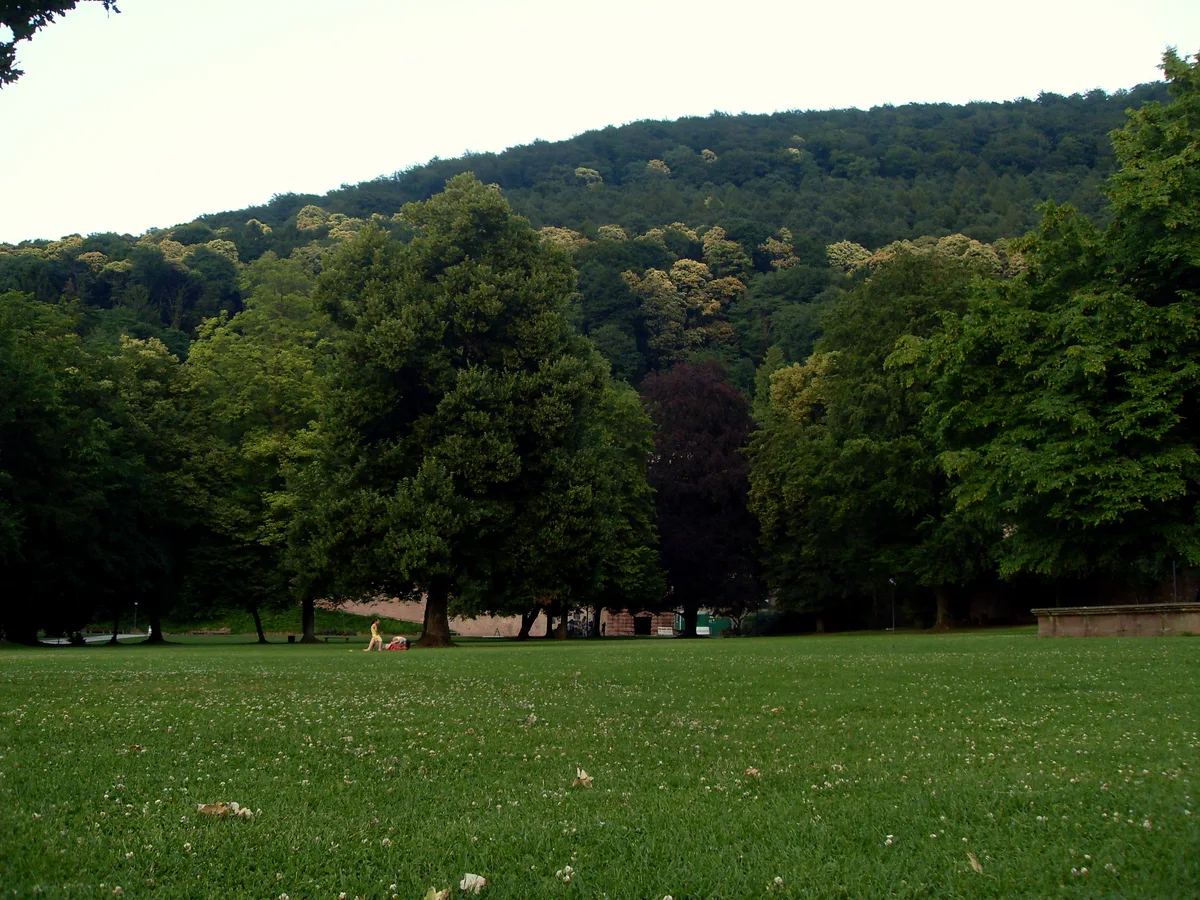
Start with the stone. The terraces under your feet are carved straight into the slope of the Königstuhl, held up by retaining walls of the same red sandstone as the castle ruins behind you. In front of you the hillside drops away: rooftops, the Old Bridge, the Neckar curving west toward the Rhine plain. This is the Schlossgarten, and it was meant to be much more than it is.
An eighth wonder, left half-built
The garden began as the Hortus Palatinus. Elector Frederick V commissioned it around 1616 for his English wife, Elizabeth Stuart. The French engineer Salomon de Caus designed it as a set of stepped terraces with grottoes, fountains and water machines, and contemporaries called it the eighth wonder of the world.
Then the Thirty Years’ War began in 1618. Frederick lost his throne, and the work stopped. That is why the terraces feel slightly bare: you are walking the skeleton of a Renaissance masterpiece. The flat lawns and gravel paths mark where the elaborate parterres were supposed to go.
The Scheffel Terrace
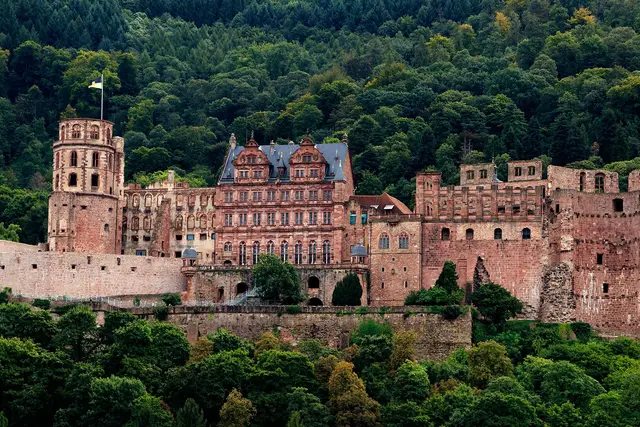
This is the view everyone climbs for. The Scheffelterrasse is the long, broad terrace on the garden’s eastern side, named after the poet Joseph Victor von Scheffel. From the balustrade you look back across at the whole castle front, with the shattered Powder Tower to one side. Below it is the Altstadt.
Go to the far end and the rest falls into place:
- The Heiliggeistkirche spire rising out of the old-town roofs
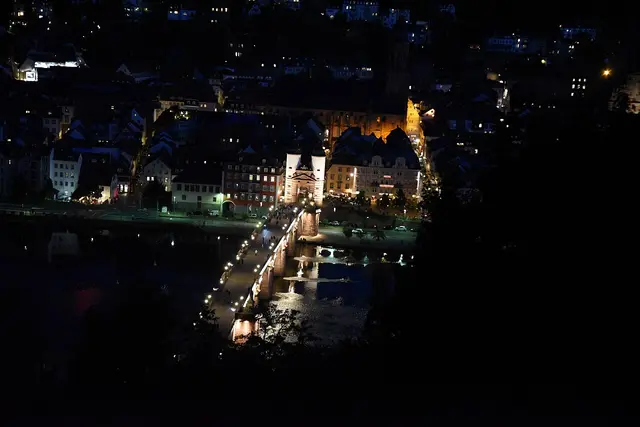
- The Old Bridge (Alte Brücke) with its twin-towered gate
- The Philosophenweg on the opposite bank, across the Neckar
- The river opening out toward the Rhine valley on clear days
Late afternoon light falls on the castle’s red facade from the west. That is the classic photograph, and it needs nothing added.
What to look for on the terraces
The garden rewards slow walking. A few features are easy to miss:
- The Father Rhine fountain (Vater Rhein): a reclining river god in a grotto niche, one of the few sculptural pieces surviving from de Caus’s plan.
- The Goethe memorial: a plaque recalls Goethe’s walks here and his poem to Marianne von Willemer. A ginkgo tree stands nearby, the tree from his poem “Ginkgo biloba”.
- The Elisabethentor: a gate decorated with carved foliage. Legend says Frederick had it built overnight as a birthday surprise for Elizabeth.
- The Stückgarten: the old cannon bastion on the western edge, now a quiet lawn with its own outlook over the town.
Getting up the hill
There are two honest options. The Bergbahn funicular leaves from Kornmarkt station in the old town and climbs to the Schloss stop beside the castle entrance. Buses into the Altstadt stop near Kornmarkt as well.
Walking is the other way. The Burgweg starts at Kornmarkt and climbs steeply on cobbles for roughly 15 minutes. The Kurzer Buckel stairway is shorter but harder. The postal address is Schloß-Wolfsbrunnenweg 18, the road that runs along the hillside above the garden, and a few visitors come in that way on foot from the east.
Ticket rules for the castle courtyard and funicular change, and so do the rules on what each ticket covers. Check the official Schloss Heidelberg site for current details rather than relying on older guides.
Timing the climb
At the moment the garden opens 8am–6pm every day of the week. Treat that as this season’s schedule, not a permanent one. Hours here follow the seasons, so look up this month’s times before planning an evening visit.
Most people come up for a few hours at most. Give the garden itself an hour, or two if you are pairing it with the courtyard and the Great Vat (Großes Fass) in the cellar. Spring blossom and autumn colour on the slopes make those the most rewarding seasons. Summer brings the longest daylight.
Finding the quieter corners
Here is the trick to the Schlossgarten. Most visitors walk straight from the funicular to the castle courtyard and the Scheffel Terrace balustrade, and stop there. The upper terraces and the far reaches of the garden see far fewer people, even when the courtyard is full.
- Head uphill past the main terrace. The higher levels, near the Father Rhine grotto, are where you get space to yourself.
- Arrive early in the opening hours. You beat the tour groups, which usually come up after mid-morning once the funicular is running at full capacity.
- People here keep their voices down. Locals use the paths for running and dog walking, so step aside on the narrower stretches.
- Benches are first come, first served. A paper bag of pastries from the Hauptstraße below makes the terrace a fine picnic spot. Take your rubbish back down with you.
- The surfaces are gravel, sandstone steps and uneven slopes. Strollers manage the main terrace, but the upper paths are harder going.
After the garden
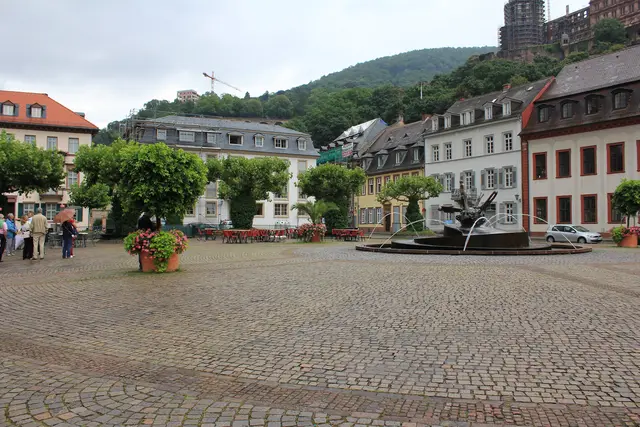
Walk down the Burgweg instead of taking the funicular back. You come out at Kornmarkt, with the Madonna statue and the cafés around the square. The Hauptstraße, the long pedestrian street of the Altstadt, starts a block away.
If you still have energy, cross the Old Bridge and climb the Schlangenweg to the Philosophenweg. From up there you see the castle and its terraces from the far bank, and the unfinished garden reads like a giant staircase cut into the hill.
Frequently asked questions
How do I get to the Schlossgarten Heidelberg?
Take the Bergbahn funicular from Kornmarkt station in the Altstadt to the Schloss stop, or walk up the steep, cobbled Burgweg from Kornmarkt in about 15 minutes.
What are the opening hours?
Right now it opens 8am–6pm every day. Garden hours shift with the seasons, so check the official Schloss Heidelberg site for this month's times.
How long should I spend there?
Give the garden about an hour. Allow two to three hours if you add the castle courtyard and the Great Vat.
Where is the best view?
Go to the Scheffel Terrace, the long terrace on the garden's eastern side. It looks back at the castle and down over the Altstadt, the Old Bridge and the Neckar.
What is nearby?
Heidelberg Castle itself, Kornmarkt and the Hauptstraße at the bottom of the hill, and the Philosophenweg across the Old Bridge for the reverse view.
Plan your trip to Heidelberg
Germany eSIM & staying connected →
Some links above are affiliate links — if you book through them, Wander Atlas earns a small commission at no extra cost to you. It's how we keep every guide free.