A city office that now shows art
The gallery’s main draw is the building itself. It is a two-storey Japanese-era civic building from the 1920s, put up as the city’s administrative office when Taiwan was under Japanese rule. You can still read its official past in the symmetrical front, the tall windows and the formal entrance facing Zhongyang Road.
Today it’s the Hsinchu City Art Gallery, known in Mandarin as 新竹市美術館. It shares the building with the Reclamation Hall (開拓館), whose name refers to the settlement and development of the Hsinchu area. Very few visitors plan a whole day around the place, so it is a calm stop between the station and the old town.
What you’ll find inside
The art changes on a rotating programme. There’s no fixed permanent collection to tick off, so what hangs on the walls depends on the month. Exhibitions tend towards contemporary work and artists connected to Hsinchu and the wider region.
Because the building started out as offices, the gallery spaces are fairly modest rooms rather than vast white halls. The scale suits a short visit:
- Time needed: around 45 minutes to an hour for both floors
- Best paired with: a walk around East Gate and the moat, which are a few minutes away
- Before you go: check the gallery’s official listings to see what’s showing, since a gap between exhibitions can leave rooms closed
The building is worth a look even when you don’t care for the current show. Look at the stairwells, the window frames and how the light comes in through the old façade.
Getting there from the trains
From Hsinchu Railway Station on the TRA line, it’s roughly a ten-minute walk. The station is itself a protected Japanese-era building, finished in 1913 and one of the oldest working stations in Taiwan. Walk out of the front entrance towards the city centre and the moat. Zhongyang Road runs through the old core, so the walk is flat and easy.
Arriving on the high-speed rail? Hsinchu HSR Station is out in Zhubei, not in the city. Take the TRA Liujia Line shuttle to Hsinchu Station, then walk. An EasyCard covers the TRA hop and local buses. Taxis from the HSR station are straightforward too. Show the driver the address: No. 116, Zhongyang Road.

The Monday lock and the 9am window
Timing matters more here than at most small museums. At the moment the gallery is closed on Mondays and open 9am–5pm from Tuesday to Sunday. Museums in Taiwan adjust hours around national holidays and between exhibitions, so check the official site for this month’s schedule before you go.
Weekends follow a clear pattern. The quietest hour is usually 9am–10am. Between 12pm and 5pm it’s typically at its busiest, which means families, school groups and day-trippers working through the old town. Don’t plan a Saturday afternoon visit expecting empty rooms.
The simplest plan is to be at the door when it opens at 9am. Spend an hour inside, then head out to East Gate and the City God Temple for lunch.
The moat, East Gate and the old town loop
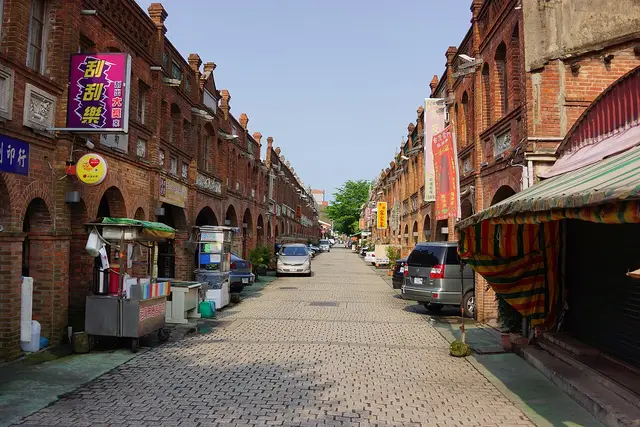
The gallery sits at the edge of Hsinchu’s most walkable area. Within about fifteen minutes on foot you can reach:
- East Gate (Yingxi Gate, 迎曦門): the surviving brick-and-stone city gate from 1829, standing in the middle of a roundabout
- The Hsinchu moat (護城河): a landscaped canal path with shade, good for a slow stroll between sights
- Hsinchu Municipal Image Museum: housed in a 1930s Art Deco cinema building on Zhongzheng Road, with film-related exhibits
- Hsinchu City God Temple (新竹都城隍廟): the busy temple whose surrounding lanes are packed with stalls selling the city’s two famous foods, pork meatballs (貢丸) and fine rice noodles (米粉)
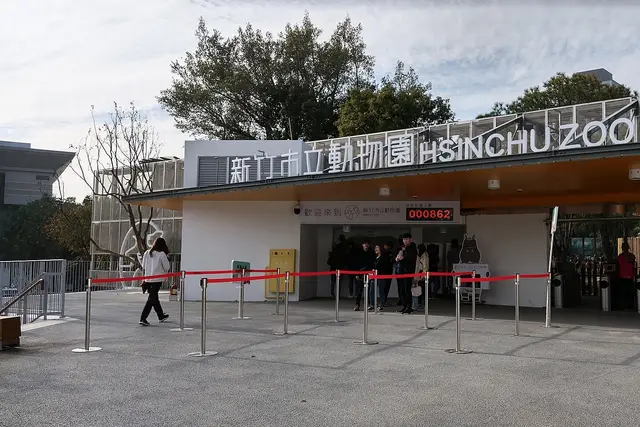
Hsinchu Park and the city zoo lie further east if you have the afternoon free. In a single morning, though, the gallery, East Gate and a temple-side lunch fit together neatly.
Gallery manners on Zhongyang Road
The galleries are small, so noise carries. Taiwanese museum-goers usually keep their voices low and phones on silent. Groups tend to spread out rather than bunch in front of one piece.
A few practical habits help:
- Photography: rules change with each exhibition. Look for the camera icons posted at the entrance to each room, and never use flash on artwork.
- Admission: any current charge or free-entry policy is posted at the entrance and on the official site, so check there rather than relying on old information.
- Signs: wall text is mostly in Mandarin, sometimes with English. A translation app’s camera mode helps with the longer panels in the Reclamation Hall.
- Bags and food: leave drinks and snacks outside. Save the meatball soup for the temple lanes.
If you’re asking for directions, say the Mandarin name, Xīnzhú Shì Měishùguǎn, or show 新竹市美術館 on your phone. Taxi drivers and people at the station will know it.
Who will enjoy it most
This is a good fit for travellers who like a city’s buildings as much as its art. It also suits anyone with a spare hour in central Hsinchu between trains. Exhibitions are modest in size, so expect a focused visit rather than a full museum day.
If you’re coming only for a particular show, confirm the dates first. On a weekday morning or right at opening on a weekend, you’ll probably get the old rooms mostly to yourself before heading back out to the moat.
Frequently asked questions
When is the quietest time to visit Hsinchu City Art Gallery & Reclamation Hall?
On weekends, the quietest window is usually 9am–10am. Avoid 12pm–5pm on Saturdays and Sundays, which is typically the busiest stretch. If you can go on a weekday, remember it's currently closed on Mondays.
What are the opening hours?
At the moment it opens Tuesday to Sunday, 9am–5pm, and is closed on Mondays. Hours can change around holidays and between exhibitions, so check the official site before you go.
How do I get there from Hsinchu Station?
It's roughly a ten-minute flat walk from Hsinchu Railway Station (TRA) towards the moat and East Gate. The address is No. 116, Zhongyang Road. From Hsinchu HSR Station, take the TRA Liujia Line shuttle to Hsinchu Station first.
How long should I spend there?
Around 45 minutes to an hour covers both floors. Add another hour or two to walk to East Gate and the moat, and to have lunch near the City God Temple.
What else is nearby?
East Gate (Yingxi Gate), the moat walkway, the Hsinchu Municipal Image Museum and the City God Temple, with its meatball and rice noodle stalls, are all within about fifteen minutes on foot.
Plan your trip to Hsinchu
Taiwan eSIM & staying connected →
Some links above are affiliate links — if you book through them, Wander Atlas earns a small commission at no extra cost to you. It's how we keep every guide free.