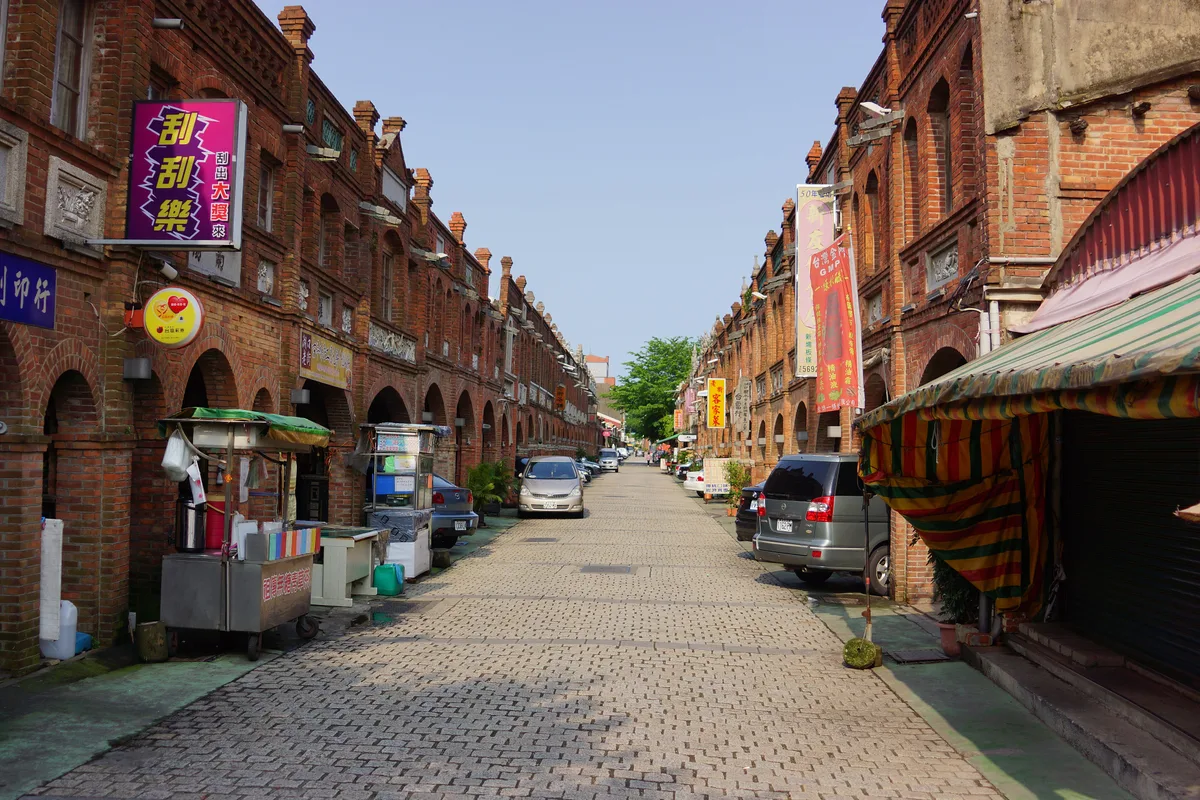
A street you walk under, not along
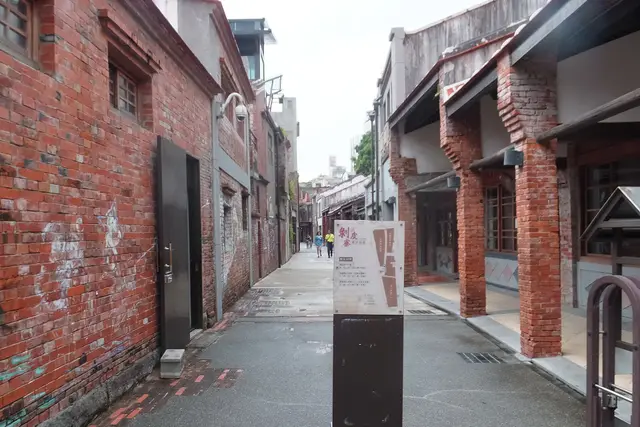
Hukou Old Street is best seen from inside its arcades. Both sides of the lane are lined with red-brick shophouses, and their ground floors are set back behind a row of arches. That covered walkway, called tingzijiao (亭仔腳) in Taiwan, runs the length of the street. It keeps you out of the sun and the rain, and from under the arches you look across the lane at the facades opposite.
Look up and the brick turns decorative. Most shophouses carry a raised pediment above the second floor, with moulded scrollwork and, on many of them, the family or shop name set into the plaster. The whole row is only a few hundred metres long. It reads as one continuous wall of brick, which explains why it’s among the most photographed old streets in northern Taiwan.
Why the railway left and the street stayed
The look of the street comes from a lucky decline. In the late Qing era, Taiwan’s first railway put a station near here, and Hukou grew into a busy Hakka market town. Merchants rebuilt their shops in brick during the Japanese colonial period, and the facades you see date from that era.
In 1929 the line was rerouted, and the station moved to the site that’s now Hukou Station. Trade followed the trains. The old street never got rich enough to tear itself down, so the brick row survived mostly intact while other towns modernised. That’s why it now looks so complete.
Hakka food on the old street
Hukou is a Hakka town, and you can see it in the stalls. You won’t find a fixed menu here, because shops come and go, but these are the Hakka staples to look for:
- Lei cha (擂茶): “pounded tea”. Sesame, peanuts and tea leaves are ground to a paste in a ridged ceramic bowl with a wooden pestle, then topped up with hot water. Some places let you do the grinding yourself.
- Hakka mochi (麻糬): soft glutinous rice rolled in crushed peanut and sugar.
- Ban tiao (粄條): wide, flat rice noodles, served in soup or stir-fried.
- Cai bao (菜包): steamed glutinous rice dumplings, usually filled with shredded radish and dried shrimp.
- Hakka xiaochao (客家小炒): stir-fried dried tofu, squid, pork and celery. It’s a sit-down dish, so save it for a proper meal.
Prices are generally budget-friendly. Each stall posts its own on a board or the menu. Snacking your way down the street can easily stand in for lunch.

Getting to Hukou
The old street isn’t next to the modern station. That surprises people who arrive by train.
- By TRA: take the Western Line to Hukou Station (湖口站). The old street is a few kilometres away, so take a taxi or a local bus from outside the station. Check the bus timetable before you set off, because services in the county are infrequent.
- By car or scooter: Hukou sits just off National Freeway 1, north of Hsinchu City. On busy weekends the streets near the old street fill up, so park at the edge of town and walk in.
- From Hsinchu City: many visitors simply take a taxi. It saves you the train-plus-bus connection.
Temples at the ends of the brick
The arcades give the street its photos, and the temples give it a reason to exist. Sanyuan Temple (三元宮) stands by the old street and is still in daily use. You’ll usually find incense burning in the main hall and locals stopping in to pray. Hukou Tianhou Temple (天后宮), dedicated to Mazu, is a short walk away.
A sensible loop takes about 1–2 hours:
- Walk the full length of the street under one arcade.
- Visit the temple.
- Come back under the opposite arcade, which gives you the facade view you missed the first time.
Taking photos from across the lane works better than standing under the arches. From there you can fit a whole pediment in the frame.
Strolling the arcades the Hakka way
Google lists the street as open 24 hours because it’s a public road. The shops keep their own hours. Weekends bring the most open stalls and also the most people. On weekdays the street is calmer, but more shutters stay down, especially at the food stalls. Getting there in the morning, before day-trippers drive in from Taipei and Hsinchu, usually gives you clearer arcades.
How things work here:
- Pay in cash at stalls. Small vendors expect coins and small notes. Some larger shops take cards or mobile payment, but don’t count on it.
- No tipping. It isn’t customary in Taiwan, at food stalls or at sit-down restaurants.
- Keep the arcade moving. The covered walkway is narrow and doubles as shop frontage. Step out into the lane to stop for a photo instead of blocking it.
- Remember people live here. Many upper floors are still homes. Don’t climb on steps or lean into doorways for a shot.
- At the temple, walk in through the right-hand door and out through the left, keep your voice low, and avoid stepping on the raised threshold.
Mandarin works everywhere. Older shopkeepers may speak Hakka among themselves. Pointing at what you want plus a xièxie (thank you) is all you need. If you’re asking directions, say “Húkǒu Lǎojiē” (湖口老街), the name locals and taxi drivers use.
Pairing it with the rest of Hsinchu County
Hukou fits easily into a half-day. Hsinchu County has other Hakka towns, and Xinpu is known for its persimmon farms, where fruit is laid out to dry in autumn. You can combine the two in one day if you’re driving.
If you’re heading south by train, Hsinchu City’s old moat and Chenghuang Temple area make a natural second stop. Visit the old street first while you’re fresh and the arcades are quieter, then save the city for the evening.
Frequently asked questions
How do I get to Hukou Old Street by public transport?
Take the TRA Western Line to Hukou Station. The old street is a few kilometres away, so go on by taxi or local bus. Buses in the county run infrequently, so check the timetable first.
How long should I spend at Hukou Old Street?
Plan on 1–2 hours. That's enough to walk both arcades, visit Sanyuan Temple and snack your way along. Allow longer if you stop for a sit-down Hakka meal or to pound your own lei cha.
Is Hukou Old Street better on weekdays or weekends?
Weekends have the most stalls and shops open, and also the most visitors. Weekdays are calmer, but more shutters stay down, particularly at food stalls. Getting there in the morning usually means emptier arcades whichever day you choose.
What should I eat at Hukou Old Street?
Look for Hakka staples: lei cha (pounded tea), Hakka mochi rolled in peanut powder, ban tiao flat rice noodles, cai bao steamed dumplings, and Hakka xiaochao stir-fry if you're sitting down for a meal.
Is Hukou Old Street open at night?
It's a public street, so you can walk it at any hour. The shops and food stalls keep their own hours, though, and most close well before late evening. Visit in the daytime if you want to eat and shop.
Plan your trip to Hsinchu
Taiwan eSIM & staying connected →
Some links above are affiliate links — if you book through them, Wander Atlas earns a small commission at no extra cost to you. It's how we keep every guide free.
Related guides
 hidden gem
Green World Ecological Farm: Hsinchu Travel Guide (4.6★)
 attraction
Hsinchu Zoo: Travel Guide (4.1★)
 attraction
Leofoo Village Theme Park: Hsinchu Travel Guide (4.6★)
 hidden gem