Mrigadayavan Palace: Hua Hin Travel Guide (4.3★)
✓ Facts verified via Google Places · Sep 15, 2026
At a glance
Opening hours
- Monday: Closed
- Tuesday: Closed
- Wednesday: Closed
- Thursday: Closed
- Friday: 9:00 AM – 4:00 PM
- Saturday: 9:00 AM – 4:00 PM
- Sunday: 9:00 AM – 4:00 PM
How this guide is made
Produced with AI assistance and reviewed against live data sources. Facts such as hours, ratings, and location come from Google Places; images are licensed or public domain. Details can change — please verify before visiting. Editorial policy
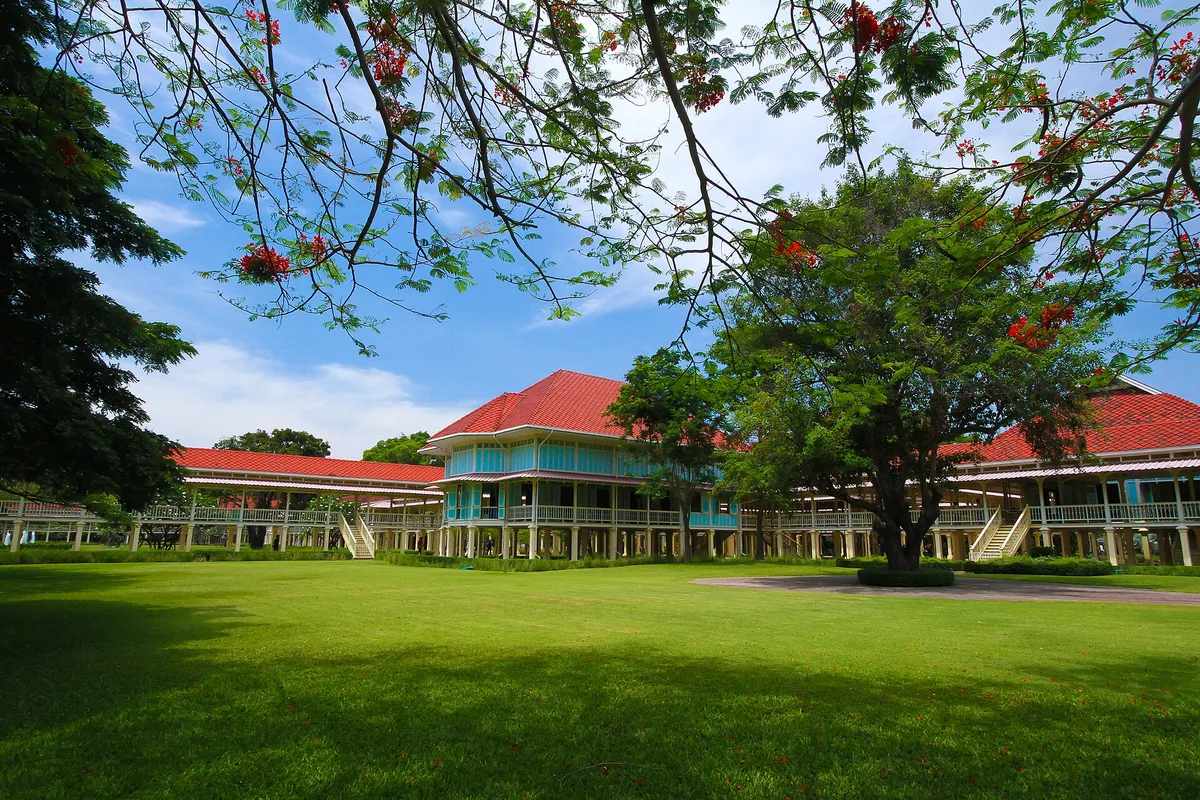
Rama VI built this as a seaside retreat in 1923, and it still reads like a royal beach house rather than a museum. Golden teak buildings stand on hundreds of concrete stilts, strung together by roofed verandas that catch the wind straight off the Gulf of Thailand. No walls separate the halls from the outdoors; louvred shutters and open corridors were the 1920s answer to air conditioning.
The complex sits on Phet Kasem Road on the border of Cha-am and Hua Hin, closer to Cha-am’s center than Hua Hin’s. Three main sections survive: Samosorn Sevakamart (the reception hall with a theater stage), Phisan Sagorn (the king’s private residence), and Ruen Rublom, the seaside pavilion where royal audiences once took place. Long covered walkways, elevated about three meters, connect all of them so you can walk end to end without touching sand.
Getting there and timing it right
The palace only opens Friday, Saturday and Sunday, 9am to 4pm; it’s closed the rest of the week, so check the calendar before you drive out. From Hua Hin it’s roughly a 20 to 25 minute taxi or songthaew ride north along Phet Kasem Road. Weekend crowds build steadily through the full 9am to 4pm window, so getting there right at opening is the only real way to beat the tour buses. Plan for 90 minutes to two hours to cover the grounds at an unhurried pace.
What you’ll actually see
The star is Phra Ruen Rublom, the honey-colored pavilion nearest the beach, famous for the phrase “Phra Ruen Rublom” translating loosely to “hall that catches the wind.” Corridors run for hundreds of meters through landscaped grounds planted with frangipani and casuarina trees. Look for the intricate fretwork gables and the open-sided design that let sea air flow straight through the royal apartments. A small museum room inside displays photographs of the king and original furnishings.
Dress code and photo etiquette
This is still a royal palace, and Thailand enforces the same modest dress rules here as at temples.
- Shoulders and knees must be covered; sarongs are sometimes available to borrow at the entrance if you arrive underdressed
- Shoes come off before stepping onto the wooden walkways and interior rooms
- Photography is generally allowed on the verandas and exteriors, but some interior rooms restrict flash or tripods
- Speak quietly inside Phra Ruen Rublom; it functions as a semi-sacred space, not just a photo backdrop
Combining it with a Cha-am or Hua Hin day
Because the palace only runs three days a week, most visitors pair it with other stops along Phet Kasem Road. Cha-am’s beach and seafood stalls sit about ten minutes north, making a natural lunch stop after the morning visit. Heading south, Hua Hin’s night market and Hua Hin Railway Station, another Rama VI-era structure, both suit an afternoon or evening add-on. Wear closed shoes for walking the grounds even though they come off indoors, since paths between buildings are uneven crushed gravel and tree roots.
Plan your trip to Hua Hin
Some links above are affiliate links — if you book through them, Wander Atlas earns a small commission at no extra cost to you. It's how we keep every guide free.
Related guides
 attraction
 Khao Hin Lek Fai: Hua Hin Travel Guide (4.3★)
 hidden gem
 Rajabhakti Park: Hua Hin Travel Guide (4.4★)
 attraction
 Prince of Chumphon Monument: Pattaya Travel Guide (4.7★)
 attraction