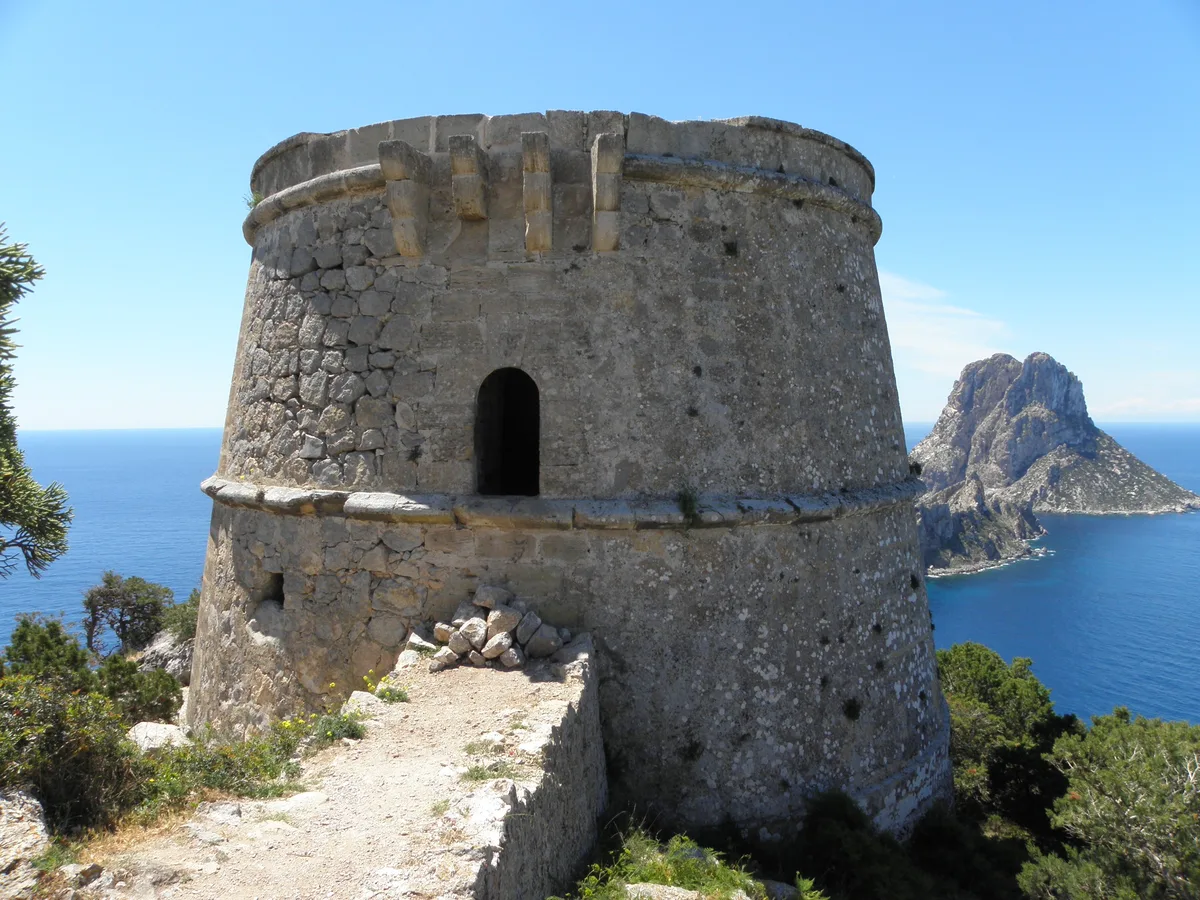
A stone drum above Es Vedrà
The tower is a squat cylinder of rough local stone on the edge of a cliff. It went up in the 1750s as one of the defence towers Ibiza built to spot pirate ships coming in, and that’s why it gets the nickname Torre del Pirata. From here the sea drops away and Es Vedrà rises straight ahead, with its smaller sister islet Es Vedranell beside it.
There are no rails, no kiosk and no signboards worth reading. What you get is the tower, the wind and a bare rock platform. Most visitors face west and wait for the sun to sink behind the island.
It stays a quieter find compared with the Cala d’Hort viewpoints below. Plan on 1–2 hours including the walk.
The walk up from the track
The tower sits in the municipality of Sant Josep de sa Talaia, off the road between Sant Josep village and Cala d’Hort. A signed turn leads onto a dirt track, where cars park along the verge or in a rough clearing.
From there it’s a walk of about 20–30 minutes along a stony path through pine and juniper. The tower’s name comes from savina, the Ibizan word for juniper. The path is uneven but not technical.
- Footwear: trainers with grip at the very least. Loose stones roll underfoot.
- Light: a head torch or a charged phone. The path back is fully dark within half an hour of sunset.
- Water: there’s nothing to buy at the top.
- Car: you need one, or a taxi from Sant Josep. Buses don’t run up the track.
Sunset etiquette on the cliff edge
Sunset is the main event, so the platform fills up in the hour before. Arriving well ahead gets you a flat rock with a clear line to Es Vedrà. Arriving late means peering over shoulders. Google currently lists the site as open 24 hours. It’s open countryside, though, so check locally for any seasonal access limits or fire-risk closures.
- No fires, no cigarettes. In summer the pine slopes are extremely dry, and wildfire is a real threat on Ibiza.
- Keep the noise down. People come up for the silence. Speakers are frowned on.
- Leave the stones where they are. Stacking rock towers damages the fragile cliff ground. You’ll see the habit near here, but don’t add to it.
- Stay back from the edge. The rock crumbles, there’s no barrier and the drop is sheer.
- Start down together. Once the sun is gone, most people leave at once. Walking with the group gives you extra torchlight on the rough stretches.
Sa Pedrera and Cala d’Hort below
A steep, scrambling path drops from near the tower to Sa Pedrera, better known as Atlantis. It’s an old seaside quarry where stone was cut, traditionally said to be for the walls of Dalt Vila. Today it’s a maze of square-cut ledges and tidal pools. The climb back up is hard going, so allow a few hours and don’t attempt it in heat or fading light.
The easier pairing is Cala d’Hort, the beach facing Es Vedrà just down the road. Its waterfront restaurants make a natural stop before you head up. Cala Vadella and Cala Carbó are both a short drive away if you’d rather swim first and walk up for the evening.
Frequently asked questions
How do I get to Torre des Savinar?
Drive from Sant Josep de sa Talaia towards Cala d'Hort and take the signed dirt track. Park on the track, then walk about 20–30 minutes along a stony path through the pines to the tower.
When is the best time to visit?
Sunset, when the sun drops behind Es Vedrà. Get there well before it to claim a spot, and bring a torch because the path down is dark soon after. Google currently lists the site as open 24 hours, but check for seasonal or fire-risk closures.
How long should I allow?
About 1–2 hours for the walk and time at the top. Allow several more hours if you add the steep path down to Sa Pedrera (Atlantis).
Can I go inside the tower?
Treat it as a monument to see from outside. The draw is the cliff-top view of Es Vedrà and Es Vedranell, not the inside of the tower.
What's nearby?
Sa Pedrera (Atlantis) is directly below and reached by a difficult path. Cala d'Hort beach and its restaurants are just down the road, and Cala Vadella and Cala Carbó are a short drive away.
Plan your trip to Ibiza
Spain eSIM & staying connected →
Some links above are affiliate links — if you book through them, Wander Atlas earns a small commission at no extra cost to you. It's how we keep every guide free.