A church with no roof
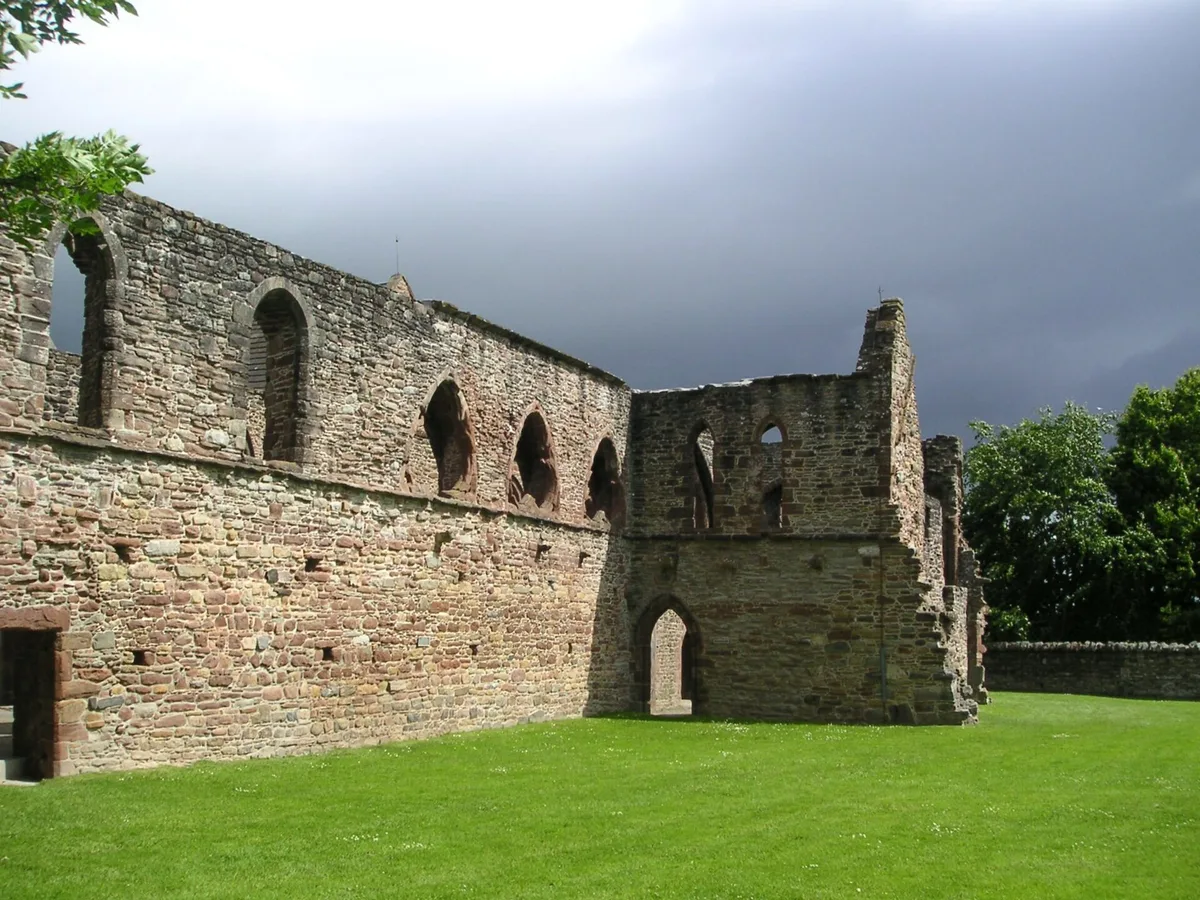
Beauly Priory stands open to the sky. The tall walls of the nave are still standing, and so are the empty window openings and the gable ends. The roof and floors went centuries ago. Grass covers the ground inside, and old trees crowd in around the walls.
The graveyard fills the land around the church. Weathered headstones lean at angles, and some are so worn the carving has nearly gone. The village of Beauly carries on just beyond them.
Monks from Burgundy
The priory was founded around 1230 for the Valliscaulians, a small order of monks from Val-des-Choux in Burgundy. Few people today have heard of the order, and they founded only three houses in Scotland. Beauly is one of them. The French connection may also explain the name: beau lieu, “beautiful place.”
There is a story that Mary, Queen of Scots, said the phrase on a visit in the 1560s. Treat it as local legend. The monks probably gave the place its name long before she came.
By the early 1500s the community had become Cistercian. The Reformation ended religious life here later that century. After that, the building served as a burial place for local families, Frasers and Mackenzies among them.
Reading the ruins
Most visitors are in and out in 30 to 45 minutes. If you like old carved stone, you can easily stay longer. Things to look for:
- The window openings in the nave walls, where the outline of the medieval tracery still shows.
- The burial aisle off the main church, used for family memorials long after the monks had gone.
- Grave slabs and wall monuments inside the walls, some with heraldry and lettering still legible.
- The graveyard, worth a slow lap for its older stones.
The ground is uneven turf with low steps, and it gets soft after rain. Sturdy footwear is a sensible choice here, especially if you plan to wander among the headstones.

Timing it around the crowds
Weekends between 10am and 6pm are when the priory is busiest. Coaches and day-trippers from Inverness arrive in that window, and the small site fills up fast. It’s hard to frame a photo through a window arch when twenty other people are doing the same.
The calmest weekday windows are 7am–8am, 7pm–8pm and 10pm–11pm. At weekends, aim for 7am–8am or any time from 7pm to 11pm. In the Highland summer, long daylight makes an evening visit easy. In winter it will be fully dark by then, so bring a torch and watch your footing.
Google currently shows the grounds as open 24 hours. The site is a Historic Environment Scotland monument, though, and access arrangements can change with the season or after storm damage. Check the official Historic Environment Scotland page before you set off.
Visiting a graveyard that is still a graveyard
Some of the burials here are recent, and local families still tend graves. A few habits help:
- Stay on the grass paths between the rows, and don’t step on the flat ledger stones.
- Don’t climb the walls or sit on monuments. Old masonry is fragile, and HES may fence off unstable sections.
- Keep your voice low. This is a quiet corner of the village, not a picnic lawn.
- Keep dogs on a lead among the graves.
There is normally no ticket desk and nobody at a gate. The information panels on site give you the outline history. If you want the full story of the Valliscaulians, read the HES website before you arrive. There is very little phone-friendly reading available once you’re standing among the stones.
Getting there and what’s nearby
The priory is at the edge of Beauly’s village square, postcode IV4 7DY. By car, take the A862 west from Inverness. The drive is about 12 miles and passes along the shore of the Beauly Firth. Park in the village and walk the last stretch.
Trains on the Far North Line from Inverness stop at Beauly, and the priory is a short walk from the platform. The station platform is very short. Check which carriage you need to be in to get off.
Beauly’s square has shops and cafés, which makes a ruin visit into an easy half-day. The River Beauly runs just outside the village if you want a riverside walk afterwards. If you’re driving, a loop from Inverness can take in Beauly with Muir of Ord or the Black Isle to the north.
Frequently asked questions
When is the quietest time to visit Beauly Priory?
On weekdays, the quietest times are 7am–8am, 7pm–8pm and 10pm–11pm. At weekends, go at 7am–8am or between 7pm and 11pm. Avoid weekends from 10am to 6pm, which is the busiest period.
How do I get to Beauly Priory from Inverness?
By car, it's about 12 miles west on the A862. Park in Beauly village and walk. You can also take a Far North Line train to Beauly station, which is a short walk from the priory.
How long should I spend at Beauly Priory?
Allow 30 to 45 minutes for the ruins and graveyard. Add time for a coffee in the village square or a walk by the River Beauly.
Is Beauly Priory open all the time?
Google currently lists the grounds as open 24 hours. It's a Historic Environment Scotland site, though, and access can change, so check the HES website before you visit.
Who built Beauly Priory?
It was founded around 1230 for the Valliscaulians, a small monastic order from Burgundy in France. It later became Cistercian and fell out of religious use after the Reformation.
Plan your trip to Inverness
United Kingdom eSIM & staying connected →
Some links above are affiliate links — if you book through them, Wander Atlas earns a small commission at no extra cost to you. It's how we keep every guide free.
Related guides
 hidden gem
The Victorian Market: Inverness Travel Guide (4.1★)
 hidden gem
Urquhart Castle: Inverness Travel Guide (4.5★)
 attraction
Ness Islands: Inverness Travel Guide (4.8★)
 attraction