Why go
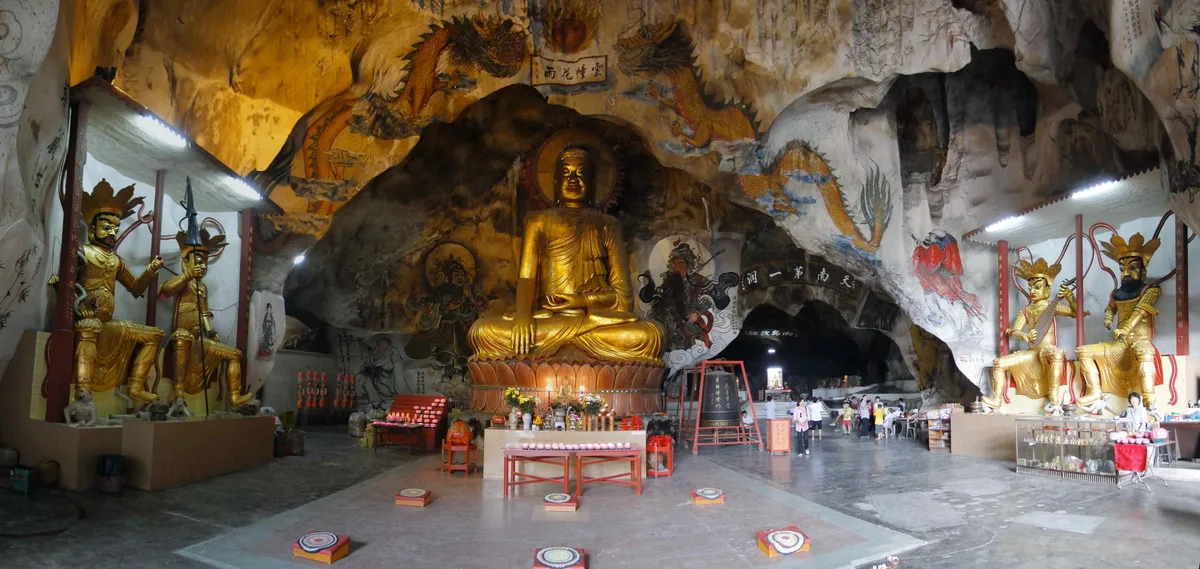
You step through the entrance and the temperature drops ten degrees. The cave swallows the traffic noise from Jalan Kuala Kangsar behind you, and what’s left is dripping stone, incense smoke curling toward a ceiling you can’t quite see, and rows of gilded Buddha statues catching whatever light makes it in.
Perak Tong, as it’s known locally, isn’t a ruin or a museum piece. It’s a working Buddhist temple built into a limestone hill, founded in the 1920s by a Chinese immigrant monk, and it still functions exactly as intended, a place of worship wrapped around a natural cavern.
What you’ll actually see
The main chamber is the payoff: a cathedral-sized cave hall lined with painted murals of Buddhist scenes, some faded to soft pastels, others recently touched up in bright vermillion and gold. Statues range from tabletop-sized to a towering seated Buddha near the back wall.
Look up and you’ll spot stalactites the temple builders left untouched, incorporated into the ceiling instead of chiseled away.
- The main cave hall with murals and multiple Buddha statues
- A rear passage leading to a smaller connected cavern
- A steep staircase (roughly 300 steps) climbing through a rock crevice to the hilltop
- A hilltop pavilion with views over Ipoh’s karst limestone landscape
That staircase is not optional if you want the view, and it’s genuinely steep, narrow steps, some uneven, with handrails but little shade. Wear shoes with grip, not flip-flops.

Getting there
Perak Cave Temple sits in Kawasan Perindustrian Tasek, a few kilometres north of Ipoh’s old town, on Jalan Kuala Kangsar. There’s no MRT or rail line here, Ipoh’s train station is downtown, well away from the temple.
Most visitors arrive by Grab (Malaysia’s ride-hailing app), taxi, or rental car. It’s roughly a 10–15 minute drive from the old town or the railway station, and there’s free parking on site if you’re self-driving. Many people pair it with nearby Sam Poh Tong or Kek Lok Tong, two other cave temples a short drive away, making a half-day loop of Ipoh’s limestone temples.
When to go
The temple opens daily from 8am to 4:30pm, so plan your visit inside that window, arriving even a little after 4:30pm means a locked gate.
Weekday mornings between 8am and 10am are the quietest stretch, with fewer tour buses and a cooler cave interior before midday heat builds outside. On weekends, only the narrow 8am–9am slot stays calm.
From 10am onward on Saturdays and Sundays, crowds build steadily and stay heavy right through to closing at 4:30pm. If a peaceful, unhurried visit matters to you, weekday morning is the clear winner.
How to visit like a local
Come early and dress modestly. This is an active place of worship, not a photo backdrop, so keep shoulders and knees covered even though the cave itself feels informal.
Entry is by donation rather than a fixed ticket price; small denomination ringgit notes are the norm, dropped into the box near the entrance. Card payment isn’t the culture here. Bring cash for the donation box and for the snack and drink stalls near the car park.
Perak Tong draws steady coach-tour traffic, so it’s well-visited rather than a quiet local secret, timing your visit matters more than seeking it out at an off hour nobody else knows.
The staircase to the top is where most tourists give up halfway; locals who climb it regularly pace themselves, pause at the shaded ledges, and carry water rather than buying it at the summit, since there’s no stall up there.
Remove your shoes only where signage indicates it, generally right at the inner shrine areas, not the whole cave. Photography is generally fine in the main hall, but ask before photographing anyone actively praying. It’s a small courtesy that goes a long way in a still-active temple.
Frequently asked questions
How do I get to Perak Cave Temple from Ipoh city centre?
It's about a 10–15 minute drive north on Jalan Kuala Kangsar. Grab (ride-hailing), taxi, or a rental car are the practical options since there's no direct rail or bus line.
What time is quietest to visit?
Weekdays between 8am and 10am are calmest. On weekends only the 8am–9am slot stays quiet; from 10am onward crowds build and stay heavy until closing.
How much time should I set aside?
Plan 45–60 minutes: 20 minutes for the main cave hall and murals, plus time for the roughly 300-step climb to the hilltop pavilion if you want the view.
Is there an entrance fee?
Entry is by donation rather than a fixed ticket price. Bring small ringgit notes for the donation box at the entrance.
Can I combine this with other sights nearby?
Yes — Sam Poh Tong and Kek Lok Tong, two other cave temples, are a short drive away, making it easy to see three of Ipoh's limestone temples in one half-day.
Plan your trip to Ipoh
Some links above are affiliate links — if you book through them, Wander Atlas earns a small commission at no extra cost to you. It's how we keep every guide free.
Related guides
 attraction
 Gunung Lang Recreational Park: Ipoh Travel Guide
 hidden gem
 Han Chin Pet Soo: Ipoh Travel Guide
 attraction
 Cactus Valley: Cameron Highlands Travel Guide (4.0★)
 attraction