
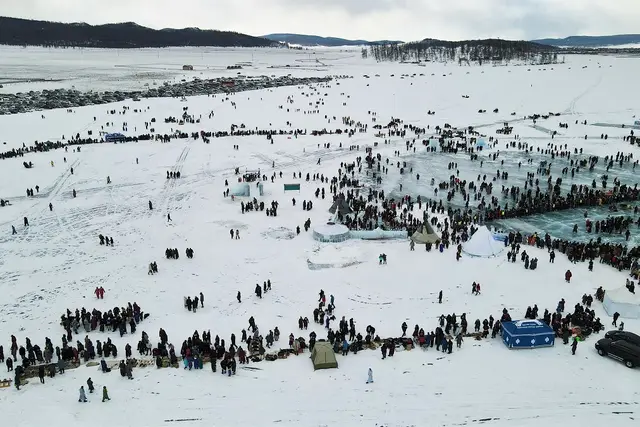
Lake Khövsgöl freezes so hard that trucks cross it in winter. For one stretch of late winter the frozen surface off Khatgal also serves as a racetrack, a shooting range and a skating rink, with snow-dusted larch hills all around it. The ice under your boots is often clear enough to see cracks and trapped bubbles running down into dark water.
A lake that becomes the venue
There is no stadium here. The Blue Pearl Ice Festival takes its name from the lake’s Mongolian nickname, and the lake itself is the venue.
Khövsgöl sits near the Russian border and holds most of Mongolia’s fresh water. In summer it is a deep blue that ripples. By late February it is a white plain, and the competitions are laid out on the ice just off Khatgal, the small log-and-timber village at its southern end.
Spectators stand on the ice or along the shore. Behind them the village chimneys trail woodsmoke, because nearly every house in Khatgal burns wood through the winter.
When the festival falls
The festival is held once a year in the late-winter window, around late February to early March. The 2025 edition ran February 13–23. The 2027 edition takes place in a similar late-February to early-March period.
The timing has a practical reason. This is when the ice is at its thickest and safest for horses, vehicles and crowds. It is also before the spring thaw makes the roads north from Mörön soft and muddy.
Because the dates move from year to year, most international visitors travel with a Mongolian tour operator. These operators build their winter itineraries around the dates the organisers set for that edition.
Hooves, blades and rifles on the ice
The programme is built around three kinds of competition:
- Horse races on the ice. Mongolian horses race across the frozen surface with riders in heavy deels, the traditional quilted robe.
- Ice skating races. Speed races on a course marked out across the lake.
- Ice shooting. A target contest held out on the ice.
The horse races are what most photographers come for. Small, stocky Mongolian horses running across flat white ice, with the shoreline hills behind, is a scene you won’t find at summer Naadam.
Between events, people cluster around vehicles parked on the ice, and families pass thermoses of milk tea (süütei tsai) back and forth. Things move at a herder’s pace, not a stadium’s. Gaps between races are normal.
Getting north to Khatgal in winter
Khatgal is remote, and getting there is part of the trip. Most people fly from Ulaanbaatar’s airport to Mörön, the capital of Khövsgöl Province. From Mörön it is roughly 100 km north to Khatgal by road.
That road is usually covered in a Russian-built UAZ van or a 4x4 with a local driver. Overland travel all the way from Ulaanbaatar takes a long day or more, on roads that are partly unpaved and icy in February.
Tour packages usually include the Mörön transfer. Independent travellers tend to arrange a driver in Mörön rather than look for public transport, which is sparse in winter.
Dressing for a day on open ice
It gets colder here than most visitors have known. Night temperatures in the Khövsgöl area in late February regularly sit far below minus 20°C, and out on the open lake there is nothing to stop the wind.
What experienced visitors bring:
- Insulated boots rated for deep cold, with room for two pairs of wool socks
- Microspikes or ice cleats, since wind-polished ice is slick
- A down parka that covers the hips, plus insulated trousers
- A face covering and goggles for wind on the lake
- Spare camera and phone batteries kept in an inside pocket, because cold drains them fast
Spectators usually go back to a vehicle or a heated ger between events rather than stand out for hours.
Manners on the ice and in the ger
Most of the festival’s social life happens inside felt gers and wooden guesthouses. Mongolian customs apply there just as they do in the countryside. A few that matter:
- Step over the threshold of a ger, never on it, and move clockwise once inside.
- Take offered tea or food with your right hand, or with both hands, even if you only take a sip.
- Ask before photographing herders, riders and their horses. A gesture with the camera is usually understood.
- Keep clear of the horses’ line at the start and finish. The racers come in fast and can’t stop quickly on ice.
Khatgal is cash country. Most people carry Mongolian tögrög drawn from a bank in Mörön or Ulaanbaatar, because cash machines and card terminals in the village can’t be relied on. Any entry charge is set by the organisers each year, and tour operators state what their package covers.
Where to sleep, and what else is nearby
Khatgal fills up for festival week. Many of the summer ger camps along the lakeshore close for winter. Visitors usually stay in the heated guesthouses and the handful of camps that stay open, often booked through the same operator who arranges transport.
If you have spare days, these are nearby:
- The frozen lake itself. Driving or walking north along the shore shows how far the ice stretches toward the Russian border.
- Uushigiin Övör deer stones, near Mörön. These are Bronze Age standing stones carved with stylised flying deer, and they’re an easy stop on the drive back south.
- Mörön, a working provincial capital with markets and the regional transport links.
Most visitors spend two to three days in Khatgal for the festival, plus a travel day on each side. That leaves time for the races and for evenings around a wood stove.
Frequently asked questions
When is the Blue Pearl Ice Festival held?
Every year in late winter, around late February to early March. The 2025 edition ran February 13–23, and the 2027 edition falls in a similar window.
How do I get to Khatgal for the festival?
Most visitors fly from Ulaanbaatar to Mörön, the Khövsgöl provincial capital. From there it is roughly 100 km north to Khatgal, usually in a 4x4 or UAZ van with a local driver. Driving the whole way from Ulaanbaatar takes a long day or more on icy, partly unpaved roads.
What events take place at the festival?
The core competitions are horse races on the frozen lake, ice skating races and ice shooting, all held on Lake Khövsgöl just off Khatgal.
How cold is it, and what should I wear?
Late-February nights around Lake Khövsgöl regularly drop far below minus 20°C, and there is wind on the open ice. Visitors wear deep-cold boots, insulated trousers, a long down parka, a face covering and ice cleats, and they keep spare batteries warm in an inside pocket.
How long should I spend in Khatgal?
Most visitors stay two to three days for the festival, plus a travel day at each end for the Mörön connection. Extra time lets you add the Uushigiin Övör deer stones near Mörön.
Plan your trip to Khatgal
Mongolia eSIM & staying connected →
Some links above are affiliate links — if you book through them, Wander Atlas earns a small commission at no extra cost to you. It's how we keep every guide free.
Related guides
 event
Khovsgol Ice Festival (Blue Pearl Ice Festival): Dates, Tickets & Venue (Khatgal)
Winter Horse Festival (Steppe Horse Festival): Dates, Tickets & Venue (Batnorov)
 event
Thousand Camel Festival: Dates, Tickets & Venue (Dalanzadgad)
 Ended