Mongolia declared a people’s republic in 1924 and became the world’s second socialist state. Most of the 20th century followed from that. From October 10 to November 19, 2026, the National Museum of Mongolia gives its attention to the four decades in the middle: 1950 to 1990.
The exhibition is called Evening Museum: Let’s Travel Through Socialism. It covers four strands of that era: everyday life, industry, science and culture.
Four decades, four strands
The years are chosen with care. In 1950 the state already controlled Mongolian life, and by 1990 it was coming apart. The exhibition’s four themes line up with some well-known moments of the period:
- Industry: Darkhan was founded in 1961 as a planned industrial city. In the 1970s Erdenet was built around one of Asia’s largest copper deposits.
- Science: in 1981 Jügderdemidiin Gürragchaa flew on Soyuz 39 and became the first Mongolian in space.
- Everyday life: this was the age of state shops, collective herding and the Soviet-style apartment blocks that still line Ulaanbaatar’s avenues.
- Culture: state theatre, film and music grew up under the party. The era ended in 1990, when demonstrations on the square outside brought about multiparty elections.
None of this is a list of what’s on display. It’s background that helps the rooms make sense.
Finding the museum off Sükhbaatar Square
It’s hard to miss. The National Museum of Mongolia stands on the corner of Juulchin Street and Sükhbaatar Street, at the northwest edge of Sükhbaatar Square. The Government Palace and its huge seated statue of Chinggis Khaan face the square a block away.
Ulaanbaatar has no metro. Most visitors staying in the centre just walk. City buses run along Peace Avenue (Enkh Taivny Örgön Chölöö), a couple of blocks south. Ride-hailing apps and taxis cover the rest.
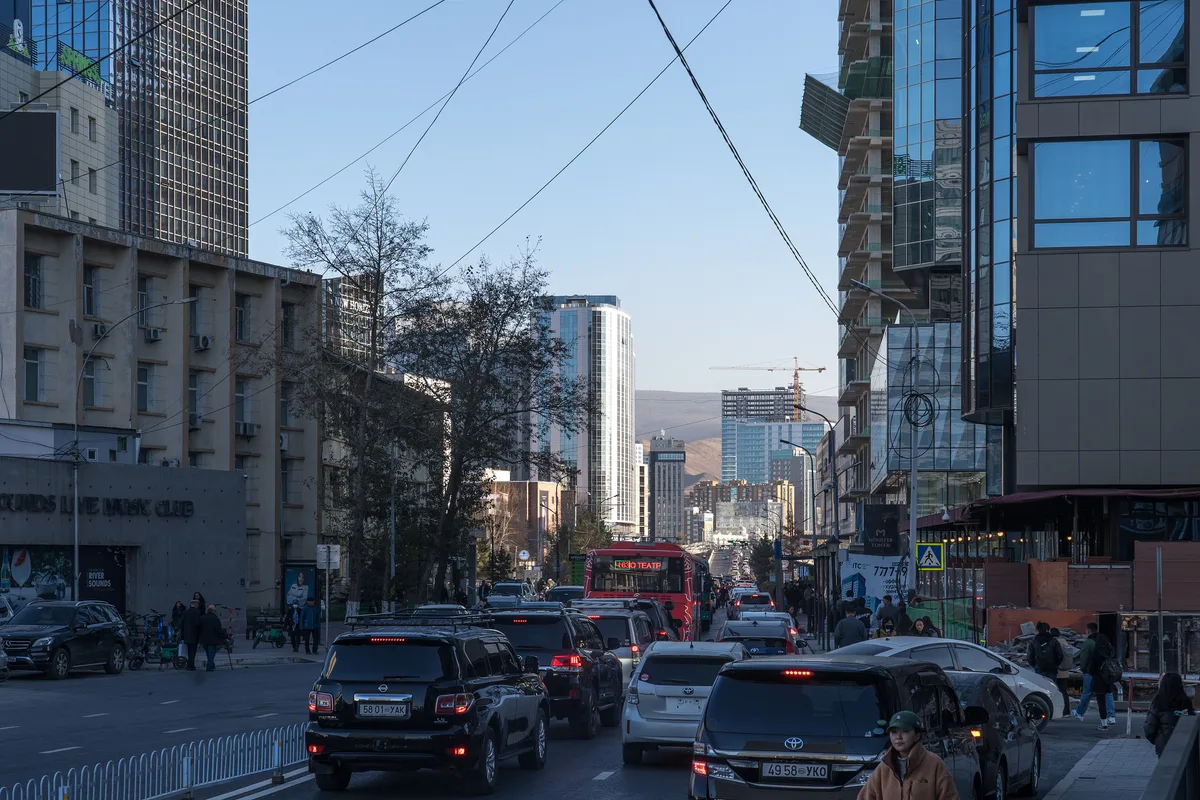
Traffic in the city centre is famously slow at rush hour. Locals going crosstown in the evening often find walking the last stretch quicker.
Moving through the galleries
The museum’s permanent galleries tell Mongolia’s story from prehistory onward. A temporary socialist-era show fits that story well. Here’s how visitors usually handle it:
- Ask by name. In Mongolian the museum is Үндэсний музей (Ündesnii muzei), and taxi drivers know it. A simple “Sain baina uu” (hello) at the desk goes a long way.
- Pay by card or tugrik. Card payment is normal across central Ulaanbaatar. The museum’s front desk sets the exhibition’s admission and photography rules.
- Read the captions slowly. Many labels in Mongolian museums are Mongolian-first. A translation app with camera mode helps with longer texts.
- Give it time. Most people spend about an hour on a themed exhibition like this. Add another hour if you’re pairing it with the 20th-century rooms upstairs.
The “Evening” in the title points to an after-work format. The museum publishes its exhibition hours and ticket details on its official website.
Socialism on the streets outside
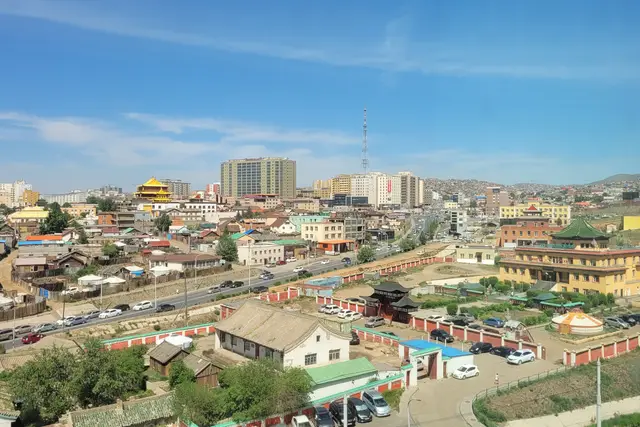
The exhibition doesn’t stop at the museum doors. Central Ulaanbaatar is still largely a planned socialist city, and you can walk through it.
- The Academic Theatre of Opera and Ballet: this salmon-pink building on the square’s east side dates from the late 1940s.
- The State Department Store (Ikh Delguur): it’s on Peace Avenue, and generations of shoppers knew it as the country’s main store.
- The Zaisan Memorial: this Soviet-built monument from 1971 sits on a hill south of the centre. Its circular mosaic shows Soviet–Mongolian friendship.
- Choijin Lama Temple Museum: it’s south of the square, a temple complex that survived the purges of the 1930s as a museum.
Seeing the exhibition first gives the Zaisan mosaic and the opera house façade much more to say.
An Ulaanbaatar autumn
The show runs while the weather turns. Ulaanbaatar is one of the coldest capitals in the world. Evenings in October are sharp, and by mid-November temperatures sit well below freezing.
Visitors usually come in a proper winter coat, a hat and gloves, especially for the walk across the open square after dark. The cold is also why so many attendees end with a hot meal or milk tea in the cafés along Peace Avenue.
Frequently asked questions
When and where is Evening Museum: Let's Travel Through Socialism held?
It runs from October 10 to November 19, 2026, at the National Museum of Mongolia. The museum is on the corner of Juulchin Street and Sükhbaatar Street, just northwest of Sükhbaatar Square in central Ulaanbaatar.
How do I get to the National Museum of Mongolia?
Ulaanbaatar has no metro. Most visitors in the city centre walk there from Sükhbaatar Square. City buses run along Peace Avenue a couple of blocks south, and taxi drivers know it as Ündesnii muzei.
Where do the ticket and hours details come from?
The National Museum of Mongolia organises the exhibition. It publishes its hours and admission details on its official website, and its front desk sets the photography rules.
How long does the exhibition take?
Most visitors spend about an hour on a themed exhibition like this. Allow another hour if you're also seeing the museum's permanent 20th-century galleries.
What else from the socialist era can I see nearby?
The Academic Theatre of Opera and Ballet is on Sükhbaatar Square and the State Department Store is on Peace Avenue. The Zaisan Memorial, a Soviet-built monument from 1971, is a short ride south of the centre.
Plan your trip to Ulaanbaatar
Mongolia eSIM & staying connected →
Some links above are affiliate links — if you book through them, Wander Atlas earns a small commission at no extra cost to you. It's how we keep every guide free.
Related guides
 event
Genghis Khan Birthday Commemoration: Dates, Tickets & Venue (Ulaanbaatar)
 event
Genghis Khan's Birthday: Dates, Tickets & Venue (Ulaanbaatar)
 event
MLBB Championship Tour East Asia (MCT EA) Ulaanbaatar: Dates, Tickets & Venue (Ulaanbaatar)
 event