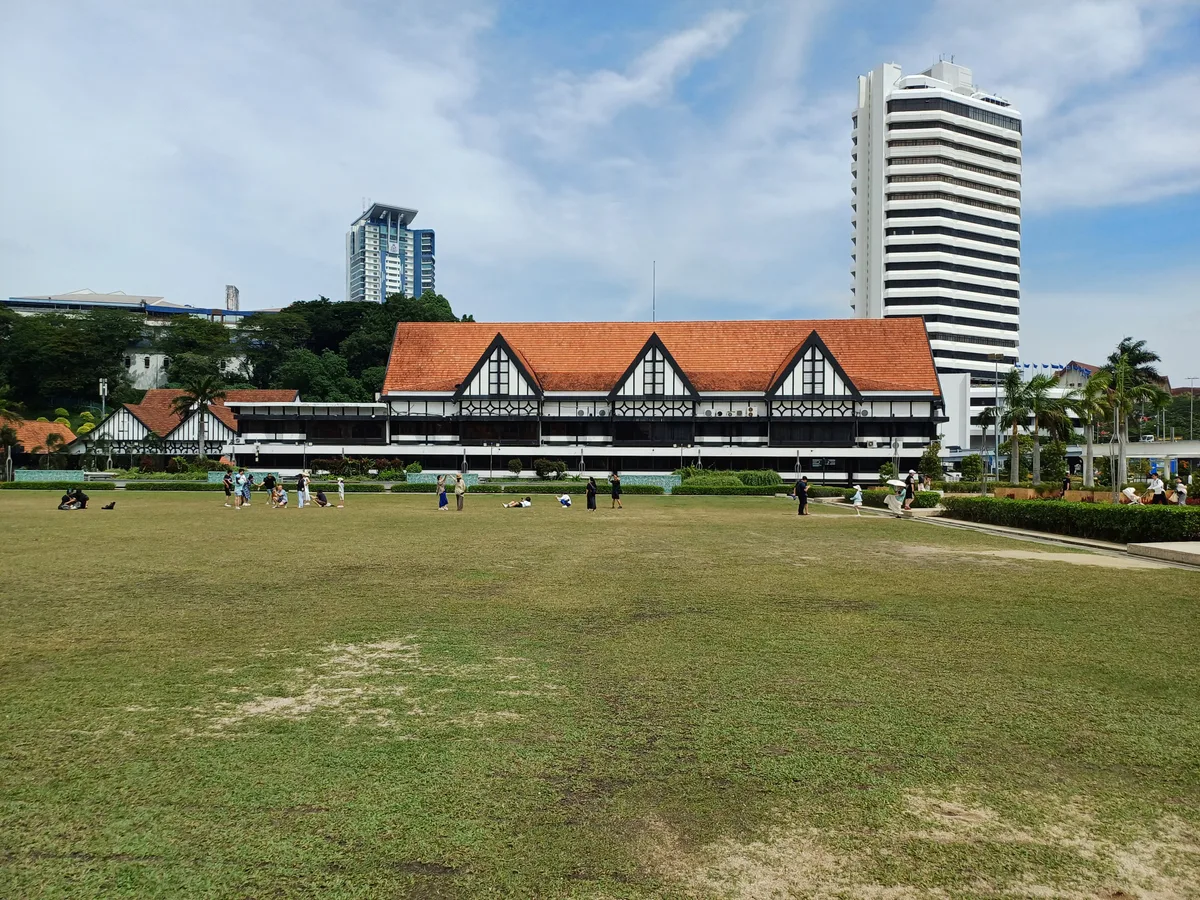
A start line on Independence Square
The race starts on Malaysia’s most symbolic patch of grass. Dataran Merdeka, Independence Square, is where the Union Jack came down and the Malayan flag went up at midnight on 31 August 1957. The start and finish of the full and half marathon were set on that same lawn.
Look east from the corrals and you face the Sultan Abdul Samad Building. It is a long run of red brick and white arches, topped with copper domes and a central clock tower. Behind you stands the mock-Tudor Royal Selangor Club, and at the square’s southern end is a flagpole that is among the tallest in the world. Few marathons put a start line in a setting like this.
Two days, four distances
The Kuala Lumpur Standard Chartered Marathon, KLSCM to most runners, splits across a weekend. As announced for 2026:
- Saturday, October 3: the 10km and 5km races
- Sunday, October 4: the marathon and half marathon, both starting and finishing at Dataran Merdeka
The split suits groups. A family could run the 5km on Saturday and still be at the finish line to cheer the marathoners on Sunday. Faster runners sometimes treat the shorter Saturday races as a shakeout before heading home.
The event holds a World Athletics Elite Label, which places it among the internationally recognised road races. That means an elite field up front. Behind them come tens of thousands of everyday runners, thousands of them from over 70 countries.
Racing Kuala Lumpur’s wet heat
Heat and humidity are the real course profile here. Kuala Lumpur sits just north of the equator, and the air stays warm and damp even before sunrise. Big road races in the city start in the dark so runners finish before the sun climbs, and wave times are seeded accordingly.
Early October falls in the inter-monsoon period. Afternoon thunderstorms are common, and a heavy shower the evening before can leave the morning air feeling thick. Visitors from cooler climates usually adapt in a few ways:
- Arriving several days early and doing short runs at the same pre-dawn hour as the race.
- Drinking to a plan from the first water station rather than waiting for thirst.
- Light, vented kit and a slower goal pace. A personal best is rarely the right target in this climate.
- Dry clothes for after the finish, since runners are soaked whatever the sky does.
Getting to Dataran Merdeka
The square sits in KL’s old colonial core, on the bank where the Klang and Gombak rivers meet. Two rail stations are a short walk away:
- Masjid Jamek LRT, an interchange for the Kelana Jaya and Ampang/Sri Petaling lines, a few minutes’ walk north-east of the square
- Pasar Seni, on the LRT Kelana Jaya Line and MRT Kajang Line, a short walk south past Central Market
Race starts can come before normal train service begins, and Rapid KL sometimes adds extended early service for race days. Roads around the square close for the race, so a car or taxi drops passengers a few blocks away.
Grab, the e-hailing app used across Malaysia, is the usual fallback: a pin outside the closure zone, then a short walk in. Hotels around Chinatown, Masjid Jamek and Bukit Bintang put the start line within a walk or a short ride, beyond the reach of road closures.
Race morning around the square
Pre-dawn Dataran Merdeka works like a small, sleepy city. The routine is a familiar one:
- Race kit collected in advance. Bib and kit collection happens at a set venue on set days before the race, with ID and registration confirmation required.
- Assigned corrals. Waves are seeded. Edging into a faster pen slows everyone behind, and is frowned on.
- An early bag drop. Queues for baggage and portable toilets build up fastest in the final half hour before the gun.
- Respect for the square. Dataran Merdeka is a national monument. The lawn is left as it was found, and gel wrappers go in the bins at the stations, not on the road.
On the course, the cheering is bilingual. Malaysians shout “Jom!” (let’s go) and “Boleh!” (you can do it) from the roadside, and runners wave back.
At water stations, runners call out or point before cutting across to the tables, then move on rather than stopping in the flow. The same courtesy goes for walking breaks: a step to the side, a raised hand, and the pack passes.
Old KL, the morning after
The finish line sits in the most walkable part of the city. Past the medals, Pasar Seni’s Central Market is right there. The Art Deco hall, painted pale blue, is full of crafts and batik. A few minutes beyond it is Petaling Street in Chinatown, with Kwai Chai Hong’s restored back lane of murals just off it.
Masjid Jamek, the city’s oldest mosque, stands where the two rivers meet behind the square. Visitors are welcome outside prayer times if dressed modestly, and robes are provided at the entrance. The River of Life promenade along that confluence is flat and easy for recovery steps.
Breakfast in this city is the right reward for a long run. These are the post-race staples:
- Nasi lemak: coconut rice with sambal, anchovies, peanuts and egg, often wrapped in a banana leaf
- Roti canai: flaky griddled flatbread with dhal or curry, at any mamak stall
- Teh tarik: sweet milky tea, poured from a height until frothy
- Kopi at a Chinatown kopitiam, served with kaya toast and soft-boiled eggs
Mamak restaurants, the Indian-Muslim eateries found all over KL, are often open around the clock. They are a dependable option at whatever hour a runner finishes.
Entries, categories and the official source
KLSCM entries are sold by category and fill by distance, and international runners register online. Entry fees, cut-off times, age limits and the route map are set by the organisers each year. Entries for 2026 were sold through the official KLSCM website.
Entry requirements vary by category. Some ask for a medical declaration, others for a qualifying time, and those conditions apply at kit collection as well as at registration. Overseas runners entering the October 3-4, 2026 weekend signed up under the same terms as local entrants.
Frequently asked questions
When is the Kuala Lumpur Standard Chartered Marathon 2026?
The announced dates were October 3-4, 2026. The 10km and 5km races were on Saturday, October 3, and the marathon and half marathon on Sunday, October 4, both starting and finishing at Dataran Merdeka.
Where do the marathon and half marathon start and finish?
Both start and finish at Dataran Merdeka (Independence Square), opposite the Sultan Abdul Samad Building in central Kuala Lumpur. The nearest rail stations are Masjid Jamek (LRT) and Pasar Seni (LRT/MRT).
How do I get to the start line before dawn?
Race starts come before normal train service begins, and Rapid KL sometimes adds extended early trains on race day. Grab, the e-hailing app used across Malaysia, is the usual fallback, with drop-offs outside the road-closure zone. Hotels in Chinatown or near Masjid Jamek are within walking distance of the square.
How hot is it during the race?
Kuala Lumpur is warm and very humid even before sunrise, and early October brings frequent afternoon thunderstorms. Races start early to avoid the heat. Light kit, a steady hydration plan and a conservative pace are the norm in this climate.
What can I do near Dataran Merdeka after the race?
Central Market (Pasar Seni), Petaling Street, Kwai Chai Hong, Masjid Jamek and the River of Life promenade are all a short walk away. Nearby mamak and kopitiam spots serve nasi lemak, roti canai and teh tarik.
Plan your trip to Kuala Lumpur
Malaysia eSIM & staying connected →
Some links above are affiliate links — if you book through them, Wander Atlas earns a small commission at no extra cost to you. It's how we keep every guide free.
Related guides
 event
5 Seconds of Summer: Everyone's a Star! Tour: Dates, Tickets & Venue (Kuala Lumpur)
 Ended
Aaron Kwok ICONIC World Tour 2026: What to Know (Kuala Lumpur)
 event
As If She Were Here: Chen Jia Sings Teresa Teng: Dates, Tickets & Venue (Kuala Lumpur)
 Ended