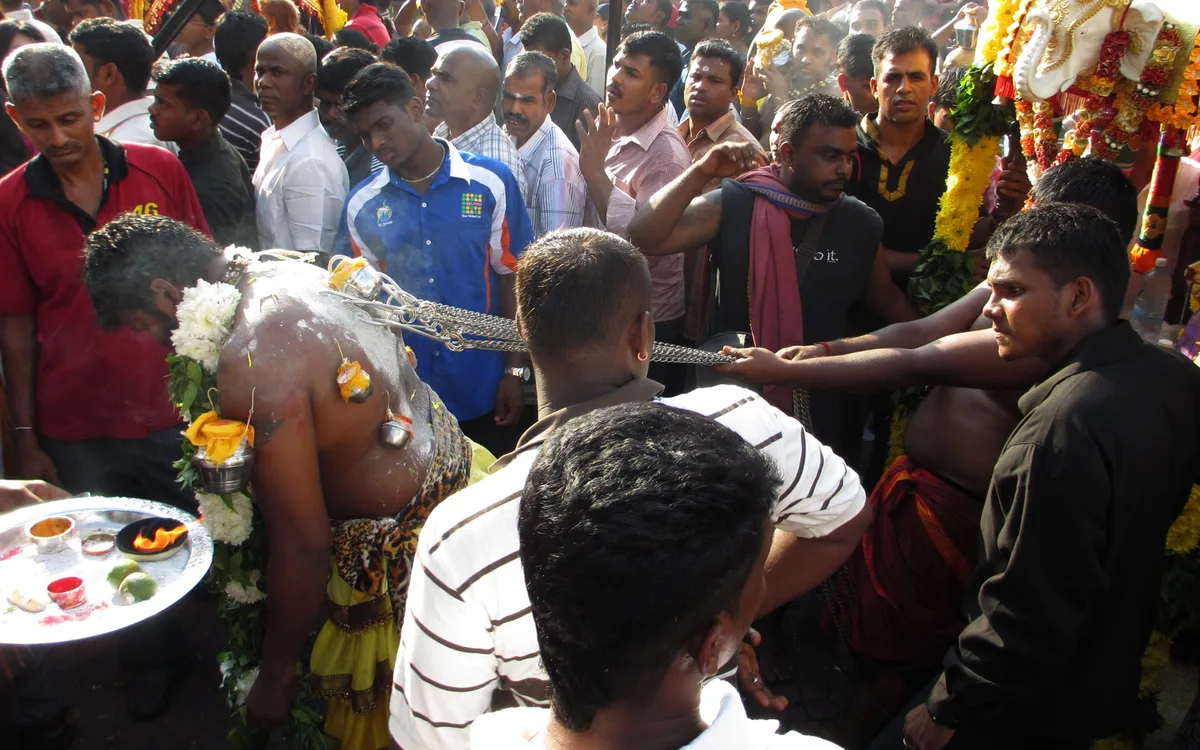
Look up from the forecourt and a gold figure of Lord Murugan, more than 40 metres tall, stands against a limestone cliff. Beside him, 272 steps climb into the rock. On Thaipusam those steps are packed from bottom to top with people carrying milk pots, peacock-feather frames and steel hooks, climbing towards the shrine inside the mountain.
What Thaipusam marks
Thaipusam is a Tamil Hindu festival. It falls on the full moon of the Tamil month of Thai and honours Murugan, the god of war and victory. It commemorates the day his mother, Parvati, gave him the vel, a divine spear, to defeat a demon.
Malaysia’s Tamil community marks it more visibly than almost anywhere outside India, and Batu Caves holds the country’s largest gathering. In recent years attendance has run into the hundreds of thousands. The 2027 festival falls on January 22, and the build-up begins the night before.
Devotees prepare for weeks with fasting, prayer and abstinence. What you see at the caves is the fulfilment of a vow:
- Paal kudam: brass or steel pots of milk carried on the head as an offering to Murugan.
- Kavadi: decorated frames, some small and some towering, carried on the shoulders or attached to the body.
- Vel piercings: small spears through the cheeks or tongue, and hooks in the back or chest.
- Shaved heads: a common offering, often for children, done at stalls near the foot of the steps.
The silver chariot’s night walk from Chinatown
The procession starts in the city, not at the caves. A silver chariot carrying Murugan’s image leaves the Sri Maha Mariamman Temple on Jalan Tun H.S. Lee, in Chinatown, on the eve of Thaipusam. Bullocks have traditionally pulled it, and it is surrounded by devotees on foot.
It covers roughly 15km through the night, heading north along roads that are closed to traffic for the procession. People along the route smash coconuts in its path as an offering, and the shells pile up on the asphalt. The chariot reaches Batu Caves in the early hours, around the time the main crowds begin to climb.
You don’t have to go to the caves for this part. Many visitors see the chariot pass in Chinatown or along Jalan Ipoh and then take a train north.
Getting to Gombak on the day
The most direct way in is the train. Batu Caves station is the northern terminus of the KTM Komuter line and sits next to the temple grounds. Riders usually change at KL Sentral. The trains are crowded on Thaipusam, but they skip the gridlock that builds on the roads around Gombak.
Taxis and ride-hailing cars get you close but often drop passengers some distance away once the police roadblocks are up. Plenty of people walk the last stretch either way. Inside the grounds you’ll find:
- Rows of stalls selling flower garlands, coconuts and Indian sweets.
- Free drinks and food handed out by volunteers and devotees’ families, a long-standing Thaipusam custom.
- Barbers shaving heads in the open air.
- Long-tailed macaques around the steps, eyeing anything edible.

Tickets, dates and who runs it
No tickets are sold for Thaipusam itself; the procession and the climb are free. The Batu Caves temple is managed by the Sri Maha Mariamman Temple Devasthanam, the trust behind the Chinatown temple where the chariot starts.
The festival date follows the Tamil lunar calendar, so it moves every year between mid-January and mid-February. In 2027 it is January 22. Thaipusam is a public holiday in Kuala Lumpur and Selangor, so offices and schools are closed and crowds are bigger than on a normal weekday.
Climbing with the kavadi bearers
The crowd follows a few unspoken rules. Learning them is the difference between being a welcome guest and getting in the way.
- Give devotees right of way. People carrying kavadi or milk pots are completing a vow, often after weeks of fasting. Step aside on the stairs and never cut through a group.
- Dress for a temple. Shoulders and knees covered is the norm. Wraps are often available at the base for anyone in shorts.
- Shoes come off inside shrine areas. Visitors usually wear sandals they can slip off quickly.
- Ask before close-up photos. Many devotees are in a trance-like state, and their families walk alongside to support them. A telephoto from the side is less intrusive than a phone in someone’s face.
- Accept food with your right hand. Free food and drink are offered as charity, and taking it is fine.
Drums and chanting, especially the cry of “Vel vel”, carry each kavadi bearer up the steps. Groups of supporters dance in front of the heavier kavadi on the forecourt, and a circle usually forms around them. Onlookers usually stay at the edge of the circle rather than stepping inside it.
Inside the Temple Cave
The 272 steps lead to the Temple Cave, a huge limestone chamber open to the sky at its far end. On Thaipusam, devotees pour their milk over the vel of Murugan at the shrine here, and priests remove the hooks and spears. Witnesses often comment that the piercings barely bleed.
The climb is steep, and on festival day the flow slows to a shuffle. Inside, the cave is noisy, smells of camphor and incense, and the floor is slick with spilt milk. Expect the round trip from the forecourt to take a good chunk of the morning on the busiest stretch.
Pacing the day
Many visitors make Thaipusam a night-to-morning trip: they catch the chariot leaving Chinatown in the evening, then reach Batu Caves for the pre-dawn and morning climb, when the procession arrives and the ritual is at its most intense. Others come mid-morning and accept heavier crowds on the stairs.
It’s January in the tropics. Heat builds through the morning and short downpours are common, so water and a light rain layer are what regular attendees tend to carry. Most people leave once the climb is done. The train back towards KL Sentral gets you to Chinatown and the Sri Maha Mariamman Temple in time to see the city side of the festival.
Frequently asked questions
When is Thaipusam at Batu Caves in 2027?
Thaipusam falls on Friday, January 22, 2027. The silver chariot procession leaves Chinatown's Sri Maha Mariamman Temple on the eve of the festival, and devotees climb the Batu Caves steps from the early hours of the 22nd.
Do I need a ticket for Thaipusam at Batu Caves?
No. The festival, the procession and the climb to the Temple Cave are free and open to visitors of any faith. Visitors are expected to dress modestly and give devotees right of way.
How do I get to Batu Caves from central Kuala Lumpur?
Take the KTM Komuter train to Batu Caves station, the end of the line next to the temple. Most riders change at KL Sentral. On Thaipusam, roads around Gombak are heavily congested, so the train is the most reliable option.
What should I wear to Thaipusam?
Cover your shoulders and knees, as you would at any temple, and wear sandals you can take off quickly for the shrine areas. A light rain layer helps in January, when short tropical showers are common.
Can I see the procession without going to the caves?
Yes. The silver chariot leaves the Sri Maha Mariamman Temple on Jalan Tun H.S. Lee in Chinatown on the eve of Thaipusam. Many people see it set off in Chinatown or pass along the route north, and some then travel on to Batu Caves.
Plan your trip to Kuala Lumpur
Malaysia eSIM & staying connected →
Some links above are affiliate links — if you book through them, Wander Atlas earns a small commission at no extra cost to you. It's how we keep every guide free.
Related guides
 event
5 Seconds of Summer: Everyone's a Star! Tour: Dates, Tickets & Venue (Kuala Lumpur)
 Ended
Aaron Kwok ICONIC World Tour 2026: What to Know (Kuala Lumpur)
 event
As If She Were Here: Chen Jia Sings Teresa Teng: Dates, Tickets & Venue (Kuala Lumpur)
 Ended