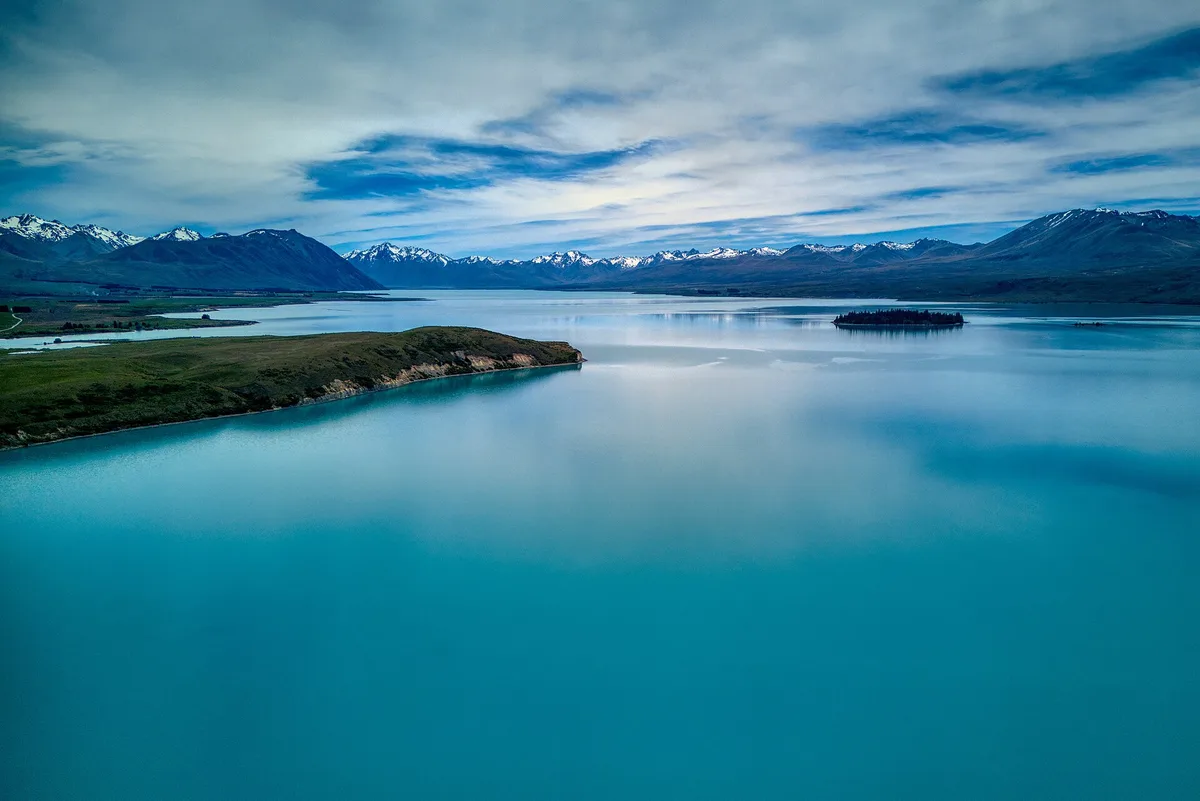
Milk-blue water, brown hills
Nothing prepares you for the colour. Lake Tekapo is a pale, chalky turquoise that looks wrong next to the tawny tussock hills around it. The tint comes from rock flour: fine particles ground off the Southern Alps by glaciers, carried down the Godley and Macauley rivers and held in suspension in the water.
Sunlight bounces off those particles. That’s why the lake looks brightest when the sun is high and goes slate-grey under cloud. On a clear day you look up the lake from the township’s foreshore to snow on the main divide at its head. The ground is open at all hours, but the colour only really shows in daylight.
Getting to Tekapo
Tekapo sits on State Highway 8, the inland route through the Mackenzie Basin. From Christchurch it’s roughly a three-hour drive through Geraldine and Fairlie, climbing over Burkes Pass. From Queenstown it’s a similar time heading north via Cromwell, Omarama and Twizel.
- By car: the easiest option, and needed for most viewpoints beyond the township.
- By coach: Christchurch to Queenstown services stop in Tekapo, often as a short break on the way.
- Next stop: Lake Pukaki is under an hour south-west, and Aoraki/Mount Cook Village is about an hour and a half beyond Tekapo.
Fill up and shop in town. The basin is wide, empty country with long gaps between services.
The stone church on the shore
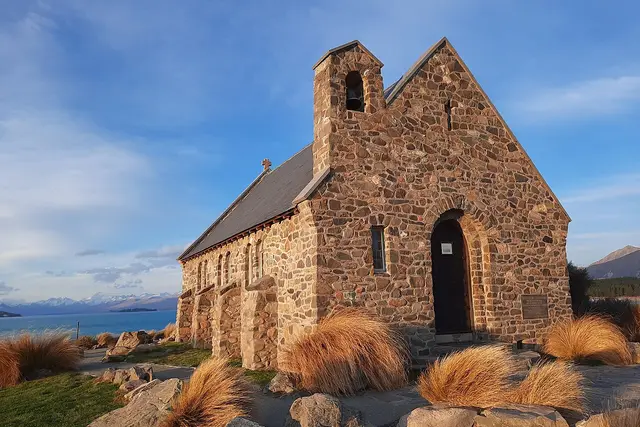
The Church of the Good Shepherd stands on a rocky point just east of the outlet bridge. It was built in 1935 from local stone, and its altar window frames the lake and mountains, so the view becomes the church’s backdrop. A short walk away, a bronze collie statue honours the sheepdogs that made high-country farming possible in the Mackenzie.
Both sit close to the main road. That makes them the first place most coaches stop. Walk the shoreline a few hundred metres either way and you’ll usually have the gravel beach far more to yourself. Opening hours for the church interior vary, so check locally before planning around them.

The Dark Sky Reserve: Tekapo after midnight
The Mackenzie Basin was designated the Aoraki Mackenzie International Dark Sky Reserve in 2012. Low light pollution, high altitude and dry air make it one of the clearest night skies in the Southern Hemisphere. Street lighting in the township is deliberately shielded to keep the dark sky intact.
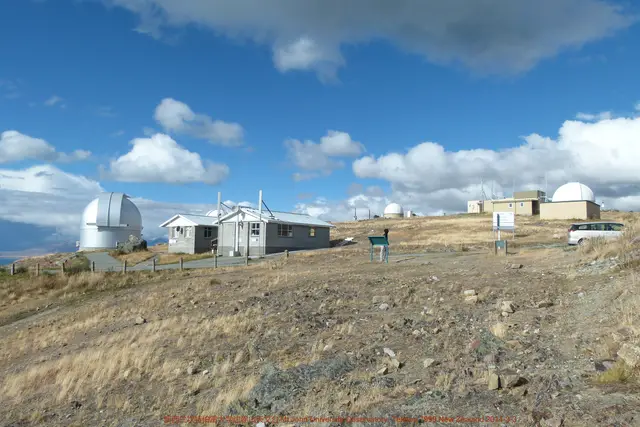
On a moonless night the Milky Way stretches across the whole sky. You’ll see the Magellanic Clouds, two small galaxies visible only from the south, and the Southern Cross. University of Canterbury’s Mount John Observatory sits on the hill above town.
- Best nights: around the new moon, with clear forecasts.
- Bring: a warm layer even in summer. The basin is high and inland, and nights drop cold quickly.
- Light: use a red torch, or switch your phone to a red screen, so your eyes stay adjusted.
Guided stargazing tours run from the township. Book ahead in clear-weather seasons and check the official operators for current times.
Up Mount John on foot
Mount John rises straight up from the lake’s western shore, and the summit has the best overview of Tekapo. A walking track climbs from the lakefront near Tekapo Springs through larch forest onto open tussock. Allow roughly two to three hours return at a steady pace.
From the top you look down on the whole lake. Lake Alexandrina, smaller and much darker, sits to the west. The observatory domes are at the summit, along with a café. The ridge is exposed, so wind can be strong even on a clear day.
If you’d rather stay low, the lakefront track along the shore is flat and easy. It connects the township, the hot pools and the base of the hill.
Lupin season and when to come
The best time depends on what you want from the lake.
- November–December: Russell lupins bloom in purple, pink and blue along the shoreline and roadsides. It’s Tekapo’s most photographed season and its busiest.
- Summer (January–February): long evenings and the best weather for walking. Darkness comes late, so stargazing means a late night.
- Autumn (March–May): the larches on Mount John turn gold, and early darkness suits stargazing.
- Winter (June–August): the longest, darkest nights and snow on the hills. Roads such as Burkes Pass can ice over, so check conditions before driving.
The lupins are an introduced weed, which is controversial locally. Admire them from the path rather than walking into them.
Lakeshore manners in the Mackenzie
A few habits keep both your visit and the place in good shape.
- At the church: it’s an active place of worship shared by several denominations. Visitors are asked not to take photos inside, so take your pictures from the grounds.
- At night: don’t sweep headlights or white torches across viewpoints where others are watching the sky. Park, switch your lights off and let your eyes adjust. That takes around twenty minutes.
- Camping: freedom camping around the lake is tightly restricted. Use the holiday park or a designated site rather than pulling over on the shore.
- Water: the lake is snow-fed and cold all year. Swim briefly and close to shore. The hot pools at Tekapo Springs are the warmer option.
- Timing: coach groups cluster at the church during the middle of the day. If you’re staying over, early morning and evening are when the shore is calmest.
Card and contactless payment are standard in the township’s cafés and shops. Tipping isn’t expected in New Zealand, though nobody will refuse it for good service.
Plan at least half a day by daylight. Better still, spend a night, because what makes Tekapo different only shows once the sun has gone.
Frequently asked questions
How do I get to Lake Tekapo?
Drive State Highway 8. It's roughly three hours from Christchurch via Geraldine and Fairlie, and a similar time from Queenstown via Cromwell and Twizel. Coaches between Christchurch and Queenstown also stop in Tekapo township.
Why is Lake Tekapo so blue?
The colour comes from glacial rock flour, fine particles ground off the Southern Alps and carried into the lake by the Godley and Macauley rivers. They scatter sunlight, so the turquoise is strongest on bright, sunny days.
When is the best time to see the lupins?
Lupins usually bloom from around November into December. It's the most photographed season and the busiest, so stay on paths and avoid trampling the plants.
Is Lake Tekapo good for stargazing?
Yes. It sits inside the Aoraki Mackenzie International Dark Sky Reserve, designated in 2012. Pick a clear night near the new moon, dress warmly and use a red light. Guided tours run from the township, so check operators for current times.
How long should I spend at Lake Tekapo?
Half a day covers the lakefront, the Church of the Good Shepherd and the sheepdog statue. Add the two-to-three-hour Mount John walk and an overnight stay for the night sky, and a full day plus one night is ideal.
Plan your trip to Lake Tekapo
New Zealand eSIM & staying connected →
Some links above are affiliate links — if you book through them, Wander Atlas earns a small commission at no extra cost to you. It's how we keep every guide free.
Related guides
 attraction
The Church of the Good Shepherd: Lake Tekapo Travel Guide
 attraction
University of Canterbury Mt John Observatory: Lake Tekapo Travel Guide
 attraction
Franz Josef Glacier: Travel Guide (4.6★)
 attraction