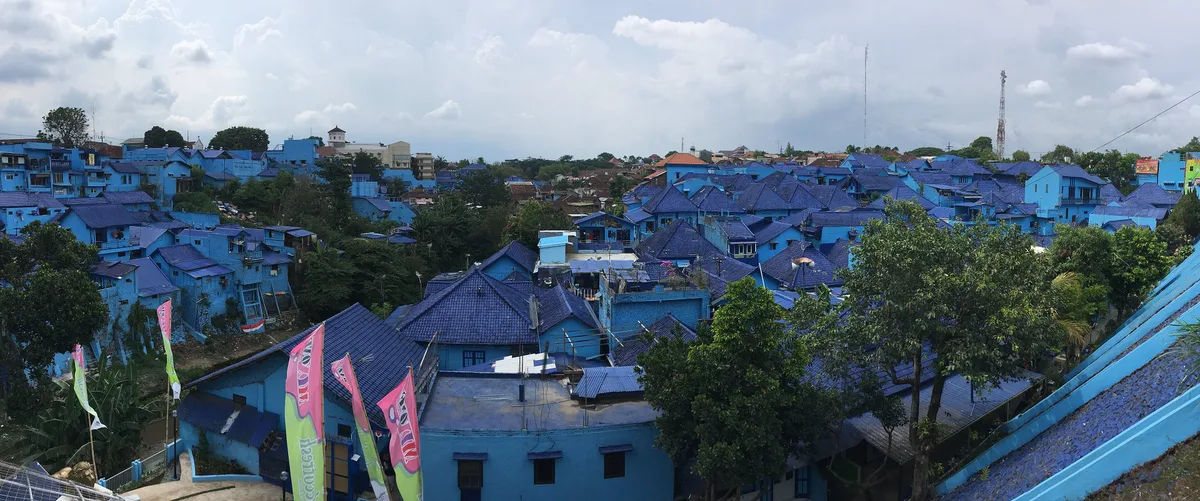
You smell the difference before you see it, cooking oil and clove cigarettes drifting from open kitchen doors as you duck off the main Klojen street into an alley barely wide enough for two people to pass.
Then the blue hits you. Not a pastel wash but a saturated, almost electric cobalt, running up walls, over door frames, across corrugated roofs and even onto the pavement underfoot.
Why this village turned blue
Arema Blue Village is a genuine residential kampung that repainted itself in the colors of Arema FC, Malang’s fiercely supported football club nicknamed “Singo Edan.”
Locals did the work themselves, house by house, turning a tight cluster of lanes in Kiduldalem into a walkable mural. It’s less a designed attraction than a neighborhood wearing its team loyalty on every surface it owns.
What you’ll actually see
The village is compact (a warren of narrow gangs, not a single street), so exploring means doubling back and poking into dead ends.
Look out for:
- Staircases painted in gradient blues leading up to family homes
- Football murals and Arema FC crests on gable walls
- Laundry lines and potted plants against the cobalt backdrop, proof people genuinely live here
- Small blue-painted shrines and doorways locals still use daily
Bring a wide-angle lens if you shoot on a phone. The alleys are tight enough that full walls are hard to frame otherwise.
Getting there
The village sits inside Kiduldalem, Klojen district, central Malang, close enough to walk from the old town core if you’re already near Jalan Basuki Rahmat or the Alun-Alun Malang square.
Most visitors arrive by ojek (motorbike taxi) or ride-hailing app like Gojek/Grab, since the alleys themselves are pedestrian-only and parking on the main road is limited.
There’s no formal entrance or ticket booth, you simply walk in from the street once you spot the blue.

When to go
Malang’s tropical climate means mornings are cooler and the light is softer for photography before the midday sun turns overhead and flattens the color.
Because this is a lived-in neighborhood, weekday mornings tend to be calmer than weekend afternoons, when day-trippers from Surabaya and Batu often pass through.
Rain is frequent in the wet season (roughly November to April), and wet paint on stairs gets slippery, so sturdy shoes help year-round.
How to visit like a local
This is still under the radar compared to Malang’s more famous colorful kampung (the Jodipan rainbow village across town), so you won’t fight crowds here, but that also means you’re walking through someone’s actual front yard.
- Keep your voice down and ask before photographing residents or their doorways directly
- A small donation to the upkeep box near the entrance is customary and appreciated, since residents fund the repainting themselves
- Pay for any snacks or drinks from local stalls in cash, small rupiah notes, nothing card-based here
- Skip the football jersey theatrics; a respectful, quiet walkthrough is the norm
- Combine it with a stop at Jodipan village or the Alun-Alun Malang square, both a short ride away, to make a half-day of Malang’s street-art side
The biggest mistake visitors make is treating it like a photo set rather than someone’s home, slow down, greet people with a smile, and you’ll likely get warmer responses than a rushed snap-and-go visit ever earns.
Nearby to pair with the visit
After the blue alleys, central Malang rewards more wandering: colonial-era buildings around Jalan Ijen, the bustling Pasar Besar market for lunch, and the aforementioned Jodipan rainbow village make natural add-ons within a short ojek ride, letting you turn a 30-minute detour into a half-day loop through the city’s most photogenic corners.
Frequently asked questions
How much does it cost to visit Arema Blue Village?
There's no entrance fee — it's a public residential kampung you walk through freely. A small voluntary donation toward the village's paint upkeep is appreciated but not required.
How do I get to Arema Blue Village from central Malang?
It's in Kiduldalem, Klojen district, an easy ojek or Gojek/Grab ride from Alun-Alun Malang square. The alleys themselves are walk-in only, with no vehicle access inside.
How long should I spend there?
Most visitors need 30-45 minutes to wander the lanes and take photos, since the village is compact and made up of narrow interconnected alleys rather than one long street.
Is Arema Blue Village crowded?
It's still under-the-radar compared to Malang's famous Jodipan rainbow village, so weekday mornings are typically calm. Weekend afternoons see more day-trippers from Surabaya and Batu.
Can I combine it with other sights nearby?
Yes — Jodipan rainbow village, the Alun-Alun Malang square, and the colonial buildings on Jalan Ijen are all a short ride away, making it easy to build a half-day walking loop.
Plan your trip to Malang
Some links above are affiliate links — if you book through them, Wander Atlas earns a small commission at no extra cost to you. It's how we keep every guide free.