Pura Luhur Poten Gunung Bromo: Mount Bromo Travel Guide

When to visit Indonesia: month-by-month weather, crowds and holidays →
✓ Facts verified via Google Places · Sep 17, 2026
At a glance
How this guide is made
Produced with AI assistance and reviewed against live data sources. Facts such as hours, ratings, and location come from Google Places; images are licensed or public domain. Details can change — please verify before visiting. Editorial policy
Most people driving across the Sea of Sand are aiming for the base of Bromo’s crater steps, eyes on the volcano, and they barely register the temple until they’re almost on top of it. Pura Luhur Poten sits by itself on the grey volcanic plain, walled in black stone, with the cone of Bromo smoking gently behind it. There’s no village around it, no row of stalls pressing in. Just sand, wind, and a temple that looks like it grew out of the ash rather than being built on it.
What you’re actually looking at
This is the main temple of the Tengger people, an ethnic group who practice a form of Hinduism distinct from Bali’s, shaped by centuries of relative isolation on this volcanic highland. The compound is split into three courtyards behind volcanic-stone walls, a layout borrowed from Balinese temple design but built for a landscape with no rain shadow and near-constant wind. It’s a working temple, not a museum piece, so you’ll often find offerings left on the stone platforms even outside festival days.
Getting there and what the visit actually involves
Almost everyone arrives here as a stop between the Mount Penanjakan or King Kong Hill sunrise viewpoint and the walk up to Bromo’s crater rim. From the parking area at Cemorolawang or wherever your jeep drops you on the Sea of Sand, it’s a short walk across open sand to the temple gate, then another 30 to 45 minutes on foot (or by horse, offered by local handlers) to the base of the crater steps.
- Jeep tours from Cemoro Lawang or Probolinggo typically include this stretch of the Sea of Sand as a drive-through or brief photo stop
- Wear closed shoes; the volcanic sand is loose and can be hot underfoot by mid-morning
- A scarf or bandana helps when wind kicks up ash and fine sand
- There’s no shade and no water source at the temple itself, so carry your own
Because it’s a genuine place of worship, modest dress and quiet behaviour inside the courtyard walls are expected, even though there’s rarely anyone enforcing it.

Why it stays quiet even when Bromo doesn’t
Bromo pulls big numbers for sunrise, and the crater rim gets properly crowded by mid-morning. The temple doesn’t share that traffic. It’s a stop, not the goal, so most visitors give it five or ten minutes on the way past rather than lingering.
That makes it one of the few spots in the Bromo area where you can actually stand still without a crowd behind you. If you want it to yourself, hang back from your jeep group for a few extra minutes after the standard photo stop rather than rushing to catch up at the crater steps.
Yadnya Kasada: the one night this temple fills up
Once a year, this quiet temple becomes the center of the Tengger calendar. During Yadnya Kasada, held around the full moon of the Tenggerese month of Kasada (typically falling in July or August), Tengger villagers walk down from surrounding highland communities carrying offerings of rice, fruit, livestock and vegetables.
The procession ends at Pura Luhur Poten, where prayers are held through the night, before the crowd continues up to the crater rim to throw offerings into Bromo’s caldera itself, an act meant to ask for blessing and prosperity. If your trip happens to land on this date, it’s worth restructuring your schedule around it; outside of it, the temple is a five-minute stop, but on this one night it’s the reason people come to Bromo at all.
Exact dates shift year to year with the lunar calendar, so check with a local guide or your accommodation ahead of a Bromo trip if you want to time a visit to it.
The Sea of Sand around it
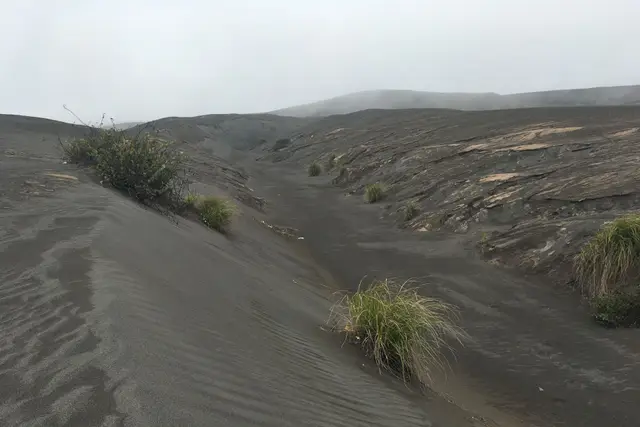
The temple sits inside what’s locally called the Laut Pasir, a flat expanse of volcanic sand roughly ten kilometres across, formed by repeated eruptions inside the vast Tengger caldera. It’s one of the more striking landscapes in the Bromo area on its own terms: no vegetation, pale grey underfoot, ringed by the walls of the old caldera and the cones of Bromo and Batok rising out of it.
Jeeps and horses are the two ways most people cross it since walking the full distance from the caldera rim is a long, exposed slog. If you’ve got extra time, ask your driver to slow down or stop briefly on the flat sand away from the temple; the scale of the place is easier to feel standing in the open than from a moving jeep.
Planning the rest of your stop
Most itineraries here run on a single pass: sunrise viewpoint, drive across the Sea of Sand past the temple, then the crater climb, all before the heat and crowds build. Give the temple itself ten to fifteen minutes if you’re not visiting during Kasada; there isn’t a ticket booth or formal opening hours since it’s a religious site sitting on open, unfenced ground within the national park.
Bring a printed or downloaded map if you’re self-driving, since phone signal across the Sea of Sand is patchy. Most travelers book a jeep package that already includes this stretch, which is the simpler option unless you’re experienced with the terrain and the park’s access rules.
Frequently asked questions
Do you need a ticket to enter Pura Luhur Poten?
There's no separate ticket for the temple itself; it sits on open ground within the Bromo Tengger Semeru National Park, which you'll already have paid an entrance fee for at the park gate.
How long should I spend at the temple?
Most visitors spend 10 to 15 minutes here on the way to Bromo's crater steps, unless visiting during the Yadnya Kasada festival, when people stay through the night.
When is Yadnya Kasada held?
It falls around the full moon of the Tenggerese month of Kasada, usually landing in July or August, but the exact date shifts yearly with the lunar calendar, so confirm locally before planning around it.
Is the temple crowded like the Bromo sunrise viewpoints?
No. Because it's a brief stop rather than the main destination, it stays quiet even on busy sunrise mornings; lingering a few minutes after your group moves on usually gets you the place alone.
What should I wear or bring?
Closed shoes for the loose volcanic sand, a scarf for windblown dust, and your own water, since there's no shade or vendors at the temple itself.
Plan your trip to Mount Bromo
Some links above are affiliate links — if you book through them, Wander Atlas earns a small commission at no extra cost to you. It's how we keep every guide free.
Related guides
 attraction
 Sea of Sand Bromo: Mount Bromo Travel Guide (4.8★)
 hidden gem
 Bromo Tengger Semeru National Park: Mount Bromo Travel Guide
 attraction
 Arema Blue Village: Malang Travel Guide (4.5★)
 attraction