Colonne di San Lorenzo: Milan Travel Guide (4.5★)
When to visit Italy: month-by-month weather, crowds and holidays →
✓ Facts verified via Google Places · Sep 12, 2026
At a glance
How this guide is made
Produced with AI assistance and reviewed against live data sources. Facts such as hours, ratings, and location come from Google Places; images are licensed or public domain. Details can change — please verify before visiting. Editorial policy
Why go
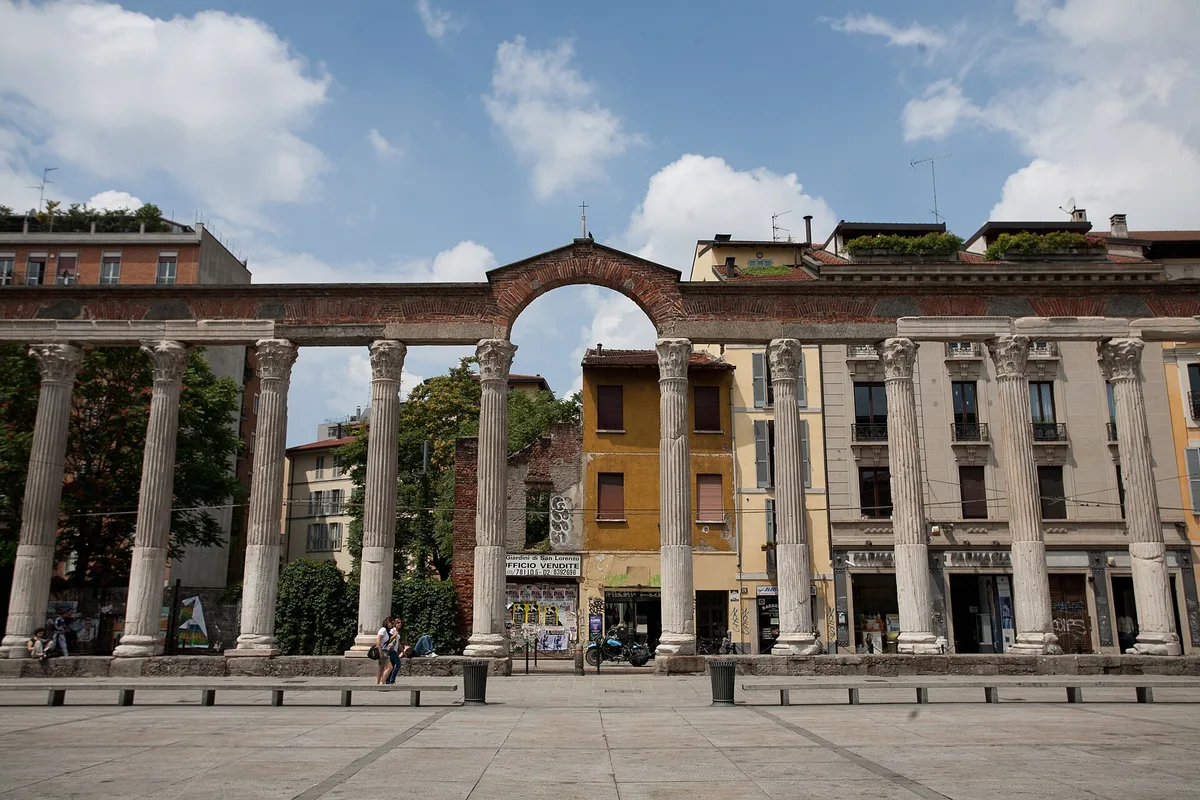
You come around the bend on Corso di Porta Ticinese and there they are, mid-pavement, looking like they’ve been forgotten by every urban planner since the fall of Rome: sixteen fluted marble columns, weathered grey-brown, holding up nothing but air and a chunk of entablature. Behind them, the red-brick facade of the Basilica di Sant’Eustorgio. In front, tram tracks and scooters weaving past as if this were the most normal thing in the world, which, in Milan, it kind of is.
The columns are almost certainly salvaged from a 2nd- or 3rd-century Roman building, probably a bath complex, and were re-erected here in the 4th century as an atrium for the basilica. Nobody stops you, nobody sells you a ticket. You just walk up and stand where Romans and early Christians once stood, on a street that’s been in continuous use for close to two thousand years.
What you’ll actually see
The columns form a straight colonnade a few steps back from the road, iron railings looped loosely between some of them, moss and pigeon-grey lichen filling the fluting on the shaded side. At the base sits a fourth-century marble fountain basin, cracked and softened by centuries of rain. A bronze statue of San Bassiano, patron of Lodi, stands off to one side, added much later and looking almost too clean next to the Roman stone.
If you look closely at the capitals you can still make out the carving style typical of late-Imperial Roman work, plain, functional, built for load-bearing rather than decoration, which is part of why they’ve survived: they were never meant to be pretty, just strong. A small plaque nearby gives the historical context in Italian and English, though it’s easy to miss if you’re focused on getting a clean photo between passing trams.
Getting there
The columns sit on Corso di Porta Ticinese, a short walk south of the Duomo through the Ticinese neighborhood. The closest metro stop is Missori on the M3 (yellow) line, about a 10-minute walk down Via Cesare Correnti. Alternatively, tram lines 2 and 3 run right along Corso di Porta Ticinese and stop within a couple of minutes’ walk. If you’re coming from the Navigli canals, it’s a flat 5-minute stroll north up the same street, an easy add-on to an evening canal walk.

When to go
Because this is an open-air monument on a public street, it’s accessible 24 hours a day, every day. There’s no gate, ticket booth, or closing time to work around. That said, the character of the spot changes a lot with the hour. Early morning, before the shops open, the street is quiet enough that you can hear your own footsteps on the cobbles and the columns catch soft, low light.
By late afternoon and into the evening, the steps around the fountain fill with students and locals having a drink from the nearby bars, and the area turns into an informal gathering spot until late. If you want the columns to yourself for photos, aim for a weekday morning; if you want to see them as a living piece of the neighborhood, come at dusk.
Nearby to combine with your visit
Sant’Eustorgio itself is worth going inside for, its Portinari Chapel holds a Renaissance fresco cycle by Vincenzo Foppa and is often called one of Milan’s most underrated art spaces. From here it’s a few minutes to the Basilica di San Lorenzo Maggiore (a separate, larger church, easy to confuse by name) and to Parco delle Basiliche behind it, a green pocket popular with locals for a break between churches. Continue south and you land at the Navigli, Milan’s canal district, dense with aperitivo bars by early evening.
How to visit like a local
Treat the columns as a passing landmark rather than a destination requiring planning. That’s how most Milanese treat it, walking past on the way somewhere else rather than making a special trip. There’s nothing to book and nothing to pay; it’s genuinely under the radar compared to Milan’s bigger sights, so you won’t find tour groups clustering here. The etiquette is simple: it’s fine to sit on the steps near the fountain, as locals do, but be mindful that people actually live and work on this street, so keep noise down late at night.
Order a coffee or spritz at one of the small bars along Corso di Porta Ticinese and take it slow rather than treating this as a five-minute photo stop. The real pleasure is in noticing how a Roman ruin, a medieval basilica, and modern tram lines all occupy the same twenty square meters without anyone making a fuss about it.
Frequently asked questions
How much time should I budget for the Colonne di San Lorenzo?
15-20 minutes is enough to see the columns, fountain, and statue and read the plaque, though many visitors linger longer if they sit on the steps or combine it with the basilica next door.
Is there an entrance fee?
No, it's a free, open-air street monument accessible 24 hours a day with no ticket or gate.
What's the closest metro station?
Missori on the M3 (yellow) line, about a 10-minute walk away. Tram lines 2 and 3 stop even closer, right on Corso di Porta Ticinese.
When is the quietest time to visit?
Early weekday mornings, before the surrounding shops and bars open, when the street is calm and the light on the columns is best for photos. Late afternoon and evening it fills with locals socializing on the steps.
What else is nearby worth seeing?
The Basilica di Sant'Eustorgio right behind the columns (don't miss the Portinari Chapel), the separate Basilica di San Lorenzo Maggiore and its little park, and the Navigli canal district a few minutes' walk south.
Plan your trip to Milan
Some links above are affiliate links — if you book through them, Wander Atlas earns a small commission at no extra cost to you. It's how we keep every guide free.