Pinacoteca di Brera: Milan Travel Guide (4.7★)
When to visit Italy: month-by-month weather, crowds and holidays →
✓ Facts verified via Google Places · Sep 12, 2026
At a glance
Live foot-traffic data via BestTime.app
How this guide is made
Produced with AI assistance and reviewed against live data sources. Facts such as hours, ratings, and location come from Google Places; images are licensed or public domain. Details can change — please verify before visiting. Editorial policy
Why go
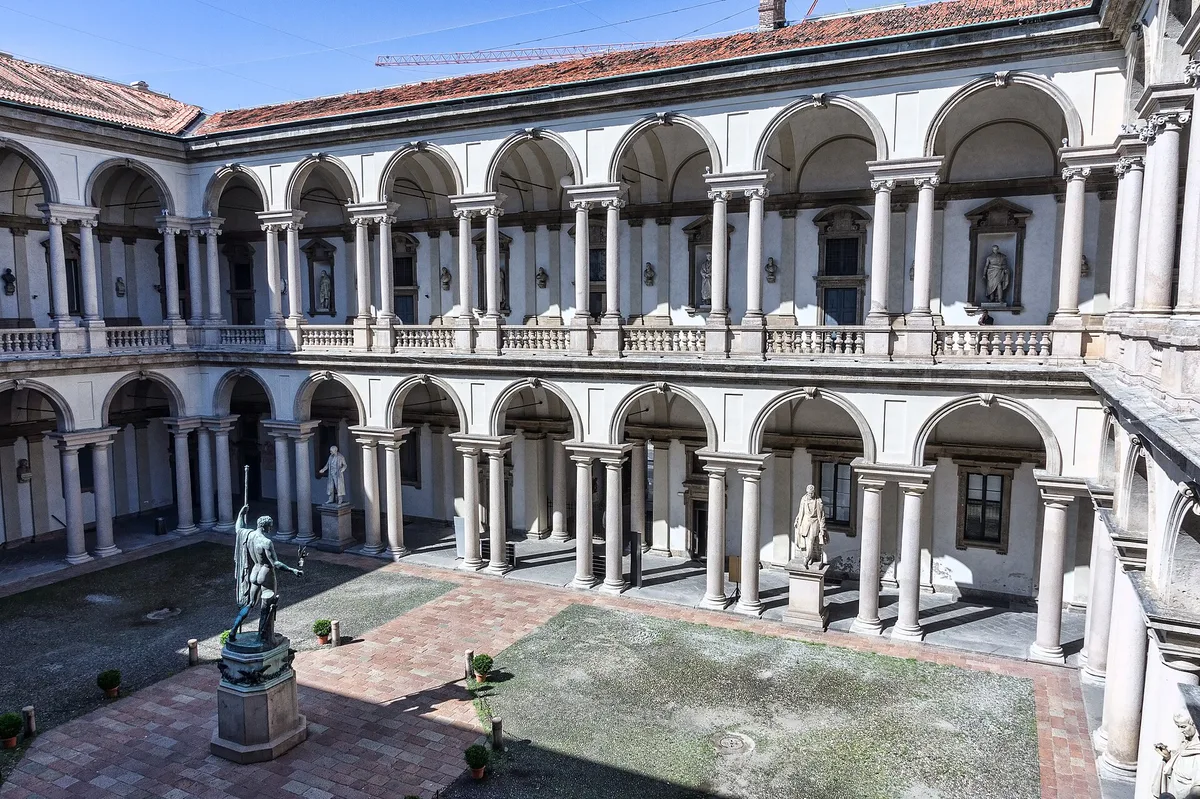
You climb a wide stone staircase off a quiet courtyard, past a bronze Napoleon posing as a nude Mars, and you’re already somewhere unlike the rest of Milan. The Pinacoteca di Brera isn’t a sprawling, exhausting museum. It’s a tight, curated run of rooms that happens to hold some of the most important paintings of the Italian Renaissance, especially from the Veneto and Lombardy.
This is the collection Napoleon assembled from churches and convents across northern Italy when he suppressed religious orders in the early 1800s, and you can still feel that origin: altarpieces sized for chapels now hang at eye level in daylight-lit galleries, close enough to see the brushwork.
Getting there
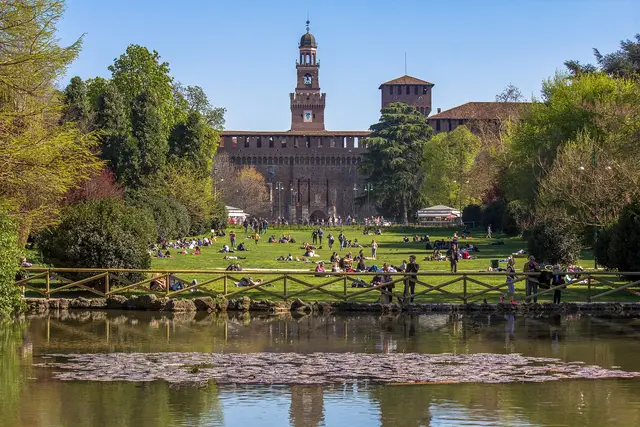
The gallery sits at Via Brera 28, in the middle of the Brera district, Milan’s old artists’ quarter of cobbled lanes, ivy-draped courtyards and small ateliers. The nearest metro stops are Montenapoleone and Lanza, both on the M2 (green) line, roughly a 10-minute walk; Cairoli on the M1 (red) is a similar distance from the other direction, passing the Sforza Castle on the way.
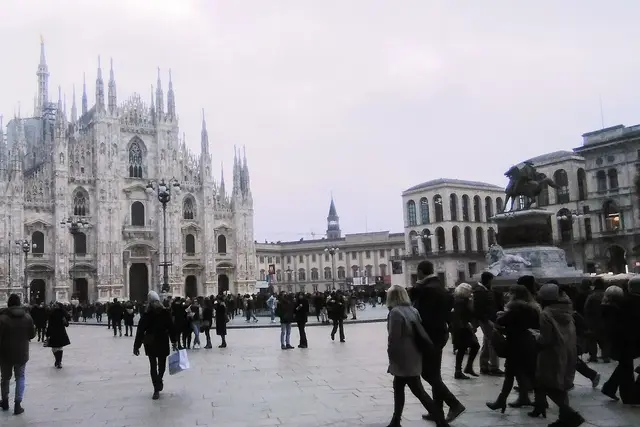
Trams 1 and 12 also stop nearby on Via Pontaccio. If you’re already at the Duomo or Castello Sforzesco, this is an easy 15–20 minute walk through streets worth wandering anyway.

What to see
Budget at least ninety minutes, two hours if you want to sit with things. The must-see is Andrea Mantegna’s “Lamentation over the Dead Christ,” painted in unnerving, steep foreshortening that makes the soles of his feet loom into the frame, small canvas, huge impact. Nearby hangs Piero della Francesca’s “Montefeltro Altarpiece,” with its famous suspended ostrich egg and the Duke of Urbino kneeling in profile.
Raphael’s “Marriage of the Virgin,” an early masterpiece with a perfectly constructed circular temple in the background, anchors one of the main halls. Look too for Giovanni Bellini’s tender, quiet Madonnas, Caravaggio’s “Supper at Emmaus,” and Francesco Hayez’s “The Kiss,” the single most reproduced image of Italian Romanticism. The rooms are arranged roughly chronologically, so the story of northern Italian painting, Byzantine gold grounds giving way to Renaissance perspective, unfolds as you walk.
When to go
According to measured visitor patterns, both weekdays and weekends stay comparatively calm across most of the day, but weekends still see a real surge between 10am and 6pm, when tour groups and day-trippers cluster in the main halls. Aim to arrive close to opening or after 6pm on a weekend, or pick a weekday morning, to have the Mantegna and Raphael rooms with breathing room.
Spring and early autumn mornings are pleasant for lingering afterward in the Brera courtyard or the surrounding streets, but the museum itself is a good rainy-day plan any season since everything is indoors and unhurried.
How to visit like a local
Buy your ticket online in advance if you can (it avoids the ticket-desk line and, on a slow morning, gets you inside within minutes. Cash and card are both accepted at the desk, but tapping a card is now the norm for nearly everyone. There’s no tipping expected anywhere in an Italian state museum. Italians and regular visitors tend to move through with a guidebook or the museum’s own free floor plan rather than a guided tour, pausing longest in the Mantegna and Hayez rooms) follow that instinct rather than rushing every gallery equally.
The most common visitor mistake is treating Brera as a quick stop bolted onto a Duomo day and rushing it in twenty minutes; the collection rewards slowing down precisely because it’s small enough to actually look, not just walk past. Note that the building also houses the Accademia di Belle Arti, Milan’s fine arts academy, so don’t be surprised to see students sketching in the courtyard. It’s a working academy as much as a museum.
Afterward, do as regulars do and wander into Brera’s side streets for an espresso standing at a bar counter rather than sitting for table service, which costs extra everywhere in Italy.
Frequently asked questions
How do I get to the Pinacoteca di Brera by public transport?
Take the M2 (green) line to Montenapoleone or Lanza, or the M1 (red) line to Cairoli, then walk 10–15 minutes into the Brera district to Via Brera 28. Trams 1 and 12 also stop close by on Via Pontaccio.
How long should I plan for a visit?
Most visitors spend 90 minutes to 2 hours; the collection is compact enough to see thoroughly without a full-day commitment.
When is the quietest time to visit?
Foot-traffic data shows both weekdays and weekends run calmer across the 8am–8pm hours in general, but weekends see a real crowd build-up between 10am and 6pm — arrive near opening or after 6pm to avoid it.
What are the must-see works?
Mantegna's 'Dead Christ,' Piero della Francesca's Montefeltro Altarpiece, Raphael's 'Marriage of the Virgin,' Caravaggio's 'Supper at Emmaus,' and Hayez's 'The Kiss' are the highlights most visitors seek out first.
What else is nearby?
The Brera district's artisan streets, Sforza Castle (a short walk via Cairoli), and the Duomo (about 15–20 minutes on foot) all pair well with a Pinacoteca visit.
Plan your trip to Milan
Some links above are affiliate links — if you book through them, Wander Atlas earns a small commission at no extra cost to you. It's how we keep every guide free.