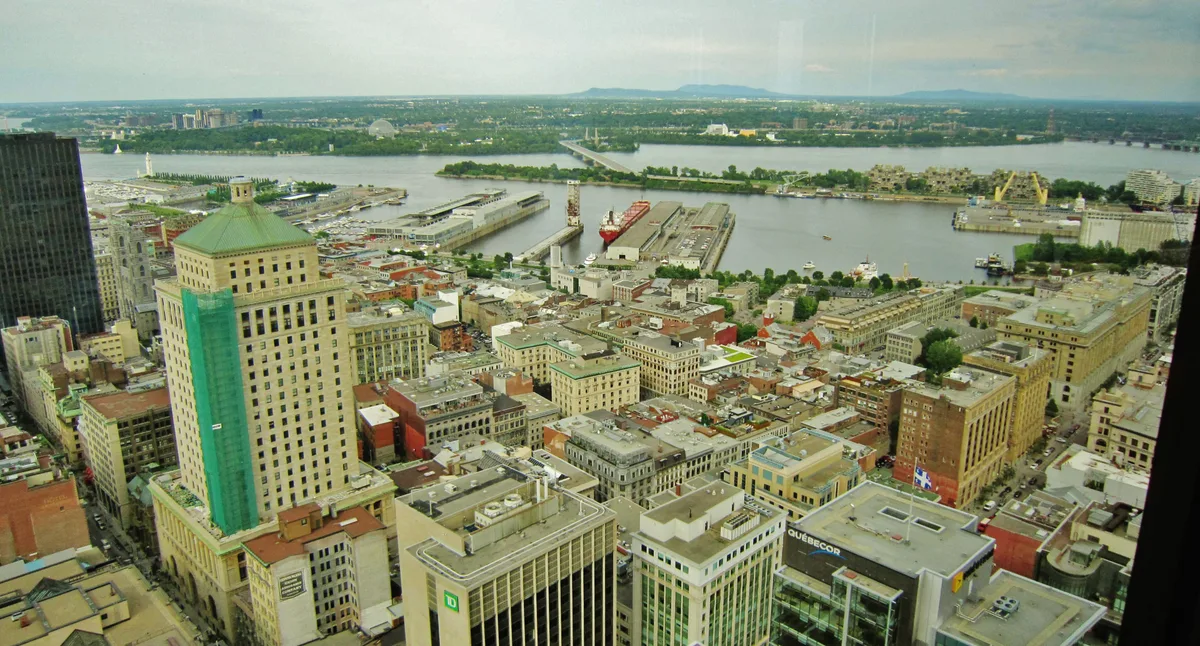
Stand in the middle of Place d’Armes and turn slowly. In one full turn you take in close to three centuries of Montreal building: a Gothic Revival church front, a 17th-century seminary wall, a domed neoclassical bank and two early office towers. This listing is pinned to that square, and the square is the best place to begin Old Montreal.
Starting on Place d’Armes
The square is a paved rectangle around a single bronze monument. That statue is Paul de Chomedey de Maisonneuve, who founded the French settlement of Ville-Marie in 1642. Louis-Philippe Hébert sculpted it in the 1890s. The figures around its base are worth a closer look, and that includes the Iroquois figure on one corner.
It is a working square, not a museum piece. Office workers cut across it, calèches (horse-drawn carriages) wait along the edges in the warmer months, and the steps of the basilica serve as everyone’s meeting point. Sit on the base of the monument for a few minutes before you walk on. It shows you how the rest of the district is laid out.
Reading the Four Sides of the Square
Each side of Place d’Armes tells you something different about how Montreal grew. Work your way round:
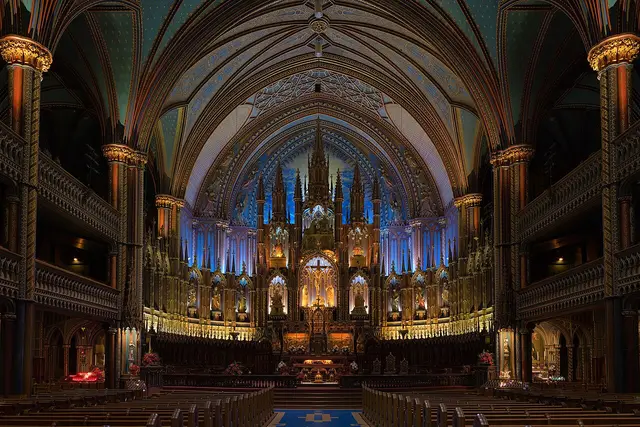
- South: Notre-Dame Basilica. The twin-towered Gothic Revival front, designed by James O’Donnell, went up in the 1820s. Inside, the deep blue vaulting and carved woodwork are the main event. Entry is ticketed, and the current price is posted on the basilica’s official site.
- Beside it: the Old Saint-Sulpice Seminary. This low stone building dates from the 1680s and is generally counted as the oldest surviving building in the city. Look up at the clock on its facade.
- North: the Bank of Montreal head office. It is a columned, domed temple of money from the 1840s, and a small museum on banking history is tucked inside.
- East: the New York Life Building and the Aldred Building. The first, a red sandstone tower from 1888, was among the city’s first skyscrapers. Next to it, the Aldred Building’s stepped Art Deco profile echoes New York of the same era.
That is a short architecture course in one square. Guided walking tours often start here for exactly that reason.
Downhill Toward the River
From the square, everything slopes gently toward the St. Lawrence. Walk east along Rue Notre-Dame and you pass the Second Empire bulk of Montreal City Hall. Charles de Gaulle gave his “Vive le Québec libre” speech from its balcony in 1967. Across the street sits Château Ramezay, an early 18th-century governor’s residence that is now a museum.
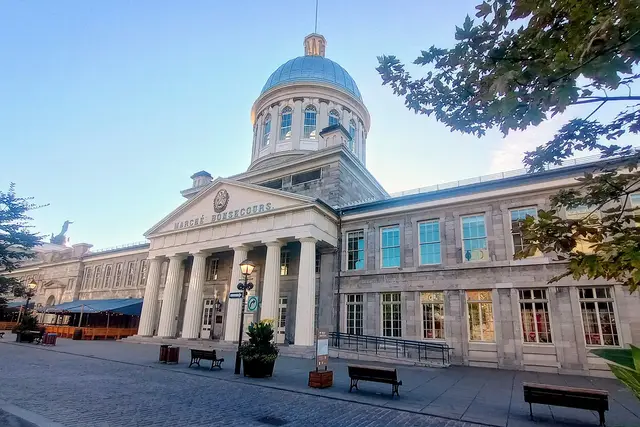
Turn down through Place Jacques-Cartier, the long sloping plaza lined with terraces, and you reach Rue Saint-Paul. This narrow cobbled street is one of the oldest in the city. Its stone warehouses now hold galleries, shops and restaurants. At its eastern end are the silver dome of Bonsecours Market and the small Notre-Dame-de-Bon-Secours Chapel, known as the sailors’ church.
Keep going and you come out at the Old Port, a long waterfront promenade with the Clock Tower at its eastern tip. West along the water, Pointe-à-Callière covers the city’s archaeology and is built over the site of the original settlement.

Getting to Place d’Armes
The metro drops you close by. Place-d’Armes station on the Orange Line (Line 2) sits just north of the old quarter, next to the Palais des congrès convention centre. From the exit it is a short walk south down Côte de la Place-d’Armes to the square.
There are two other useful stations:
- Champ-de-Mars (Orange Line) is better if you are starting at City Hall or Place Jacques-Cartier.
- Square-Victoria–OACI (Orange Line) is best for the western side and Pointe-à-Callière.
Driving into the old quarter is slow, with narrow one-way streets and limited street parking. If you arrive by car, leave it at your hotel or a garage on the edge of downtown and walk in.
Bonjour, Then the Rest
Old Montreal runs mostly in French, but nobody expects you to be fluent. Shop and café staff usually greet you with “Bonjour-Hi” and switch to whichever language you answer in. Start with “bonjour” yourself. It is a small courtesy that people here notice and appreciate.
A few practical habits:
- Paying: tap-to-pay cards work almost everywhere. Card terminals at restaurant tables usually offer tip percentages on screen.
- Tipping: around 15–20% at table-service restaurants and bars is the Quebec norm. The menu prices you see exclude sales tax, which is added at the till.
- Footwear: the cobbles on Rue Saint-Paul and around Place Jacques-Cartier are uneven. Leave thin-soled shoes and rolling luggage for the smoother downtown pavements.
- At the basilica: it is still an active church. Keep your voice down, and check before visiting on a Sunday or holiday, when services can limit visitor access.
Seasons in the Old Stone Streets
How the district feels depends heavily on the month. From late spring to early autumn the terraces on Place Jacques-Cartier fill up, street performers work the plazas, and the Old Port promenade is at its liveliest. That is also when calèches line Place d’Armes.
Winter is a different city. Montreal gets properly cold, and the cobbles can ice over, so walk carefully. The upside is that the stone facades look sharp under snow and the side streets are far quieter. Ducking into the basilica or Pointe-à-Callière is a good way to warm up between walks.
Whatever the season, the quieter time on Place d’Armes tends to be early morning, before the walking tours and day visitors gather on the basilica steps. Evenings are worth seeing too: many facades in the old quarter are floodlit after dark.
Where This Listing Fits
This entry is fairly lightly reviewed, and that is a good reason to treat it as a starting pin rather than a single sight. Use Place d’Armes as the anchor, read the square, then let the slope carry you down to the river. A few hours covers the core. A full day lets you add a museum and a slow meal on Rue Saint-Paul.
Frequently asked questions
What is the nearest metro station to Le Vieux Montréal at Place d'Armes?
Place-d'Armes station on the Orange Line (Line 2) is the closest. It is a short walk south down Côte de la Place-d'Armes to the square. Champ-de-Mars and Square-Victoria–OACI, both also on the Orange Line, serve the eastern and western ends of Old Montreal.
How long should I spend in Old Montreal?
Allow two to four hours to walk from Place d'Armes past City Hall, down Place Jacques-Cartier and Rue Saint-Paul to the Old Port. Make it a full day if you want to go inside Notre-Dame Basilica, Pointe-à-Callière or Château Ramezay.
What is there to see on Place d'Armes itself?
You'll find Notre-Dame Basilica, the Old Saint-Sulpice Seminary from the 1680s, the domed Bank of Montreal head office with its small museum, the 1888 New York Life Building, the Art Deco Aldred Building, and the Maisonneuve monument in the centre.
Do I need to speak French in Old Montreal?
No. Staff usually greet you with "Bonjour-Hi" and switch to English if you reply in English. Opening with "bonjour" is still a polite habit that people appreciate.
Is Old Montreal worth visiting in winter?
Yes, if you dress for real cold and watch your step on icy cobbles. The streets are quieter than in summer, and indoor stops like the basilica and Pointe-à-Callière make good breaks. Check the official sites for each venue's current seasonal hours.
Plan your trip to Montreal
Canada eSIM & staying connected →
Some links above are affiliate links — if you book through them, Wander Atlas earns a small commission at no extra cost to you. It's how we keep every guide free.
Related guides
 hidden gem
Bonsecours Market: Montreal Travel Guide (4.1★)
 hidden gem
Montréal Underground City: Montreal Travel Guide (4.4★)
 hidden gem
Jean Talon Market: Montreal Travel Guide (4.6★)
 attraction